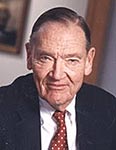
Don’t be surprised if Vanguard founder and index fund pioneer Jack Bogle is not invited to next year’s Morningstar Advisor conference. Bogle had very few positive things to say about the mutual fund industry – the industry from which Morningstar derives the bulk of its revenues.
Bogle delivered his remarks at this year’s Morningstar conference, which was held in Chicago last week.
Thirteen years ago he received a heart transplant and, despite spending a dozen or so days in the hospital last year, he said he “is still filled with a great taste for the battle.”
Bogle took on the mutual fund industry for its failures in active management, excessive turnover, target date funds, 130/30 funds and other areas, but before doing so offered an admission of his own failure to foresee much of the current crisis. Bogle admitted he did not realize that lending standards had deteriorated to “devastating proportions” or that financial derivatives had created so much instability in the financial system. “I was not surprised by the speculation,” he said, “just that it went so far. This is a catastrophic decline that will take a long time to get out of.”
As for the mutual fund industry, Bogle said he understood a long time ago that it had gone from an investing to a speculative focus.
Responding to renewed claims that “buy and hold is dead,” Bogle repeated an argument he has made many times before: Divide the S&P index into two sections, and let the “buy and hold” proponents own 50% of every stock, which they won’t trade. The other 50% is held by traders and investors, who trade amongst themselves and pay the “croupiers” for that trading. “At the end of the day, week, month, or any period you choose, the ‘buy and hold’ proponents will capture 100% of the return, while the other group captures at best 50% of the return.”
“If buy and hold is dead, we are all dead in terms of our financial futures,” Bogle said.
Bogle cited statistics that last year the turnover in the stock market was 330%, versus about 25-30% when he started his career. “We have plenty of liquidity, and we don’t need all that trading,” he said. “The mutual fund industry cannot survive in this mode.”
The money is flowing to the firms, like Vanguard, with lower costs, according to Bogle. But he noted that Fidelity is still a big fund company, despite having “lower but not low costs.”
Bogle also refuted claims that the “policy portfolio” – a static asset allocation such as the classic 60/40 mix – is dead. Bogle said the policy portfolio reigns in the aggregate. “If an individual changes in one direction, someone else changes in a different direction,” he said. In the aggregate, the market will always a static allocation between stocks and bonds.
Nor does Bogle think that the endowment model, practiced by Yale and other large institutions, will thrive. “I have argued with David Swensen that you can’t get 15% returns forever. It’s not in the cards,” he said. But he acknowledged that Yale was way ahead of where it would have been, had it not taken such a risky strategy.
One asset class took the full force of Bogle’s criticisms. “Commodities don’t belong in anybody’s portfolio at any time for any reason,” he said.
Stocks and bonds are investments and generate an internal rate of return. For commodities that return is zero, according to Bogle. “It is a total speculation. You can make money by speculating, and someone else will lose,” he said. “Look at gold - with no internal rate of return, it has not matched Treasury Bill performance. It is not investing, it is a gamble.”
Bogle took aim at another asset class – private equity – which he said was responsible for many of the problems faced by practitioners of the endowment model. Private equity investors are now being forced to invest through “cash calls” at precisely the wrong time – when the rest of their portfolio is losing value. Bogle said there are a lot of sellers of private equity, and not a lot of buyers.
“I have never felt more confident in my beliefs and strategies than at this very minute. Indexes are down but outperformed most active managers. The difficulty of picking active managers is apparent from analysis of fund returns versus investor performance,” Bogle said. Mutual funds that achieve reasonable performance have a performance gap – fund returns outpace returns earned by investors. That gap grows as you get to more speculative funds, like energy and real estate.
Bogle said he has never seen a time in his career when it was more difficult to value the market. “The problem is we don’t know the earnings. Reported and operating earnings have diverged over the last 25 years, and reported earnings are always lower,” he said. Bogle claims he doesn’t know what earnings are or how they are calculated. Valuation based on cash flow is no better, since companies don’t always put money in their pension plan when they are supposed to.
Despite this barrier to determining valuations, Bogle estimated that equity returns should average approximately 8% annually, based on 3.5% dividend yields, earnings growth of 1-2% in real terms, 3% inflation, and some contraction in P/E ratios. A mix of Treasury and corporate bonds will yield 5%, and Bogle said the “odds are highly probable that stocks will outperform bonds.”
“Don’t bother with money market mutual funds,” according to Bogle. With yields of less than 25 basis points, investors should choose short term bond funds instead.
“I love municipal bonds, with a caveat,” Bogle said. He is worried about municipalities losing revenue with their pension plans being stressed. Investors should buy very high quality bonds and should be highly diversified (through a fund with at least 1,000 holdings) and should do this using the lowest cost municipal bond fund that meets these criteria.”
Bogle is increasingly nervous about target date funds, for a number of reasons. “The fact that you are going to retire in 2015 means different things to different investors, such as the extent of their social security benefits,” he said. “It’s a little bit too clever a solution. Investors can just rebalance once a year and only when proportions get markedly different from their targets.”
Bogle said he is “not amused by a race to the top for equity allocations (which are based on Monte Carlo simulations, which I don’t trust). As markets go up, firms raise their target allocations of equities. That is irresponsible.” Bogle said target date funds should use index funds or very low cost funds.
Investors should not use absolute return funds under any circumstances, Bogle said. “Nobody can give you an absolute return; it implies an absolute positive return. It is greatly oversold.”
As for 130/30 funds, Bogle said they “don’t advance the ball.” Bogle noted, sarcastically, that these managers don’t have enough smarts to buy stocks but are smart enough to know what to sell. “This is the kind of gimmickry we have had too much of in the mutual fund business. It leads you down the primrose path that there are better answers than the tried and the true,” Bogle said.
“The index fund must be the gold standard. My question is why does the industry create all these lead ingots?” Bogle said. He believes it is for marketing purposes, because things get hot, and sometimes they do well. “I am an apostle of simplicity and low cost,” Bogle said.
His skepticism of ETFs is increasing. He said there are few differences between the Vanguard total stock market ETF and the corresponding fund. ETFs may do a little better and be a little more tax efficient. But ETFs have been abused by those who trade them actively, and the difference in performance gap (noted above) between fund and ETF investors is substantial. “We are not serving investors; ETF investors do badly relative to mutual fund investors,” he said.
Bogle’s latest crusade is helping investors who “give far more credence to past returns in the stock market than they deserve.’ He said it is the sources of the returns that determine the future, and investors should rely on reasonable expectations based on those sources of returns. “There goes Monte Carlo simulations, which are based on past returns,” Bogle said. Monte Carlo simulations that rely on outdated assumptions of 4.5% stock yields will produce erroneous forecasts. Instead, investors should “construct returns based on relate P/E levels.”
Paraphrasing the English poet Coleridge, Bogle called past returns “but a lantern on the stern.”
Last month Bogle celebrated his 80th birthday, and is intent on fighting what he called “a wonderfully lonely battle.” He is not looking for a fight, and “if everyone was fighting this battle I’d be bored. There are some standards we have abandoned in the investment field.” In addition to tackling the problem of reliance on past returns, Bogle said he will continue to fight battles over pension plan abuses and imperfect structures of retirement plans. When he gets done with all of them, he will think of something else to fight.
Read more articles by Robert Huebscher