Advisor Perspectives welcomes guest contributions. The views presented here do not necessarily represent those of Advisor Perspectives.

This essay is excerpted from the most recent version of the HCM Market Letter. To subscribe directly to this publication, please go here.
“The relation between the real and final value of the object and its representation by a bond has lost all stability. This clearly shows the absolute flexibility of this form of value, a form that the objects have gained through money and which has completely detached them from their real basis. Now value follows, almost without resistance, the psychological impulses of the temper, of greed, of unfounded opinion, and it does this in such a striking manner since objective circumstances exist that could provide exact standards of valuation. But value in terms of the money form has made itself independent of its own roots and foundation in order to surrender itself completely to subjective energies. Here, where speculation itself may determine the fate of the object of speculation, the permeability and flexibility of the money form of values has found its most triumphant expression through subjectivity in its strictest sense.”
George Simmel, The Philosophy of Money (1900)
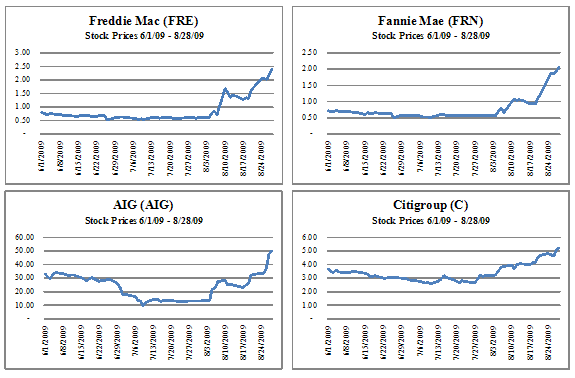
The stock market has been running its own ‘cash for clunkers’ program as the shares of the worst companies are trading as though they are AAA. Some attribute this to the flight of short-sellers. HCM attributes it to the deeply embedded culture of speculation that the financial crisis did little to shake. As the S&P 500 reached its highest level in ten months in August, some of the best performing stocks were the walking dead: Citigroup; AIG; Fannie Mae; and Freddie Mac. What they had in common was major ownership by the U.S. government and a record of abject business failure. While a rising tide is supposed to lift all boats, rusted hulls riddled with holes always end up sinking back to the bottom.
Graphs 1-4
Cash For Clunkers
The 'cash for clunkers' program is an apt metaphor for the entire stimulus enterprise. Short-term, artificial stimulus can only provide short-term, artificial economic support. The real test of the government’s economic policy will be whether it sows the seeds of sustainable long-term economic growth, and that type of policy will require significant changes to tax, energy and spending policies. Some of these changes have been enacted, particularly in the energy area, but the tax code remains untouched (although there is a special panel headed by Paul Volcker working on the matter), and spending remains a captive of Congress unless the President wants to go to war with his former colleagues on Capitol Hill. We remain in the early innings of the Obama Presidency and much has been accomplished to stanch the economic bleeding, but the patient is still in need of a comprehensive preventative health plan. No pun intended, but attempting to start with a comprehensive health plan that expands coverage before it reduces costs may place too much stress on the system’s heart and cause it to expire.
There can be little question, however, that massive amounts of money have returned to the financial markets, and that these markets have in turn made these funds available to the financial economy. As a result, short-term systemic risks have receded, particularly among the largest financial institutions in America and Europe. But there should be no misunderstanding that governments are the source of the liquidity underlying this stability and that the private sector remains a drain on liquidity. A reported $11 trillion of support commitments have been made by the U.S. government, $2.8 trillion of which has already been paid out, according to CNN. This has permitted the largest U.S. financial institutions to reduce their balance sheet leverage meaningfully from the levels that pushed several of them over the cliffs last year. Moreover, the Obama Administration and Congress are taking the necessary regulatory steps to dramatically reduce the odds of a replay of 2008’s near-death experience.
Stability may be an essential phase on the way to growth, but it should not be mistaken for growth. More importantly, it must be examined closely to determine if it is sowing the seeds for growth or merely throwing dirt over a rotten crop that will never make it to harvest. One cannot avoid the uncomfortable observation that even with all of this huffing and puffing on the part of the government, employment, corporate revenues, housing prices and retail sales are still declining! Where has all of this liquidity gone? We think the answer is rather obvious – the financial markets have been lapping it up. If we are correct, it suggests that very little of the government stimulus in its various forms has ended up adding to the productive capacity of the U.S. economy. Such an outcome should not be surprising in an economy that was suffering prior to the crisis and is still suffering from massive overcapacity in industries such as banking, retailing, automobile manufacturing and the like.
As noted in last month’s issue of this publication, U.S. stimulus pales in comparison with the efforts of the Chinese government to prevent its economy from falling off a cliff. In world-historical terms, China’s stimulus has been unprecedented in amount and has caused price spikes in Chinese stock and commodity prices that are clearly unsustainable. On the ground, however, this massive stimulus has increased Chinese GDP by only 7.9 percent, which may seem like a lot but is a relatively modest number when measured against the size of the stimulus. Now we are beginning to hear noises (which we predicted last month) that bank reserve requirements are going to be raised and that banks themselves are taking steps to limit loan growth. These reports have thrown China’s stock and commodities markets into reverse. Investors with an appetite for volatility could do worse than short the Chinese stock market in response to these efforts to withdraw the stimulus.1
1 The Shanghai composite index dropped 21.8 percent drop in August after rising 90 percent earlier this year, including a 6.75 percent drop on August 31. We are certain that this drop had nothing to do with my appearance on CNBC’s Street Signs on August 27 predicting just such a reversal in the Chinese markets.
Moreover, let’s not forget, as John Maynard Keynes reminded us (and God reminds us every day), that in the long run we are all dead. And the real challenge for investors is trying to figure out the meaning of “long term.” If we peek behind the curtain of the U.S. economy, there is a great deal to be concerned about. That does not mean that we are forecasting a near-term market reversal – we are not. As long as credit markets remain open for business, the stock market should continue to perform reasonably well and ignore the long-term risks outlined below. But investors should keep a sharp eye on credit. If capital stops flowing in the corporate bond market in particular, equity investors should start reducing their holdings.
On a long-term basis, however, the U.S. economy is still trapped in a deflationary dynamic. If deflation is going to prove to be a positive economic force, this will be the first time in history that this will have been the case. Has anybody been watching short term Treasury rates? At the close of trading on August 28, the one-month bill was on the verge of vaporizing completely, with yields running at 10 basis points. Three-month bills were barely higher at 14 basis points, while six months bills were limping along at 23 basis points. One year bills were all of 43 basis points, three year bills at 102 basis points, etc. Libor markets were no better, with one month Libor limping along at 26 basis points and 3-month Libor at 35 basis points. These microscopic Libor rates, coupled with this year’s rally in bank loan prices, have rendered bank loans unattractive as an asset class, with rare exceptions. Investors who rushed into bank loans earlier in the year when they were trading at sharp discounts should begin exiting broadly diversified portfolios now that prices have recovered far more than credit conditions merit. More targeted portfolios can still be profitable in the hands of a capable manager.
UK government bond rates are also dropping out of sight. Two year gilt yields hit their lowest level since records began in the mid-1980s, hitting 0.83 percent on August 25. This yield has dropped by 50 basis points since the Bank of England announced on August 6 that it would extend quantitative easing by £175 billion. Commercial banks are switching deposits into gilts due to fears that the Bank of England will follow Sweden’s Riksbank and introduce negative rates in an attempt to encourage banks to make more loans. Bank of England Governor Mervyn King has warned that the British central bank may begin charging banks for deposits rather than paying interest itself because he fears that quantitative easing is being trumped by commercial banks hoarding cash. Investors in U.K. gilts seem to have reached the same conclusion as U.S. Treasury investors – low rates are going to be with us for an extended period of time.
Another indication of the depths to which U.S. yields have dropped is the fact that for the first time in 16 years, it is now becoming cheaper to borrow in dollars than Japanese yen. (There goes the dollar/yen carry trade! Actually, the differential between the two borrowing rates is so small that the carry trade has been unattractive for quite awhile.2) On August 26, three-month dollar Libor reached 0.37188 percent while yen borrowing cost 0.38813 percent, the first time since May 1993 that dollars have been cheaper to borrow than yen. If we think about what has transpired in Japan over the past two decades, the markets now may be trying to tell us something about their view of the structural challenges facing the American economy over the foreseeable future. Their prognosis is for high government deficits and slow growth.
But the cross-over in rates is also telling us several other things. First, the world is awash in dollars, something we already know from watching the actions of the Federal Reserve and U.S. Treasury. The U.S. government has made it no secret that it intends to flood the world with liquidity until the financial crisis is squarely in the rear-view mirror. Second, global investors are signaling their expectations that global interest rates – led by those in the U.S. – will remain extremely low for an extended period of time. Fears of an inflation scare and consequent spike in interest rates that seem to pop up every time a Treasury auction fares worse than expected are unfounded. Inflation perma-bears are on the wrong side of the argument this time around. Third, the world is watching the continuing demise of the dollar standard as the U.S. currency suffers the fate that fiat currencies deserve when they are chronically mismanaged by short-sighted societies that allow their politicians to sacrifice the economic future for near-term palliatives. The global investors that hold trillions of our dollars pay attention to news like the recent report about projected U.S. government deficits of $9 trillion over the next ten years.3 They watch the debate about healthcare reform that focuses on extending benefits rather than containing costs with no plausible plan for covering the additional costs. They see little economic discipline in the American soul, and little upside in the American currency absent another global crisis that causes investors to flock to the dollar as a bastion of stability. In view of the fact that the epicenter of the earthquake that shattered the global financial system last year was the United States, the safe haven argument for the dollar is wearing thin. In order for the dollar to retain its safe haven status, it is incumbent upon the U.S. government to insure that America is again perceived as the least dangerous place to invest in a crisis. It cannot do that when financial crises emanate from the canyons of Wall Street.
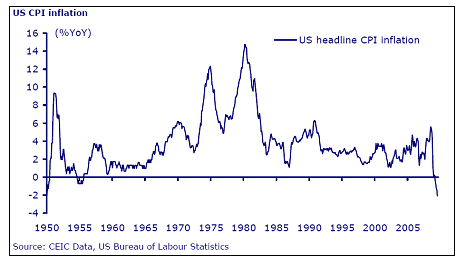
HCM has long maintained that low interest rates are a sign of economic weakness, not economic strength, and in this case are indicative of the deflationary dynamic eating at the core of the global economy. Recent inflation data supports our view. U.S. CPI dropped by 2.1 percent in July 2009, the largest annualized decline since January 1950, as Graph 5 (borrowed from our friend Christopher Wood) illustrates quite dramatically. This deflationary dynamic is based on the destruction of the Everests of debt that were built up during the credit bubble of the mid-2000s. Governments, banks, and private equity firms still have a great deal of debt to write off, and until that process advances much further, the deflationary dynamic will not reverse and interest rates will remain low. We do not expect the Federal Reserve to raise interest rates for a very long time (through 2010). Re-nominated Federal Reserve Chairman Ben Bernanke, who should easily be confirmed by the Senate, remembers the lesson of the Great Depression, which saw a stock market rally not dissimilar to the current one collapse into a long and painful bear rally in 1937.
Graph 5
2Is it merely coincidental that so many hedge funds find it much more difficult to generate double-digit returns without the ability to utilize massive amounts of leverage, either in the form of carry trades or other structures? That is a rhetorical question.
3 Of course, as Floyd Norris pointed out in his August 28 column in The New York Times, a lot can happen in a decade. The last time people started freaking out about a ten year budget forecast, they were worrying about a projected $5 trillion surplus! So much for long-term forecasts!.
Banking
The U.S. banking system is not out of the woods, although the largest banks are clearly acting under the aegis of the U.S. government. The commercial real estate correction is still in its early innings, with commercial real estate delinquencies at U.S. commercial banks continuing to increase in the second quarter of 2009. Delinquencies on commercial loans and leases reached their highest levels since 1985 (6.49 percent), while the delinquency rate on commercial real estate loans reached their highest level since 1993 (7.91 percent) in this year’s second quarter. HCM fears that these numbers will reach double-digits before this down-cycle reaches its nadir. Much of this pain will be borne by smaller banks, which seem to be failing at an increasing rate as the year goes on. There is little doubt that the 84 institutions that have already failed will be joined by hundreds more before the commercial real estate meltdown concludes.
There is a sharp dichotomy, however, between the improving condition of the largest banks and the deteriorating health of smaller institutions. Moreover, this split in many ways parallels larger patterns in the U.S. economy. A disproportionate share of stimulus dollars (direct and indirect) has gone to Wall Street rather than Main Street. This is reflected in the phenomenal recovery in the fortunes of previously struggling banking and investment banking firms while indicia of Main Street recovery like employment and retail sales remain tepid. In fact, the economy appears to have divided into two worlds, the haves and have-nots. The haves include those firms operating under implicit or explicit government guarantees, while the have-nots are those who remain outside the circle of protection. While there is merit to the argument that the government needed to step up and support the financial industry in order to stabilize the economy, there remains an equally righteous feeling that too much has been given to the parties responsible for the crisis and not enough to those who were victimized by it. The Obama Administration has a very thin tightrope to walk in terms of issues such as executive compensation (i.e. Citigroup’s $100 million man, derivatives regulation) in order to restore the proper balance to the political debate surrounding American capitalism.
In the ‘cash for clunkers’ economy, the FDIC will remain under severe stress for years to come. The agency recently announced that the number of banks on its troubled list grew by over a hundred in the last quarter to over 400, suggesting that industry trends remain abysmal. Political pressure to allow private equity and other non-banking sources of capital to enter the banking business has been intense. HCM’s views on this issue are well-known – the private equity business has demonstrated little fitness for this task and should only be permitted to enter a business that partially fills a public utility function under the strictest of conditions. Federal regulators initially proposed that private equity takeovers of banks require a 15 percent Tier I capital standard, significantly higher than the 8 percent required for a new bank. On August 26, the FDIC voted to lower this requirement to 10 percent but retained other stricter rules on private equity investments in banks. The private equity industry is still crying foul, although we don’t remember them complaining when Congress singled them out for special tax treatment on their carried interest profits. So much for their patriotic zeal to help out the American economy! The impulse to hold private equity investments to a higher standard is correct in view of the selfish behavior they have exhibited for far too long. Practices such as raising debt to pay dividends to shareholders and flipping companies from one private equity firm to another were rampant during the recent credit bubble and demonstrated where private equity firms’ interests lie – in generating profits as quickly as possible for themselves with little regard for the health of their portfolio companies.
The FDIC should be particularly wary of allowing investments by firms that have engaged in dividend deals that left their portfolio companies crippled by debt. For our lay readers, “dividend deals” are transactions in which already leveraged companies raise additional debt and use the proceeds to pay a dividend to their equity sponsors. Among the most short-sighted and unproductive financial strategies extant (almost as unproductive as public companies buying back stock at high prices – are you listening Eddie Lampert?), private equity has found an all-too-willing partner in these dividend deals in high yield bond investors, who seem hell-bound on buying high and selling low through as many cycles as possible until they either lose their jobs or their minds. Where “private equity” is just a polite name for “private debt,” it would be better to allow banks to fail and their assets to be sold to another institution than to give large buyout shops another chance to strip these institutions of profits before turning them back to the American taxpayer.
The real issue is that there are too many banks in this country, and many of them should be closed down rather than given a lifeline. Managed failure (or managed shrinkage) should be the name of the game for the bloated and terminally mismanaged banking business. There can still be more than enough competition without allowing every Tom, Dick and Harry (or Sally) to open a bank and start making real estate loans to his friends and cousins. Competition in the banking world is nothing other than a process of dumbing down the credit process. It is a massive race to the bottom. As long as our society remains intent on socializing risk and privatizing reward, the fewer banks we have, the better off we will be.
The New Roach Motels
Speaking of Eddie Lampert, nobody should be feeling too sorry for the Sears Chairman. Reportedly, despite all of the sound and fury about his failure as a retailer, his investment in Sears and Kmart is still worth more than $3 billion more than he paid for it. Still, Sears’ latest quarterly loss threw Wall Street for a loop. The same store sales shrinkage at Sears’ domestic stores for the quarter was pretty alarming (-12.5 percent), while at Kmart it was just business as usual (-3.9 percent). Mr. Lampert continues to shrink the share count at the retail giant, purchasing another $126 million of stock (2.7 million shares) during the last two quarters. It may make sense to him to own more of this mess, but it doesn’t make a heck of a lot of sense to the rest of us. The real estate play that so many analysts pointed to as the exit strategy for this investment seems highly dubious in an environment where more “big box” stores are closing than opening. And we all know about the outlook for general retailing. Sears just may prove to be the ultimate Roach Motel – now that he is trapped inside it, Mr. Lampert is finding that there is no getting out.
Mr. Lampert is not the only hedge fund manager turned private equity mogul whose dreams of empire building haven’t worked out as planned. Cerberus Capital Management announced on August 28 that 71 percent of the investors in its two hedge funds had elected to ask for their money back. That does not mean that they will get their money back anytime soon, however, since much of it is invested in illiquid securities whose value is more a matter of opinion than fact. According to press reports,4 a mere five percent of the requested capital will be returned immediately, and investors may have to wait as long as three or four years to receive the other 95 percent (which may or may not be worth 95 percent before day is done). Cerberus will be placing those hard-to-value and impossible-to-sell assets in a liquidating trust and lowering its management fee to what it views as a modest 50 basis points while it tries to sell them. Investors should not be charged any fee on a liquidating trust because their funds are being held against their will, but apparently Cerberus believes it is entitled to what is reported to be $28 million in annual fees for doing what it was supposed to do in the first place, give investors back their cash. Cerberus is also reserving the right to scrap the liquidating trust plan and freeze redemptions for another year (perhaps while charging even higher fees to investors for the privilege of being trapped by the three-headed beast). This Roach Motel has a warning sign hanging on its entrance: “Beware of Dog!”
4 "Cerberus to Raise New Funds After Investors Pull $4.77 Billion," Bloomberg News, August 31, 2009.
Housing
The latest housing numbers suggest that the worst of the housing crisis may be behind us. The media is certainly treating them that way. The day after the S&P/Case-Shiller index for home prices in 20 major cities rose for the second consecutive month, the media began to run with the story that the housing crisis was over. The New York Times wrote that “[i]n a convincing sign that the worst housing slump of modern times is coming to an end, prices are starting to rise in nearly all of the nation’s large cities.”5 Coupled with a report that the Conference Board’s consumer confidence index rose to 54.1 in August, belief that the worst is behind us gained further momentum. Of course some were not buying the happy talk. The King Report’s Bill King put it best: “Just because you have ascended from the sixth ‘circle of hell’ to the fifth circle does not mean you are about to enter heaven.”6 This is Bill’s gentle way of suggesting that there is a lot of rough sledding ahead. And indeed, the housing numbers still showed a decline of 31 percent from their peak in July 2006, and foreclosures rose by 7 percent month-over-month and 32 percent year-over-year in July to a record high of 360,149 properties according to RealtyTrac (thanks to Chris Wood for this data). Housing inventories are still running high, with June inventories of existing homes running at 9.4 months supply and new home inventory running at 8.8 months supply. (That causes HCM to ask the obvious question – who in the world - other than someone with a death wish - is building new homes in this environment?) Less bad is not the same as good, but it is better than worse – or something like that. In plain English, if housing is getting better, it is only getting better very slowly. Don’t bet the ranch – or what equity still remains in your ranch – on a rapid housing recovery because it ain’t gonna happen!
Derivatives Regulation
The proposed derivatives regulation that was sent to Congress by the Obama Administration, coupled with other regulatory changes that have already been enacted, should significantly reduce the odds of another derivatives crisis in the near term. It remains to be seen what form the final rules will take, however, so it is too early to breathe a full sigh of relief. And there will undoubtedly be other crises in the future since the markets are already returning to their speculative ways. The current crisis was a result of a combination of factors – financial institutions with over-leveraged balance sheets; an excess of naked credit derivative contracts written by financially unfit counterparties; the lack of any central clearing exchange that made it impossible to know who owed what to whom in the event of “credit events” (we used to call them defaults or bankruptcies, but today we use this politer term). Financial firms are now significantly less leveraged than they were leading into the crisis, which reduces the risks that they will fail. What has not changed, and appears unlikely to change as a result of the proposals being discussed in Washington, is the fact that major financial institutions continue to devote more of their capital to speculation (i.e. trading for their own account or supporting customers trading for their own account) and less to making loans that can be used for productive investment in the economy.
People ask what can be done to urge banks to make more loans to worthy borrowers. One answer is that a regulatory regime can be put into place that treats banks more as public utilities and less as speculative enterprises. Trading is potentially far more profitable (and risky) than many lending activities. As a result, the JP Morgan’s and Goldman Sachs’s of the world (although Goldman is a really a bank in name only) would rather use their capital to trade than to make loans. But this business mix is not carved in stone. Banking is a privilege, not a right, and a banking license is something that is conferred by the government and comes with certain public responsibilities. One of the most important public policy issues of our day is whether the government should play a greater role in influencing the behavior of financial institutions, and whether such a role could help avoid financial crises. HCM obviously believes that the government should play a larger role than it has played in the past, and that enlightened regulation could go a long way to preventing the damage that runaway speculation has inflicted on our economy and society.
The current debate over derivatives legislation has raised the question whether naked credit default swaps should continue to be permitted. A naked credit default swap is one that is written by an investor who does not own the underlying bond or loan but is merely speculating on a change in the price of the underlying instrument (and ostensibly a change in the credit quality – or perceived credit quality – of the underlying borrower). Wall Street is dead set against a ban on naked credit default swaps because these products are a major profit center. This year, according to Bloomberg News, this product will account for as much as $35 billion of earnings for five large banks, including JP Morgan Chase & Co., Goldman Sachs Group Inc. and Bank of America Corp.7 Of course, that is just a fraction of the trillions of dollars that were vaporized during the credit crisis and that U.S. taxpayers had to make good on to keep these firms in business. Thus far the free marketers in Washington appear to have the upper hand in the argument. Legislators and the Administration remain reluctant to ban naked credit default swaps, instead taking the route of increasing the amount of capital that must be posted with respect to such trades and requiring them to be listed on an exchange. These capital and transparency requirements should certainly reduce the systemic risks posed by speculation, but they will not eliminate it. Moreover, it is unduly optimistic to expect regulators to be able to understand the risks posed by complex derivative contracts that are themselves difficult to decipher. Finally, the current proposal will permit financial institutions to continue to devote large amounts of capital to speculation rather than to productive lending and may work at cross-purposes with the goal of getting banks to make more loans to worthy borrowers.
Ted Kennedy
Like Ronald Reagan, Teddy Kennedy was in many ways a polarizing figure in American politics for most of his career. Yet when he died, both his political friends and political opponents rushed to sing his praises as a legislator and a man. Mr. Kennedy lived a life filled with many highs and many lows, and managed to retain his dignity throughout as he battled his own demons and at the end when he battled a terrible disease. Many men might have thrown in the towel after the incident at Chappaquiddick, but Mr. Kennedy persevered through many more self-inflicted personal setbacks to fight for the rights of others. What was most impressive about his life and career was his passionate fight for the underprivileged and less fortunate members of our society while he was himself blessed with both privilege and fortune. His idea of a special interest was an unemployed factory worker or an uninsured single mother trying to cope with the stresses of surviving in a society that, despite its great wealth, still leaves too many behind. He was buried near his brothers in Arlington, where he was forced to grieve publicly so many times knowing that he would come to rest there someday himself. Brothers Joe, Jack and Bobby are waiting to welcome him home.
Michael E. Lewitt
[email protected]
Disclosure Appendix
This publication does not provide individually tailored investment advice. It has been prepared without regard to the circumstances and objectives of those who receive it. This report contains general information only, does not take account of the specific circumstances of any recipient and should not be relied upon as authoritative or taken in substitution for the exercise of judgment by any recipient. Each recipient should consider the appropriateness of any investment decision having regard to his or her own circumstances, the full range of information available and appropriate professional advice. Harch Capital Management, LLC recommends that recipients independently evaluate particular investments and strategies, and encourage them to seek a financial adviser’s advice. Under no circumstances should this publication be construed as a solicitation to buy or sell any security or to participate in any trading or investment strategy, nor should this publication or any part of it form the basis of, or be relied on in connection with, any contract or commitment whatsoever. The value of and income from investments may vary because of changes in interest rates or foreign exchange rates, securities prices or market indexes, operational or financial conditions of companies, geopolitical or other factors. Past performance is not necessarily a guide to future performance. Estimates of future performance are based on assumptions that may not be realized. The information and opinions in this report constitute judgment as of the date of this report, have been compiled and arrived at from sources believed to be reliable and in good faith (but no representation or warranty, express or implied, is made as to their accuracy, completeness or correctness) and are subject to change without notice. Harch Capital Management, LLC and/or its employees, including the author, may have an interest in the companies or securities mentioned herein. Neither Harch Capital Management, LLC nor its employees, including the author, accepts any liability whatsoever for any loss or damage arising from any use of this report or its contents. All data and information and opinions expressed herein are subject to change without notice.
The HCM Market Letter
Michael E. Lewitt, Editor
The HCM Market Letter is published on a monthly basis by The HCM Market Letter, LLC in partnership with Forbes.com. Offices at One Park Place, 621 NW 53rd Street, Suite 400, Boca Raton, FL, 33487. Telephone (561) 226-6199; Fax (561) 995-4946. Delivery is by electronic mail. Annual subscription rate is $395 for individuals and $995 for institutions. Visit our web site at www.hcmmarketletter.com. Copyright warning and notice: It is a violation of federal copyright law to reproduce or distribute all or part of this publication to anyone (with the exception of individuals within the same institution pursuant to the subscription agreement) by any means, including but not limited to photocopying, printing, faxing, scanning, e-mailing, and Web site posting without first seeking the permission of the publisher. The Copyright Act imposes liability of up to $150,000 per issue for infringement. Information concerning possible copyright infringement will be gratefully received.
5 The New York Times, August 26, 2009, “Housing Perks Up,” p. B1.
6 The King Report, August 26, 2009.
7 “Wall Street Lobby Defends $35 Billion Derivatives Haul,” Bloomberg News, August 29, 2009.
Read more articles by Michael Lewitt