Investors should expect extremely low inflation – just slightly above zero – for the indefinite future, according to Connie Everson, the Managing Director and co-founder of the Capital Markets Outlook Group, a Boston-based economic consulting firm that serves institutional investors throughout the world. Everson delivered her remarks to an audience of financial analysts in Boston last Thursday.
“For many investors, it’s taken as a given that government spending will lead us to inflation,” Everson said. Stagnant flows in the credit markets and sluggish economic activity, however, lead others to assume that we are instead facing deflation – or at least an extended period of low interest rates.
But Everson said that excess capacity in the economy will dominate, driving low inflation. “Inflation is really the opportunity for industries in many sectors to raise prices,” she said, adding that current and foreseeable economic conditions will prevent that from happening.
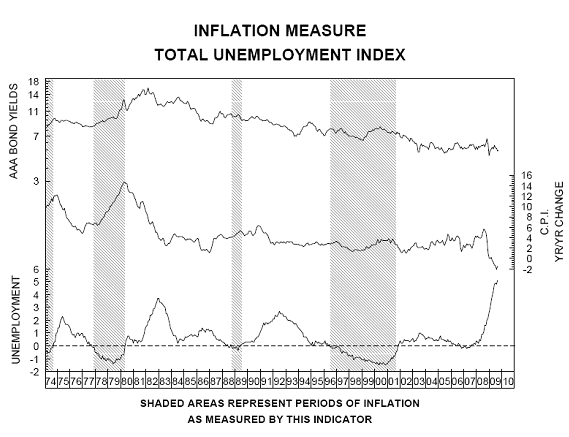
One classic measure of excess capacity is the unemployment rate, and Everson provided the data below, which shows the level of unemployment relative to an assumed full employment level of 4.5%. 
As long as unemployment remains high, wage-driven inflation will be impossible, she said.
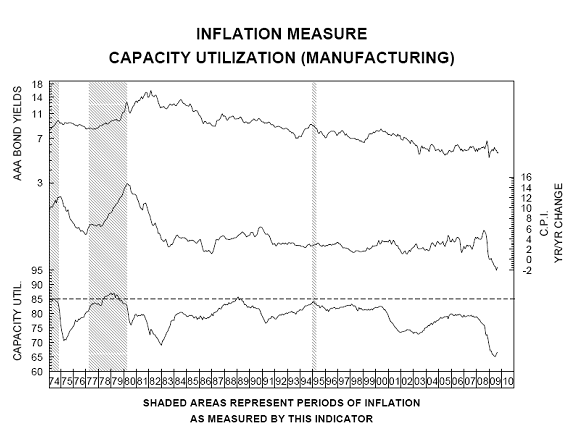
Industrial capacity utilization is the other classic metric by which to assess the likelihood of inflation. It reached a 50-year low earlier this year, as shown by the following graph.
Although it is slightly above its lowest level, industrial capacity is a “long way off” from the 80% level that historically heralds the onset of more widespread pricing power, Everson said.
Comparisons to the 1970s – an era of large budget deficits and high inflation – are inaccurate, according to Everson, because in the ’70s capacity utilization was high, and industries were able to pass along price increases to consumers.
“Central banks remained accommodative in their monetary policies even when capacity had begun to tighten, and it still took at least two years for capacity utilization to reach levels that triggered inflation,” Everson said.
Even looking two years ahead, Everson still sees inflation as unlikely. Flows in a number of credit markets are too weak to sustain healthy economic growth.
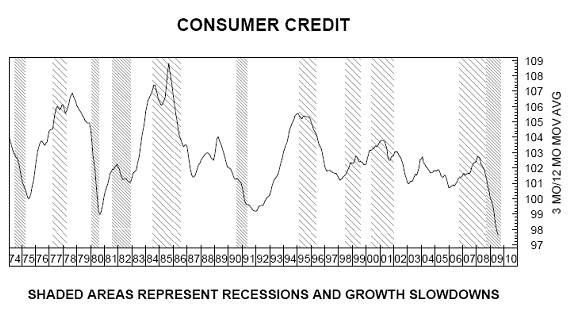
Everson presented data showing significant contraction in consumer credit (credit cards, auto loans, health care loans).
Consumer credit is an adjunct to consumer spending, and until it begins expanding again, Everson said inflation will be “a long way off.”
Low mortgage rates are not leading to increased mortgage loan applications, and Everson believes mortgage yields are “still too high for most of us,” constraining the growth in housing prices, an important component of inflation.
There has been a notable drop in the level of outstanding commercial paper since the start of the crisis, which is significant because commercial paper is the primary mechanism for companies to finance receivables from new orders. In the absence of cheap credit from the commercial paper market, many companies are tempering their growth plans.
But what about the massive amount of government borrowing and spending?
“When you think of the credit that used to flow through the financial markets until mid -2007,” Everson said, “when FNMA alone was generating tens of billions of dollars of mortgage securities per month and the shadow banking system was gushing credit, these flows of credit are only partially replaced by the expansion of the Fed’s balance sheet and federal debt.”
Nor is government spending likely to raise interest rates to levels approaching 6%, as some have predicted. This would imply mortgage yields of 7.5% based on existing spreads, far above the 5.5% levels of this summer, which were already too high for most borrowers.
“We have an economy that just can’t tolerate much at all in terms of rising bond yields,” she said. If government spending were on a road that could provoke rising yields, it would backfire and could result in another crisis of bank solvency.
“This fragile set of green shoots that looks like it’s trying to be a recovery is very much dependent on bond yields remaining low,” she said. Indeed, the bond market is not pricing in much inflation, either through the yield curve or through the TIPS market.
Commodity prices have declined since June of 2008, and that has contributed to CPI rates being currently below zero. Oil prices have since recovered, along with prices of several other commodities, but that hasn’t done much for US coal or natural gas prices, nor has the rally extended to grain prices. Some sectors of the commodity markets are rallying, she said, but not across the board to a degree sufficient to indicate inflation.
Gold prices are high but signal “something other than inflation,” Everson said. Most likely rising gold prices are fueled by speculation, low cost of carry, and the increasing acceptance of gold as a legitimate asset class.
Everson said deflation is unlikely, because the economy is recovering, and government programs, such as cash-for-clunkers, have proven to be stimulative of spending. She expects similar fiscal measures to prevent deflation would be effective also. Mortgage activity still reacts when the cost of financing falls, even if it is more muted this time.
Any comparisons to a Japanese-style lost decade are misguided, she added. Japan had to contend with a rising currency (most of the 1990s), a tough hurdle for an export-dependent economy. Everson does not expect dollar devaluation, nor has there been any since the onset of the crisis. Our central bank has also been far more proactive in its policy responses than was the Japanese central bank. In the 1990s commodity prices were relatively flat or falling, which contributed to measurement of deflation in Japan.
Although we share anemic growth with Japan, we don’t share the factors that led to deflation.
“Investors should position their portfolios for a sustained period of low growth and low inflation,” she said.
Read more articles by Robert Huebscher