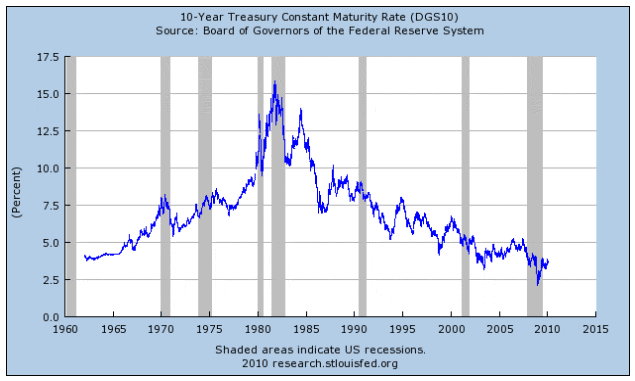
The current generation of financial advisors has never experienced rising interest rates. Rates peaked in the early 1980s and, aside from a few brief interruptions, have declined ever since, leading to the startling finding that bonds outperformed stocks over this period and, moreover, outperformed them over the last 40 years.
That has been great news for bond investors and even better news for bond funds, which benefited from record inflows, particularly over the last year. No fund has benefited more than the PIMCO Total Return fund, currently the largest mutual fund with assets of more than $200 billion.
PIMCO’s success has come from outstanding performance. It consistently beats its benchmark (the Lehman/Barclay AGG index) and ranks in the top of its Morningstar peer group. Over the last three years, for example, its institutional share class returned 9.19% annually.

But what will the next three years look like, and what risks do investors face in the Total Return fund? To answer those questions, we surveyed our readers to gather their forecasts for interest rates and inflation and to determine what risks they see in the fund.
Advisors, based on their forecasts, expect to earn higher returns in inflation-protected securities than in the Total Return fund over the next three years. Moreover, their perceptions of the risks in the fund appear to be unrealistic.
Those findings carry with them a number of caveats, so, before you sell the Total Return fund and buy TIPS, let’s take a closer look at the results of our survey and at the fund.
Survey results
We received 967 responses to our survey, the results of which are summarized below:
- 880 responses (91%) were from advisors who manage the assets of individuals
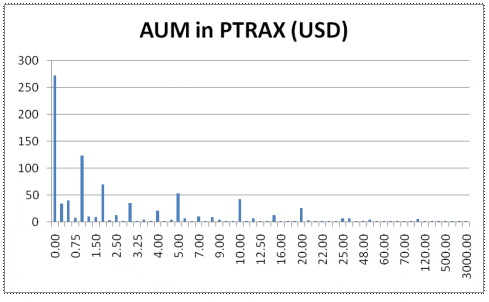
- Those 880 advisors manage a total of $10.9 billion across all share classes of the Total Return fund, which represents approximately 0.5% of the assets in the fund. The average holding in the fund was $12.35 million
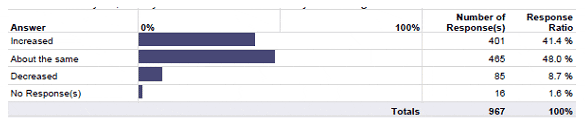
- Over the last year, 41.4% of respondents increased their holdings in the fund; 48.0% kept holdings about the same, and 8.7% decreased their holdings.
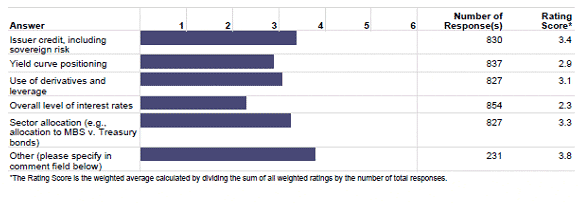
- Respondents cited the overall level of interest rates as the most important source of risk with regard to the fund, followed by yield curve positioning, the use of derivatives and leverage, sector allocation, issuer credit, and “other.”
- The least important source of risk, with respect to the fund, was in the “other” category. Within this category, the most frequently cited source of risk was the size of the fund. Related to this, many worried that the fund could experience large outflows once investors face rising interest rates. For example, one person responded, “The sheer size of the fund makes it cumbersome to manage. The fund is highly inflexible and may get caught in a market in which nimbleness is required. We have not had such a market in bonds for some time, but we will again. When that happens, look out if you own this or several of PIMCO’s other bond funds.” Thus, some of the risk attributed to the fund’s size was closely rated to the risk of rising interest rates.
- The second most frequently cited source of risk in the “other” category was the fund’s reliance on Bill Gross as its manager and uncertainty regarding his eventual retirement and longevity.
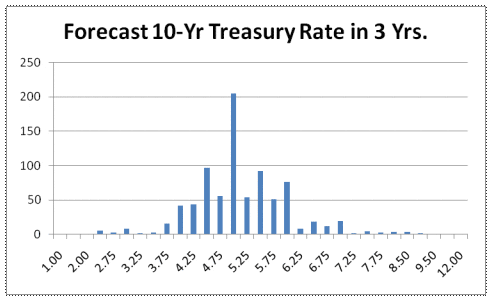
- The average forecast 10-year Treasury rate in three years was 5.28%, based on 840 responses to this question from those advisors who manage assets for individuals.
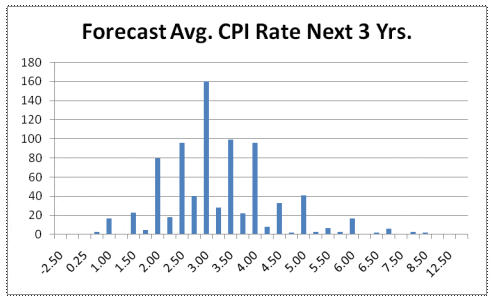
- The average forecast inflation rate (based on the CPI-U) over the next three years was 3.29%, based on 823 responses to this question from those who manage assets for individuals.
Detailed survey results are presented at the end of this article.
Understanding the risks and opportunities
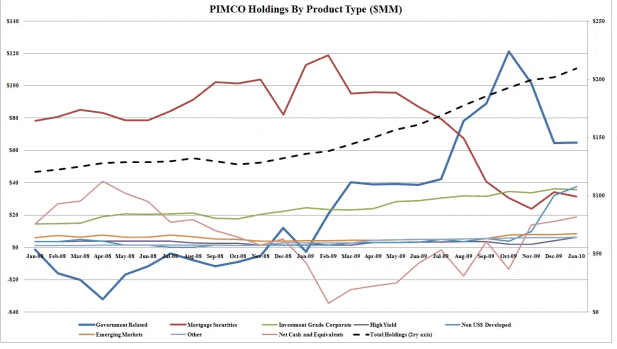
The Total Return fund is actively managed against the Lehman/Barclay AGG index, and it achieves its alpha through sector selection, yield curve positioning, individual security selection, leverage, and use of derivatives. The following illustrates the sector selections of the fund over the last two years:
High-yield and emerging market bonds are not part of the AGG index, and the fund’s exposure to these sectors may explain some of its outperformance against its benchmark.
Truly understanding the risks in this fund is beyond the average advisor and certainly beyond virtually all individual investors. The fund’s most recent quarterly statement is over 100 pages, devoted mostly to a list of its holdings – US and foreign government bonds, mortgage-backed securities, credit default swaps, futures contracts, interest rate swaps and swaptions, and foreign currency contracts.
On your own, you would have as much chance of understanding the risks and opportunities in those holdings after perusing this statement as you would successfully performing brain surgery after watching an episode of Grey’s Anatomy. If you insist on fully understanding the risks in your investments – a perfectly reasonable attitude – this fund is not for you.
Indeed, many advisors reject the fund for its lack of transparency, a concern that has been prominently portrayed by many in the financial media. Since I believe this concern is largely misplaced, let’s examine how advisors can overcome perceived risks related to the fund’s opacity.
Karen Dolan, the director of fund analysis at Morningstar, said in a recent interview that investing in the fund requires “a little bit of a leap of faith.”
Advisors can take that leap by using research from firms like Morningstar, which has followed the fund since its inception. Eric Jacobson is Morningstar’s lead analyst for this fund, and when I spoke to him last week he had just returned from a meeting with the fund’s management team. He explained that the fund uses tools, like derivatives, that in the wrong hands can amplify risk. “PIMCO uses them liberally,” he said. “They are one of a handful of fund managers who have proven they can handle that responsibility.”
“It’s very difficult for an outsider to mathematically analyze the portfolio from the raw data without having PIMCO give the data to you and say this is what it means,” he said. Nonetheless, he is confident it is not an overly aggressive portfolio. It does not use high degrees of leverage or exposure to volatile sectors like emerging markets and high-yield bonds, Jacobson said.
Advisors have less access to Gross than with most active fund managers. Most of the communication from Gross comes through his periodic commentaries published on PIMCO’s web site and his frequent appearances on CNBC and elsewhere in the media. He occasionally meets with advisors at PIMCO’s offices and holds conference calls with advisors. Gross declined to be interviewed for this article.
PIMCO, though, shares more information than many of its peers, and it provides detailed, quantitative profiles of the fund to advisors. Making sure one understands that information and asks the right questions is the challenge, Jacobson said. For example, advisors should ask why and how PIMCO is using derivatives, and how they might contribute to risk in the portfolio, he said.
Maryland-based Fortigent, LLC provides consulting and investment management services to over 70 advisory clients, and those clients own approximately $250 million of the fund. Adam Cohen directs fixed income research at Fortigent and relies on many of the same sources of information as Jacobson. Relative to the other fixed income funds he follows, he said, PIMCO provides better information about the fund’s position on the yield curve, its sector and duration positioning, and other factors.
“One of our biggest worries about the fund is its use of derivatives,” which are susceptible to counterparty risk, Cohen said.
“The reality is that for the really deep due diligence, we are smart enough to rely on firms like Fortigent and [the California-based research firm] Litman Gregory,” Jim McGurren of New York-based Dartmouth Advisory told me. “You have to pay close attention to their commentaries to understand their thinking and philosophy.” McGurren’s clients have significant exposure to the fund.
Harold Evensky of Florida-based Evensky & Katz uses the Total Return fund, and, as he does with other fixed income funds he considers, he looks primarily at duration and quality, then at other factors like turnover and volatility. “Because it is so actively managed and sophisticated, I can’t say we completely grasp its very complex management,” he said. Nonetheless, he doesn’t believe there are “any embedded time bombs I don’t understand.” The fund is part of his core fixed income component, filling out the higher duration segment of his laddered interest rate position. He typically holds about 3% of clients’ assets in the fund; the bulk of his fixed income positions, which comprise 40% of most portfolios, are in short- term maturities.
Steve Lee, of Pittsburgh-based H.L. Zeve & Co., has approximately $21.5 million of client assets in the fund. He is concerned about derivatives and leverage and, like the other advisors I spoke with, he is confident that PIMCO’s managers are sufficiently skillful to properly use them. “Their long-term track record backs this up,” he said.
Is the fund too big?
Our survey showed that advisors consider the fund’s size to be its greatest source of risk. Size restricts the fund’s opportunity set and can limit its ability to quickly shift direction in response to changes in the macro environment. Some of the advisors I spoke with voiced this apprehension.
McGurren, for instance, is most worried about the size of the fund, but he finds comfort in the depth and liquidity of the markets. Nonetheless, he said that PIMCO could get caught “flatfooted” by an abrupt change in the economy or the market, and the fund’s performance might lag in such an environment.
“The bigger you get, the harder it is for positions to have an impact on the portfolio,” Zeve’s Lee said.
At $200 billion, the fund’s assets represent approximately 0.03% of the $648 trillion that make up the global debt markets, including the cash bonds, OTC derivatives, and exchange-traded futures and options, based on Q1 2009 data provided by PIMCO.
Of that $648 trillion, $510 trillion represents the notional value of the OTC derivatives market, so the fund’s size relative to the size of exchange-traded securities is much greater. Excluding the derivatives market, the fund’s assets represent 0.15% of its investible universe. That is roughly the same percentage as a $20 billion US equity fund, relative to the market capitalization of the US equity market, and about one-quarter to one-third the size of the largest actively managed US equity funds, such as Fidelity’s Contrafund.
It is not just the fund’s assets that matter, though. PIMCO manages nearly $1 trillion in assets and, if PIMCO’s perceptions of market opportunities change, asset flows across all its funds could be constrained.
Interest rates and inflation
On balance, I agree with those who consider concerns about a lack of transparency and the use of derivatives to be red herrings. It wasn’t derivative contracts per se that contributed to the financial crisis; it was their improper use, and PIMCO’s managers have amply demonstrated their expertise.
I am less worried than most about the fund’s size. Its position relative to the exchange-traded markets is relatively modest. The bond markets are far more homogenous than the equity markets. Although the fund may be constrained in its ability to take positions in individual securities, its ability to move across sectors is unlikely to face limits, at least at its current size.
But interest rate risk is another story.
“We are very concerned about interest rates and inflation,” Evensky told me.
I agree. It is those twin concerns that deserve the lion’s share of our attention.
“We are not overly scientific in our analysis of the fund,” Zeve’s Lee told me, “but what really worries us the most about fixed income today is the impact of rising interest rates.” He believes inflation is not a big deal for now, but “you don’t have to be an economist to see that interest rates have nowhere to go but up,” he said.
Our survey showed that advisors forecast a 150-plus-basis-point increase (to 5.28%) in the 10-year rate over the next three years, and they forecast an average CPI-U inflation rate of 3.29% over that time period.
If that forecast is accurate, the price of a constant-maturity 10-year Treasury bond will decline approximately 12% over that period. The 10-year bond has a longer duration (approximately 8) than the target duration of the fund (between 4 and 6), so the fund’s exposure to rising rates, based on the current shape of the yield curve, is smaller. Also, that 12% decline would be partially offset by coupon income and reinvestment income on those coupons.
It would be a mistake to translate this 12% headwind directly into a projection of performance for the fund. The fund’s managers have an arsenal of tools to combat rising interest rates. They are surely focused on these concerns and have already signaled that they are taking steps, such as increasing the fund’s position the German bond market, to mitigate interest rate risk. Other tools to defend against rising rates include shifting duration outside the US or positioning along the yield curve, and the ability to reinvest coupons at higher rates.
Since the inception of the fund in 1987, there have been four major tightening cycles (involving the Fed Funds rate) by the Fed. In three of those four cycles, the fund generated positive alpha and positive cumulative return.
The due diligence that advisors perform on this fund should undoubtedly focus on the questions of how the fund will perform under different interest rate environments and how effectively its managers can defend against rising rates. Advisors should understand the parallels between those four tightening cycles and today’s environment and, in particular, how long-term rates behaved in those cycles.
“Gross has a reasonably good chance of outperforming other funds through a cycle, but that doesn’t mean he can sidestep interest risk,” Morningstar’s Jacobson said. If you are in the camp that forecasts higher interest rates, he said, you would be better off in an asset allocation fund or one of PIMCO’s unconstrained funds.
Given advisors’ inflation forecasts, one alternative are inflation-protected bonds. The (real) yield on 10-year TIPS is approximately 1.50%. Add to that projected inflation of 3.29%, and their projected return is 4.79% – which will be tough for any fixed-rate fund to beat, given advisors’ forecasts. (This calculation assumes that real yields remain constant. In a period of rising rates, real rates might rise. On the other hand, rising inflation could increase the demand for TIPS, lowering real rates. The limited historical data for TIPS provides insufficient data to accurately forecast real yields.)
The Total Return fund does not currently hold any inflation-protected securities.
Lee worries about how he will explain to clients when the NAV of a fund declines in response to declining rates. “Our biggest worry is to keep folks from reacting improperly from perceived bad events,” he said.
The Total Return fund is not unique – exposure to rising rates is a concern for any fixed-rate bond fund. The question is not whether to be in such a fund, since nobody can forecast interest rates precisely, but how much exposure one should have.
Detailed Survey Results
1. Are you a financial advisor who manages assets for individuals?
2. Please indicate your practice’s holdings in the PIMCO Total Return Fund (PTRAX), across all share classes in millions USD. Enter "0" if you do not own this fund.
Total AUM = $10,867 million; Avg. AUM = $12.35 million |
880 respondents managing assets for individuals |
3. Over the last year, have you increased or decreased your holdings in PTRAX?
4. Please rank what you consider to be the greatest risks in PTRAX over the next three years? (1=greatest risk; 6=least risk) You may skip this question if have not owned PTRAX or are not familiar with this fund
5. What is your forecast for the 10-year Treasury bond rate in three years?
(Currently, it is approximately 3.75%)
Average = 5.28%; 840 responses (those who manage assets for individuals); graph shows values rounded to the nearest 0.25%.
6. What is your forecast for the average inflation rate over the next three years, based on the CPI-U index?
Average = 3.29%; 823 responses (those who manage assets for individuals); graph shows values rounded to the nearest 0.25%.
Read more articles by Robert Huebscher