Headlines warn that the rapid buildup in the money supply, caused by the Federal Reserve’s efforts to confront the financial crisis, is destined to result in inflation. That may be the case, but a more ominous signal from the money supply warns of impending economic contraction.
The broadest measure of money supply, known as M3, has decreased rapidly over the last year, which, both economic theory and historical evidence teach, presages a contraction in GDP and a rise in unemployment.
The government ceased publishing M3 in 2006. It is now available only from private sources, such as Shadow Government Statistics, a California-based economic consulting firm run by John Williams. I spoke with Williams on March 5 to understand the role of M3 in forecasting economic growth.
Reflecting on the events of 2008, Seth Klarman issued the following warning in his annual letter:
Things that have never happened before are bound to occur with some regularity. You must always be prepared for the unexpected, including sudden, sharp downward swings in markets and the economy. Whatever adverse scenario you can contemplate, reality can be far worse.
It is in this spirit that you should pay close attention to Williams’ warnings.
Measuring the money supply
Let’s start with a review of the measures of the money supply.
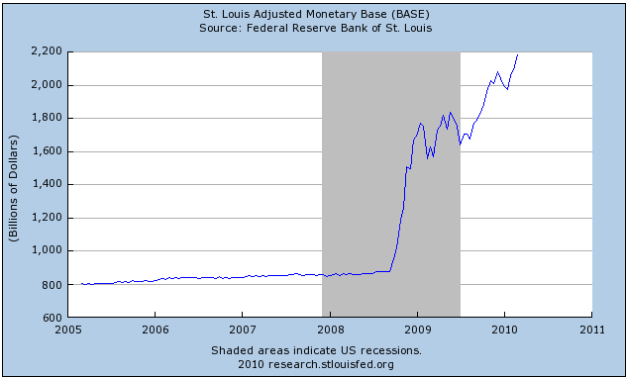
The monetary base, or M0, is not technically a measure of money supply. It is the tool used by the Fed to control money supply. It includes currency and bank reserves, which are under the Fed's control.
At the end of 2008, the Fed responded to the financial crisis by increasing the monetary base, causing an initial spike in M0:

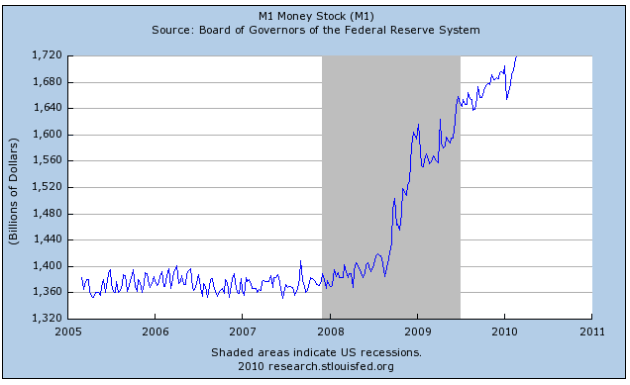
A broader measure of money supply is M1, which includes M0 plus demand deposits, CDs, and other short-term deposits, but does not include required or excess bank reserves.
Under normal circumstances, an increase in bank reserves will trigger higher bank lending and, because banks are leveraged eight- or ten-fold, higher inflation results.
Under the conditions banks faced as the crisis unfolded, however, banks built excess reserves to offset losses they faced through loan write-offs. M1 and the other measures of money supply did not follow M0, as the banks did not lend money into the flow of commerce.
Bank reserves have now grown to unprecedented levels. Normally, reserves fall between $50 and $60 billion, but now they are approximately $1.1 trillion, according to Williams.
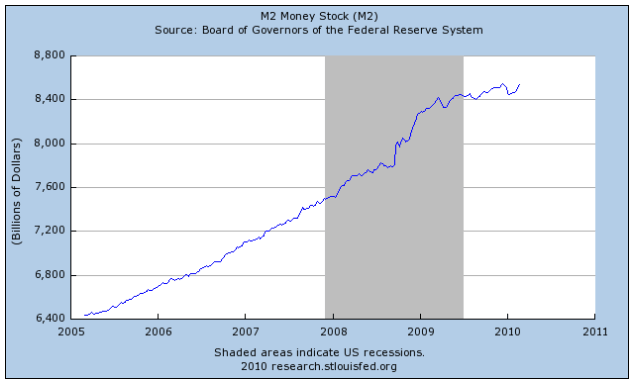
Broader still is M2, which includes M1 plus savings accounts, time deposits and retail money market funds.
The liquidity created by the Fed remained in bank reserves and, as with M1, did not make its way into the broader measure of M2:
Williams said that M2 has flattened out and is in decline on an inflation-adjusted basis, reinforcing his argument that the economy is suffering from a readily observable lack of liquidity.
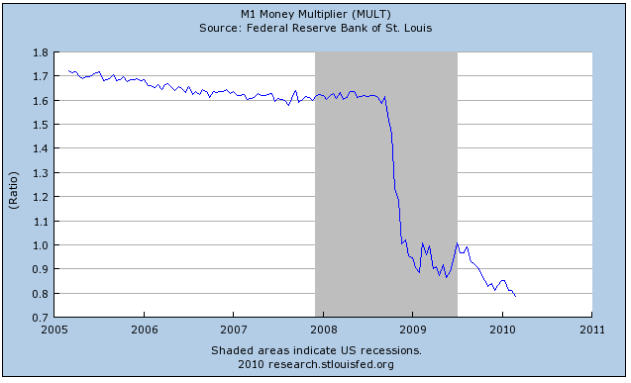
The velocity of money is a residual byproduct measured by dividing two measures of the money supply. For example, the St. Louis Fed calculates velocity as the “M1 money multiplier” using the ratio M1/M0. It is not directly observable.
Growth in the monetary base that was unaccompanied by growth in M1 meant that the velocity of money dropped off.
The measure that should raise alarms, M3, includes M2 plus institutional money market funds, time deposits, repurchase agreements, and a few other sources. As such, it is the broadest measure of the money supply.
Williams calculates M3 based primarily on data published by the Fed.
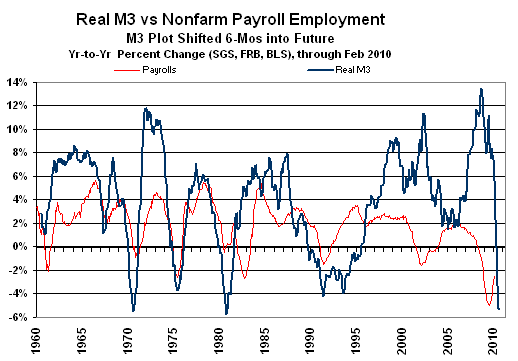
The next graph, provided by Williams, illustrates the history of M3, and shows its relationship to unemployment (nonfarm payrolls). Williams has shifted the data for M3 six months into the future, to show that declines in M3 coincide with increases in unemployment with a six-month time lag.
Data for M3 show that institutional money funds are “falling off a cliff,” Williams said, and liquidity is flowing out of M3 and into M2 and M1 as more investors go into cash. The M3 data show monthly and annual declines.
Every time M3 has contracted there has been a bad recession or, as was the case in 1974-75, an intensification of an existing recession. “It’s a very solid signal, and it also makes good sense,” Williams said.
That “good sense” is the theoretical basis for the relationship between liquidity and economic growth, Williams explained. Specifically, the relationship lies in what economists call the “equation of exchange”:
Where,
M = money supply
V = velocity of money
GDP = GDP in real dollars
Unless offset by an increase in the velocity of money, a drop in the money supply translates to a drop in the GDP.
Liquidity is a necessary ingredient of commerce and economic activity. It allows existing businesses to expand and new businesses to emerge with the help of bank lending and readily available credit.
Given the central role of liquidity in economic growth, you want the broadest measure of it. Otherwise you can see shifting of money between accounts that masks the overall picture. For example, M2 has been growing over the last couple of weeks, but M3 has not, indicating that M2 growth was offset by contraction in either M0 or M1.
Implications for the future
The data for M3 reinforce Williams’ broader thesis that the US is headed for a severe and prolonged economic contraction that will ultimately result in hyperinflation – possibly within the next year, a forecast we have written about previously.
“You are going to see an intensified economic downturn in the next couple of months,” Williams said, “that will show up in the statistics.”
The banks are largely insolvent, he said.
Williams said the Fed, in its recent Beige Book, recognized the fragility of the banking system. It attributed lack of credit to tightened lending standards and to the inability of mid-sized and regional banks to lend because of their impaired balance sheets. “These problems are the same as at the beginning of the crisis,” Williams said. “Until the banking system gets healthy enough to resume lending into the flow of commerce, you are not going to have positive economic growth.”
The Fed’s primary function is to maintain the solvency of the banking system, not to control inflation, Williams said. “All the programs thus far have been aimed at that goal,” he said. “The Fed is in an impossible situation without a robust economy.”
Williams expects the Fed to “debase” the dollar as much as necessary, by decreasing the interest rate on reserves held by banks, for instance, in order to stimulate bank lending. Such actions would be designed to increase M3, but they would carry with them the risk of inflation.
So far, the Fed has been successful in stabilizing the system without causing inflation.
“The Fed will talk one game to keep the dollar stable,” he said, “but will act otherwise to keep the system stable.”
Without growing M3 the system “will implode on itself,” Williams said.
A weak economy will create additional funding needs for the Treasury. Insufficient auction demand for Treasury securities will force the Fed to step in to buy to keep rates down. In doing so, it will be monetizing the debt and increasing the money supply
The contraction in M3 has been deflationary and runs contrary to Williams’ larger theme of a hyperinflationary threat. Williams is convinced that contraction is temporary, and he believes Fed actions to fight deflation will eventually grow the money supply and lead to uncontrollable inflation.
If that were happen, it would require a movement out of the dollar, reflected in lower dollar exchange rates. The sale of dollar-denominated assets, such as Treasury securities, could cause this.
“The thing to watch for is the dollar,” Williams said. “If there is fundamental or panicked selling of the dollar, the system will freeze and rates will skyrocket, or the Fed will be forced to flood the system with liquidity, which will be very inflationary.”
You can subscribe to Williams’ Shadow Government Statistics service here.
Read more articles by Robert Huebscher