Advisor Perspectives welcomes guest contributions. The views presented here do not necessarily represent those of Advisor Perspectives.

This essay is excerpted from the most recent version of the HCM Market Letter. To subscribe directly to this publication, please go here.
“There is a more elemental way of regarding Post-Modernism, however, and that is in terms of climax inflation not only of wealth, but of people, ideas, methods, and expectations – the increasing power and pervasiveness of the communications industry, the reckless growth of the academy, the incessant changing hands and intrinsic devaluation of all received ideas. The Post-Modern era represents only the last phase in a century of inflation – when it becomes structurally permanent in the longest sustained economic rocket ride since the industrial revolution, arguably the most explosive period of sustained growth in human history.
“The effects are by now clear even to the most literary mind. Chronic excess demand fosters irrational consumption; all goods, intellectual as well as material, become nondurable, buying and selling take precedence over production and investment. Rather than a genuinely productive wealth, a patrimony which can be passed on, chronic inflation increasingly produces only hedges against inflation and distortions of the market, which is to say, it fosters cultural incoherence of the most destructive sort. As inflation affects members of the community unequally, alienation is intensified, consensus unravels, the trade unionist mentality permeates all levels of society, the social order becomes a war of group against group for decreasing shares of the national income, and the skepticism of all forms of governance intensifies. Power flows to those institutions which can take on the highest debt.”
Charles Newman (1985)1
Goldman Sachs tempts the fates
When Lloyd Blankfein boasted several months ago that Goldman Sachs was doing “God’s work,” he neglected to mention that he was speaking about the Greek Gods. For it now turns out that Greece was able to conceal its deteriorating financial condition with the able assistance of Goldman Sachs’ financial wizards, who arranged a dozen off-balance sheet currency swaps between 1998 and 2001. These swaps allowed Greece to convert Japanese yen and U.S. dollars into Euros at artificially favorable rates that allowed Greece to understate its external debt by more than €2 billion, according to The Wall Street Journal. Ironically, the benefits of fudging its true indebtedness were relatively minor, reducing Greece’s debt as a percentage of GDP from 105.3 percent to 103.7 percent, and reducing its 2001 deficit by a mere 1/10 of one percent. Of course, when a country’s debt exceeds 100 percent of its GDP, its finances are already in a parlous state, so Greece was trying to push water uphill in any event. Then again, with God on its side, Greece probably figured that Goldman would teach it how to walk on water.
After disclosure of its work with the descendants of Achilles, Goldman Sachs entered damage control mode and dispatched the highly respected Gerald Corrigan, a former President of the Federal Reserve Bank of New York and Chairman of Goldman Sachs Bank USA, to tell a UK parliamentary committee that “with the benefit of hindsight…the standards of transparency could have been and probably should have been higher.” This occurred just a couple of days before The New York Times revealed, in a front page article that should have surprised nobody, that Goldman Sachs and other Wall Street firms that had helped Greece conceal its debts were now seeking to profit from Greece’s deteriorating finances through trades in credit default swaps. As The New York Times phrased it, “[t]hese contracts, known as credit-default swaps, effectively let banks and hedge funds wager on the financial equivalent of a four-alarm fire: a default by a company or, in the case of Greece, an entire country. If Greece reneges on its debts, traders who own these swaps stand to profit.”2 The paper of record failed to add that Greece need not default on its debt to render these trades profitable; a mere deterioration in Greece’s credit standing (either actual or in the perception of the market) would lead to a widening in Greece’s credit spreads and allow traders to close out these trades at a profit.3
Of course, it must be presumed that some of these swaps are being used to hedge existing holdings of Greek sovereign debt. But as has long been the case in the credit default swap market, a significant amount of these trades are undoubtedly “naked” swaps in which speculators are not hedging existing positions but are merely trying to profit from Greece’s troubles. The piling on of these trades raises Greece’s borrowing costs and makes it far more difficult for Greece to refinance its debts. In short, these trading strategies are highly destabilizing to the financial system. This is precisely the scenario that unfolded in 2008 with respect to Bear Stearns and Lehman Brothers, which were effectively driven out of business, initially by their own reckless management and ultimately by the ability of credit default swap traders to drive their financing rates to unsustainable levels. Ironically, that same phenomenon also pushed Goldman Sachs (as well as Morgan Stanley) to the brink until former Goldman Sachs Chairman and then Secretary of the Treasury Hank Paulson and Federal Reserve Chairman Ben Bernanke were able to cobble together a rescue plan that included granting these firms banking licenses.
In recent Congressional testimony, Lloyd Blankfein defended his firm’s trading practices with the argument that Goldman was merely providing sophisticated customers with the types of products that they demanded. In that case, he was speaking about the firm’s shorting of subprime credit at the same time that it was selling Collateralized Mortgage Obligations stuffed with subprime loans. Goldman was savvy enough to realize that the products it was selling were going to decline in value and was able to profit by buying insurance (in the form of credit default swaps) on those products. In the case of Greece, the firm appears to be doing something very similar, although the work it did to help Greece conceal its debts dates back several years.
The point Mr. Blankfein might want to consider, however, is whether Goldman wants to be perceived as continuing to profit from the fires it is setting throughout the financial world. As the smartest guy in the room, Goldman cannot claim it didn’t understand the potential consequences of its work on behalf of the government of Greece. And it certainly cannot claim ignorance of the destabilizing effects that its current trading strategies are causing. There is a plethora of ways to earn a profit in the financial world, as Goldman knows better than any other firm in existence; that doesn’t mean the firm has to take advantage of every one of them.
The Greek Gods had a funny way of exacting their revenge on those who tempted the Fates. At some point, Goldman’s hubris is going to catch up with the firm if it doesn’t begin to consider that how it generates profits is just as important as how much profit it generates.
The fallacy of the periphery
Whatever the outcome of the Greek economic drama, the fact that a relatively small country can cause the global financial markets to sell-off so sharply illustrates how interlinked the global markets remain in today’s globalized world. Years of short-sighted fiscal and monetary policy have trapped Western economies in a boom and bust cycle from which there is no easy escape. As a result, global markets remain highly vulnerable to instabilities at their periphery. Greece in a case in point, but it is only a symptom of the deeper disease ailing the global financial system. That disease is the severe weakening of sovereign balance sheets.
For in an interconnected world, there is no such thing as a periphery. The system is only as strong as its weakest link. A Greek default would cause financial turmoil because as much as €250 or €300 billion of Greek debt is owned by international bond funds, pension funds, insurance companies and banks. All of these institutions – banks in particular – are undercapitalized and would be further impaired if Greece defaulted. American banks have $176 billion of exposure to Greece, according to Barclays Capital. There will be considerable behind-the-scenes pressure brought to bear to prevent a default.
Greece plans to reduce its fiscal deficit from roughly 13 percent to 3 percent of GDP by 2013. Whether or not this plan is achievable, it illustrates the degree of austerity that will be required to bring not only Greece’s but other sovereign balance sheets into balance, including those of Spain, Portugal, Italy, the UK and the United States. The prospects for success are minimal without radical changes in entitlements and reductions in these countries’ already fraying safety nets. Moreover, the impact of efforts to reduce government spending inevitably will be deflationary; there is virtually no way that the withdrawal of almost 10 percent of GDP (which represented the government contribution to economic growth in many countries in 2009) can prove to be anything other than a deflationary shock to these economic systems. There is no way that private-sector demand can compensate for the withdrawal of government stimulus on such a massive scale.
The pain in Spain
For other EU countries, Greece’s problems are an ominous sign of what the future could hold if their leaders do not take action to rein in deficits and stimulate employment. Spain is a case in point. Some observers, such as Nobel Prize winning economist Paul Krugman, are suggesting that Spain, not Greece, is the real epicenter of Europe’s economic crisis. Mr. Krugman may be a bit premature in his warning, but Spain’s leaders do not have the luxury of time in dealing with their country’s economic woes. With a 2009 budget deficit that reached 11.4 percent of GDP, and a January 2010 unemployment rate of 18.8 percent (twice the European average), Spain’s economy is in desperate straits.
Finance Minister Elena Salgado argues that the country’s debt-to-GDP ratio remains 20 percentage points below the Eurozone average (although this may be likened to the adage that “In the kingdom of the blind, the one-eyed man is king.”). According to the government, Spain’s debt remains (for the moment) under 50 percent of GDP, well below the EU limit of 60 percent. Others place the figure much higher. The Bank Credit Analyst recently wrote that the public debt-to-GDP ratio is at 60 percent while Bridgewater Associates, which treats its research like national security secrets, recently wrote that “Spain owes the world about 80% of its GDP.” Whatever the actual figure, it appears that the Spanish government recognizes the severity of the situation and has begun taking steps to attack the fiscal challenge. Recently, it announced an austerity plan that increases the retirement age from 65 to 67 (a move every other Western country will have to make sooner or later) and cut €50 million from the budget by 2013, which will reduce the deficit to an EU-mandated 3 percent.
The Spanish government will have to stand up to strong resistance from unions and other political factions that have traditionally rendered it very difficult to make responsible, long-term decisions about economic matters (which are how matters were able to become so grim). Bridgewater noted, correctly we think, that Spanish sovereign credit trades much tighter than it should at a spread of +140 basis points. Bridgewater believes that the appropriate level is much closer to +650 basis points, suggesting that the highly secretive firm is currently shorting Spanish sovereign credit. Such a trade certainly makes sense (leaving aside the ethical questions raised above, which wouldn’t apply to Bridgewater as they do to Goldman Sachs since to HCM’s knowledge Bridgewater is not in the business of advising governments on how to structure their balance sheets) since a spread of 140 basis points offers a paltry return for the risks involved in lending to such a deeply troubled country at this point in time.
1 Charles Newman, The Post-Modern Aura: The Age of Fiction in an Age of Inflation (Evanston: Northwestern University Press, 1985), pp. 6-7.
2 The New York Times, February 25, 2010, “Banks Bet Greece Defaults on Debt They Helped Hide,” p. A1.
3 There was further potentially embarrassing disclosure in Business Week that Goldman Sachs may have failed to disclose the currency swaps it had arranged for Greece in the sale of $15 billion of Greek bonds it underwrote subsequent to 2002. According to Business Week, “[n]o mention was made of the Greek currency swap in sales documents for the bond offerings in at least 6 of the 10 sales the bank arranged for since the 2002 currency transaction.” Business Week, March 1, 2010, “Goldman Stars in This Greek Tragedy,” p. 30. Goldman should be hoping that European politicians and regulators will be more forgiving than the Greek Gods.
America’s economic decline
HCM has long argued that fiscal and monetary policies in the United States have been detrimental to sustainable long-term economic growth. This argument is supported by data that shows how economic performance deteriorated over the past three decades in this country. HCM believes there is a direct relationship between policy and performance. This deterioration culminated (or at least our readers should hope that it culminated and will not worsen, although we are not so sanguine) in the decade of the 2000s, which were not called the “ought’s” for nothing!
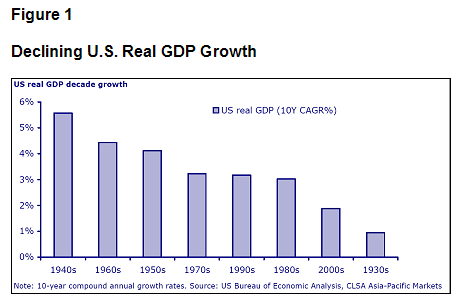
Our friend Christopher Wood points out that during the past ten years, the United States experienced the worst macroeconomic growth since the 1930s. During the 2000s, real GDP rose by an annualized 1.9 percent compared with an average annualized growth of 3.9 percent during the previous six decades (and an annualized 0.9 percent in the 1930s). This is graphically illustrated by Figure 1 below.
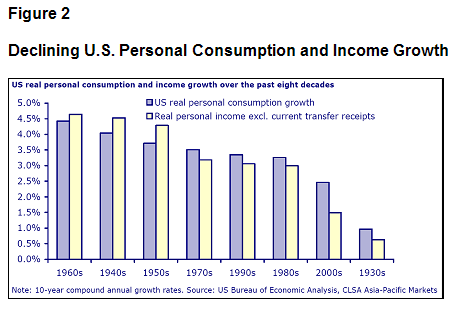
This poor economic performance was also reflected in lower-than-average real personal consumption and real personal income growth shown in Figure 2 below. Consumption rose by an annualized 2.5% in the 2000s compared with an average increase of 3.7 percent in the six preceding decades and income rose by a meager 1.5% in the 2000s compared with a robust 3.8 percent during the six previous decades.
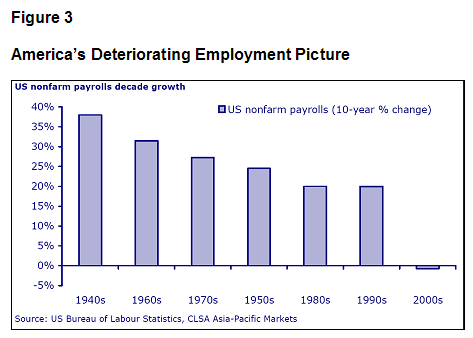
Employment growth was particularly disappointing during the last decade. Total non-farm payrolls dropped by 0.8 percent during the 2000s, compared with average decade growth of 27 percent between the 1940s and 1990s. Figure 3 below vividly illustrates this phenomenon. As David Rosenberg points out, “the level of employment today, at 129.5 million, is the exact same level it was in 1999. And, during this 11-year span of Japanese-like labor market stagnation, the working-age population has risen 29 million.”4 This is a not only an economic tragedy, it is a human tragedy. It is also, as Mr. Rosenberg points out, a highly deflationary phenomenon that leads to lower consumer spending on housing, automobiles and other consumer goods.
HCM would argue that the poor economic performance of the first decade of the new millennium was the result of the poor monetary, fiscal and tax policies that were put in place over the final decades of the previous millennium. These policies promoted speculation rather than productive investment, finance instead of manufacturing, and debt over equity. Regardless of one’s short-term view of the economic recovery and the financial market’s prospects, it is impossible to paint a positive long-term view in the absence of a dramatic reversal of the policies that have been in place over the past three decades.
The Carried Interest Tax
The steadily declining economic performance of the United States over the past three decades lends further support to the arguments in favor of repealing the egregiously favorable tax treatment that has been bestowed on private equity and hedge funds. Financial markets love to spout on about correlation, yet they deliberately ignore the increasing evidence of correlation between ill-advised policies (in this case tax policy) and deteriorating economic performance. The carried interest tax is one issue on which torches and pitchforks are entirely appropriate since the special pleaders’ arguments are particularly vacuous.
The latest special pleading comes from a gentleman named Scott Talbott, senior vice president of the Financial Services Roundtable in Washington, D.C. (in other words, a lobbyist). Mr. Talbott was quoted in the February 8, 2010 issue of Pensions & Investments defending the current regime that taxes the labor of private equity managers at ridiculously low capital gains rates on the basis that, “[t]he markets need capital from all sources, and the proposed increase in tax rates will have a chilling effect and prevent capital from coming off the sidelines.” Think about the absurdity of stating that taxing a carried interest as ordinary income will “chill” the flow of capital! Another unnamed private equity industry source stated that, “[t]here are members of the Senate Finance Committee who are concerned about raising taxes on investment at a time when it’s unclear how strong this economic recovery really is.” Senators Max Baucus and Charles Grassley are reportedly leading the resistance to changing this law. That is the same Senator Grassley who was so outraged at the AIG executives receiving bonuses in early 2009 that he suggested they either resign or commit suicide (seriously). Oh well – consistency is the hobgoblin of little minds.
Let’s be very clear – there is no intellectual or policy justification for taxing different types of labor at different rates. Accordingly, the labor of private equity managers should not be taxed at a lower rate than that of teachers or scientists. A carried interest represents payment for labor, not capital. By taxing one type of labor over another, society is making a judgment about what type of labor is more valuable to society. In this case – as in many cases – society has matters completely backward. It is taxing activities that are primarily speculative in nature at much lower rates than activities that are productive in nature. If we want to use our tax system to encourage certain types of behavior, shouldn’t we use it to encourage productive investment rather than speculation? Society should be favoring equity investments, not debt investments with lower tax rates – such a regime would create a far more stable economy than the one we have today. The fact that the carried interest tax has not yet been changed is a sad commentary on the ability of lobbyists and special interests to subvert genuine financial reform.
There is another aspect to the debate surrounding the favorable tax treatment meted out to private equity fund managers and hedge fund managers that deserves discussion. The recent revelations concerning the role played by Goldman Sachs and other investment houses in helping sovereign nations conceal their balance sheet problems and later engaging in trading strategies that exploited the very weaknesses that were being obfuscated points to another flaw in the regime governing our financial markets. As discussed in a front page article in The Wall Street Journal on February 26, hedge funds have been a major participant in shorting the Euro in reaction to the fire set by Greece in the European Union. HCM can assure its readers that it takes no special genius to realize that the Euro is overvalued, and that Greece’s problems will only render it even more vulnerable to further declines. But the question that the Journal article raised in HCM’s mind is whether it is advisable to have a financial regime that rewards speculation in currencies with the types of favorable tax treatment that the hedge funds who are speculating in currencies currently receive. Most of these hedge funds are speculating with significant amounts of money that is not subject to taxation (and not because it belongs to tax exempt institutions, believe me). It would seem that the world would be far better served by extracting its pound of flesh from these speculators rather than allowing them to disrupt the financial world while giving them what amounts to a free lunch on taxes. In particular, we noted that George Soros’s firm was reported to be one of the major speculators against the Euro. If that is true, we would only question whether such activity is consistent with Mr. Soros’ role as one of the most astute spokesmen for improving global financial regulation (including promoting a ban on naked credit default swaps, a position with which HCM strongly agrees).
4 David A. Rosenberg, Gluskin Sheff + Associates Inc., Lunch with Dave, February 5, 2010, p. 3.
Testing the “Crowding Out” thesis
Global financial markets are going to have a chance to test the “crowding out” thesis over the next 24 months. This thesis, which has failed to gain much traction in the real world, poses the possibility that government borrowing will absorb so much capital that the private sector will find it more difficult – or at least more expensive – to borrow. In 2009, the U.S. government will be borrowing approximately $4 trillion, of which roughly $2.5 trillion will involve the refinancing of existing debt and the remaining $1.5 trillion will require raising new capital. On top of that, European governments must raise an additional €1.6 trillion this year. HCM does not expect governments to experience too much trouble raising these funds, with the exception of countries such as Greece that have well-known financial problems (and even these countries will undoubtedly raise what they need, albeit at higher rates than they would like).
The difficulty that may arise, however, will involve private sector borrowers. European banks need to roll over more than €1 trillion over the next two years, according to Morgan Stanley. This will undoubtedly cost them more than what they are currently paying. Roughly €560 billion of EU bank debt matures in 2010 and another €540 billion matures next year. In addition, as discussed below, corporate borrowers in the U.S. are facing a wall of debt maturities in coming years.
The next corporate bond crash
Over $600 billion of high yield bonds and bank loans are scheduled to mature between 2012 and 2014. Approximately 85 percent of all high yield loans outstanding today mature during that period.5 While issuers have been making Herculean efforts to extend maturities and otherwise deal with impending debt maturities, the mountain of impending debt obligations coming due remains imposing. Moreover, it looms above the market in an environment of what will likely be below-trend economic growth once the effects of government stimulus wear off. The outlook for corporate credit, which enjoyed a historic 2009 recovery from a catastrophic 2008 sell-off, is therefore extremely troublesome. Managers who fail to understand the boom-and-bust dynamic in which corporate credit markets are trapped are bound to poorly serve their clients (as they have done in the recent past, with years of positive performance artificially boosted by the use of leverage followed by enormous losses). By mid-2011 (if not sooner), spreads on corporate credit will begin to widen again in anticipation of an enormous wave of refinancing that will take place in the context of the Federal Reserve raising rates and the economy struggling to grow. Leveraged companies will be the main casualties of such an environment, resulting in higher defaults as their cost of capital rises and their ability to refinance at reasonable rates becomes increasingly difficult. This will have a particularly negative impact on large private equity deals that were done at the peak of the previous cycle at egregiously high multiples of cash flow. Private equity returns will prove disappointing for yet another cycle, even if investors choose not to risk-adjust them for leverage, concentration risk, illiquidity and the obscene fees charged by private equity firms. For those who are capable of shorting corporate credit (such as my firm), there are going to be wonderful opportunities to profit from the mistakes of others in the years ahead.
What’s so great about debt anyway?
On a related note, The Wall Street Journal ran a front-page article on February 24 under the title “Lending Falls at Epic Pace.” The article reported that “U.S. banks posted their sharpest declines in lending since 1942 at the end of last year, suggesting that the industry’s continued slide is making it harder for the economy to recover.” Certainly the inability of creditworthy borrowers to access loans is impeding the economic recovery, but HCM has a slightly different take on the slowdown in lending. Rather than consider the shrinkage in debt a national tragedy, HCM views it as a necessary step in correcting the excesses of the past and moving the U.S. economy to a sounder base. An economy constructed on a foundation of debt is far more precarious and unstable than one that emphasized equity investments as the basis of growth. One of the primary policy errors that have persisted in the U.S. economic system for decades has been the unduly favorable tax treatment of debt, which was only partially corrected by President Bush II’s lowering of the tax on dividend income. Rather than focusing on how debt capital can be made more widely available, it would be a far more prudent long-term policy to encourage equity investments in new businesses. After all, it is a fallacy to believe that funds invested in a new business venture possess the risk characteristics of debt rather than equity; funds invested in new ventures are highly susceptible to loss and possess the risk attributes of equity, and calling these funds debt is not only misleading but creates a culture of debt-dependence that permeates all segments of our society. One of the most significant policy changes that should be made to the U.S. economic system is one that creates incentives that favor equity investments and discourage the use of debt.
The shrinkage in lending is a precursor to the type of scenario that has to occur for the system to be brought back into a state of health. Unfortunately, such a scenario would involve severe economic disruption that would make 2008 and early 2009’s recession look like a stroll in the park. For the boom-and-bust cycle in which we are trapped necessitates a severe purging of the mountains of bad debt that have built up at all levels of the financial system. We can be certain, however, that the government will fight tooth-and-nail to prevent any such scenario from unfolding. Instead, it will continue to engage in all types of reflation maneuvers in order to avoid the pain that a true flushing of the system would require. That is why everything is being done to incentivize banks to begin lending again despite the paucity of worthy borrowers and the strong desire of banks of all sizes to shrink their balance sheets. As noted above, equity – not debt – should be the basis of future economic growth, and policy should focus on making that possible. HCM views the chances of any such policy reform taking place as virtually impossible under our current political regime. It would literally require a (non-violent) revolution to make the types of changes necessary to change course.
Michael E. Lewitt
5 Source: Bank of America Merrill Lynch, February 23, 2010, Situation Room, “No Confidence in Greece…or the US,” pp. 5-6.
Disclosure Appendix
This publication does not provide individually tailored investment advice. It has been prepared without regard to the circumstances and objectives of those who receive it. This report contains general information only, does not take account of the specific circumstances of any recipient and should not be relied upon as authoritative or taken in substitution for the exercise of judgment by any recipient. Each recipient should consider the appropriateness of any investment decision having regard to his or her own circumstances, the full range of information available and appropriate professional advice. Harch Capital Management, LLC recommends that recipients independently evaluate particular investments and strategies, and encourage them to seek a financial adviser’s advice. Under no circumstances should this publication be construed as a solicitation to buy or sell any security or to participate in any trading or investment strategy, nor should this publication or any part of it form the basis of, or be relied on in connection with, any contract or commitment whatsoever. The value of and income from investments may vary because of changes in interest rates or foreign exchange rates, securities prices or market indexes, operational or financial conditions of companies, geopolitical or other factors. Past performance is not necessarily a guide to future performance. Estimates of future performance are based on assumptions that may not be realized. The information and opinions in this report constitute judgment as of the date of this report, have been compiled and arrived at from sources believed to be reliable and in good faith (but no representation or warranty, express or implied, is made as to their accuracy, completeness or correctness) and are subject to change without notice. Harch Capital Management, LLC and/or its employees, including the author, may have an interest in the companies or securities mentioned herein. Neither Harch Capital Management, LLC nor its employees, including the author, accepts any liability whatsoever for any loss or damage arising from any use of this report or its contents. All data and information and opinions expressed herein are subject to change without notice.
The HCM Market Letter
Michael E. Lewitt, Editor
The HCM Market Letter is published on a monthly basis by The HCM Market Letter, LLC. Offices at 751 Park of Commerce Drive, Suite 118, Boca Raton, FL, 33487. Telephone (561) 226-6199; Fax (561) 995-4946. Delivery is by electronic mail. Annual subscription rate is $395 for individuals and $995 for institutions. Visit our web site at www.hcmmarketletter.com. Copyright warning and notice: It is a violation of federal copyright law to reproduce or distribute all or part of this publication to anyone (with the exception of individuals within the same institution pursuant to the subscription agreement) by any means, including but not limited to photocopying, printing, faxing, scanning, e-mailing, and Web site posting without first seeking the permission of the publisher. The Copyright Act imposes liability of up to $150,000 per issue for infringement. Information concerning possible copyright infringement will be gratefully received.
Read more articles by Michael Lewitt