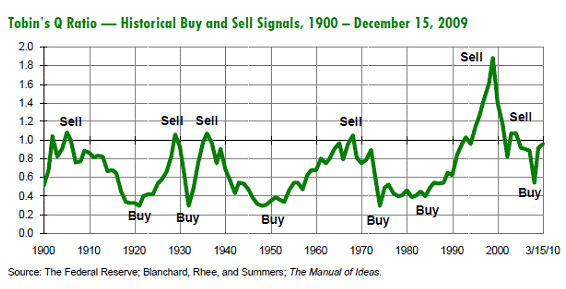
One of the most reliable measures of broad market valuation is Nobel Prize-winning economist James Tobin’s Q-ratio. Data released less than two weeks ago show that the ratio is generating a bearish signal over the next three, five and ten years. Over the next year, though, the signal is neutral.

“The medium- to longer-term outlook has dimmed as a result of the rise in the S&P 500 since June 30th, 2009,” said John Mihaljevic, whose publication, The Manual of Ideas, provides regular updates on movements in the Q-Ratio. Mihaljevic was a research assistant for Tobin.
“If the S&P 500 fell back from 1,150 to 919, the index level on June 30th, the medium- to long-term outlook would move from bearish to neutral,” he said.
Q-Ratio measures the market value of a company (its stock price) relative to the replacement cost of its assets. A value greater than one indicates that a company’s assets could be purchased more cheaply than the company itself and, hence, the market is overvaluing the company, while Q ratios less than one indicate market undervaluation.
We have written previously several times about the Q-ratio, most recently here.
The Q-ratio increased from 0.88 at the end of the third quarter of 2009 to 0.92 at the end of the year, and Mihaljevic estimates that it had reached 0.96 as of March 15. Most of this rise is attributable to increases in the numerator (market price). The denominator (replacement cost) rose by only 1% in 2009.
Several studies have identified a successful market timing strategy based on buying equities when the Q-ratio is below 0.40 and selling when it reaches 1.00, as shown below: