Advisor Perspectives welcomes guest contributions. The views presented here do not necessarily represent those of Advisor Perspectives.
One of the most remarkable discoveries in modern finance is the ability to improve the expected return of a portfolio while simultaneously reducing its risk. While the proverbial “free lunch” does exist, its exploitation requires a focus not only on the returns and volatility of the assets in the portfolio but on the degree of covariance between those assets – i.e. the extent to which the returns of the assets move in tandem. All other things being equal, mixing assets that do not move in tandem will improve a portfolio’s risk-adjusted returns.
Unfortunately, the typical investor, eschewing diversification in favour of the latest hot manager or the recommendations of a market prophet, often misses out on the free lunch. That is unfortunate because, in retrospect, one can clearly discern the tremendous value that diversification offers. Take a single asset class portfolio comprised of the S&P 500 stocks (in blue) – by diversifying equally into foreign stocks as represented by the MSCI EAFE index (in brown), the new two asset class portfolio (in red) outperformed the single asset portfolio from January 1972 through July 2010.
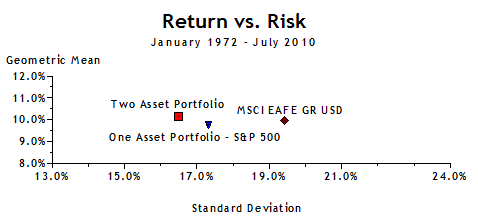
Most importantly, this outperformance was achieved with less volatility. The standard deviation of the two asset class portfolio – a measure of its volatility – was less than that of either the S&P 500 or MSCI EAFE. The free lunch was served!
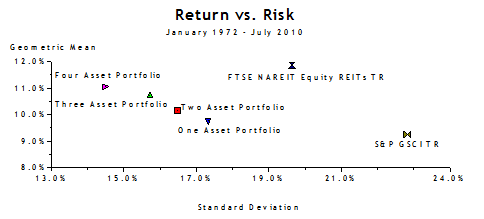
Incorporating additional asset classes with low covariances to equities into the portfolio increases the size of the free lunch. For example, the following graph illustrates that the addition of a 20% allocation to real estate investment trusts (FTSE NAREIT Equity REIT index) with the balance invested equally in U.S. and foreign stocks creates a three asset class portfolio (in green) that had a higher return with less volatility than the two asset portfolio (in red).