No commodity impacts the global economy more than oil. When geopolitical threats loom, two questions often dominate discussion: Will the price of oil rise? And what will be the economic consequences?
When crude prices rose to nearly $150/barrel in 2008, many feared a worldwide correction as energy costs, passed through to goods and services, dampened growth. In fact, persistent high energy prices may have been one of the factors that drove the global economy into the Great Recession.
We will review the key drivers of recent, current, and forecast oil prices, including a template for the necessary eventual alignment of supply and demand. Much of the information presented below is from an interview with a senior energy analyst at a major investment firm.
In short, don’t expect a return to $150/barrel in the short term (2010-2012), although there is reason to fear such a spike if sustained global economic growth occurs.
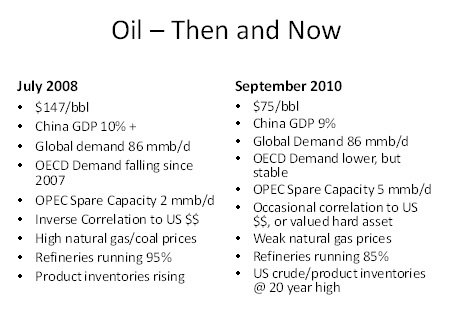
The price of oil is maddening – it often rises while fundamentals are deteriorating, and forcing decisions amongst its industry participants that otherwise appears irrational. Let’s try to make some sense out of this, and start our analysis of crude oil by comparing today’s oil markets with what we faced in July, 2008:

Since 2008, supply growth has outpaced demand. New non-OPEC capacity, generally from projects initiated in 2004-2006, has come on-stream and OPEC production is running about two million barrels a day above its internal quotas. Demand continues to grow in emerging markets, albeit at a slightly lower rate than it did before the recession. OECD (developed market) consumption, on the other hand, peaked in 2004-5, and it has been slipping ever since.
Meanwhile, the oil industry collectively upgraded and expanded its refinery infrastructure worldwide, leading to a glut in processing capacity. These projects also allowed refiners to produce a mix of higher-valued end fuels, just as demand for these products stalled. The net result was that inventories ballooned to multi-year highs, as overall consumption, while recovering, simply did not meet previous forecasts.
Why prices fell
Given that reality, how exactly do we explain a 50% decrease in price since 2008?
One view is that today’s price is the normal price, and that ($147) was the abnormal one. Let’s think about the factors at play in 2008 – a time when supply and demand for oil was close to equilibrium. Imagine one consumer standing near an oil tanker docked in Guangdong (China), and another on the NYMEX floor (New York). The former was desperate to get incremental fuel oil to run an export-oriented factory or to build roads. That customer would have been competing with a trader whose sole interest in owning oil was as a liquid bet against the US dollar. Both buyers lost by pushing the price they paid ever-higher.
That’s right. For many customers, higher prices had already started forcing customers to curtail demand for oil and many other commodities, even though prices, geared to customers in less efficient or subsidized markets in Guangdong and to speculators, marched toward the $150/bbl mark.
In sum, 2008’s tight equilibrium of supply and demand and resulting high price rid the market of marginal consumption. At the same time, the taut market forced oil markets to price commodities the way they always have – in concert with the longstanding (though imprecise) rubric that one extra unit of demand is a ‘shortage,’ while one extra unit of supply is a ‘glut.’ The result was exceptionally high volatility and, ultimately, a collapse in prices. As the fraught psychology of the 2008 economy unfolded, working capital curtailment, reduced trade, and, of course, manufacturing all reduced demand for those marginal barrels.
Demand destruction has kept prices low
Since the fall, 2007, when oil first passed $100/barrel, many forms of demand destruction emerged. Americans bought smaller cars and used mass transit. Municipalities implemented four-day work weeks to minimize commuting expense. Surcharges discouraged airline customers. Yet, still, the price marched higher.
Demand destruction, which often takes the form of changing habits, altered lifestyles, or innovation and substitution, is rarely temporary, and it is often inertial. Once it is in motion, it can breed further demand destruction, permanently altering consumption patterns.
What are today’s signals? Some are the same as two years ago – oil and product inventories are stubbornly high in the US, and many traders continue to use oil to bet against both the US dollar and the euro.
Others signals look different. In the United States, both gasoline (consumer) and diesel (industrial) demand remain sluggish at lower levels than in 2007-2008, as high unemployment, smaller cars, and a range of energy-efficient behaviors have taken hold. Over time, increased industrialization and urbanization have produced modest (1.5% over last 35 years) growth in oil demand, but the opportunities for increased efficiency that emerge in coming decades could far surpass what we’ve seen in the past. In fact, OECD consumption, which peaked in 2004, continues to slip, and it now trails emerging market demand, which continues to grow at 3-4% per year. Overall, the longer term (2005-2030) forecast growth rate for oil consumption has slipped from 1.6% per year to around 1.2%.
But demand destruction is everywhere – not just in the United States and other mature economies. A rapid transition away from motor scooters has led to the use of 120 million electric bicycles now in China. Many who ride these new bikes may never upgrade to the internal combustion engine. China’s massive railway investments, beyond mere stimulus, could materially reduce the long-term penetration of automobiles in that country’s transport network. China’s fuel efficiency requirements are much more stringent than those in the US, and the government has a mandate in place to reduce energy consumption throughout its economy over the next ten years.
On the other hand, Chinese car density, at under ten-per-thousand, will rise sharply, overwhelming any improvement in efficiency.
Where supply issues may arise
The oil industry does not stand still. New technologies allow producers to economically extract hydrocarbons once viewed as non-commercial. For instance, the Williston Basin in North and South Dakota, once viewed as depleted, has been revived. Now renamed the Bakken Shale formation, it is giving up enough oil to attract major companies like Marathon, Hess, and ConocoPhillips.
While over half of global production yields acceptable economic returns at $40, marginal projects (e.g., the Canadian oil sands, where oil exists in a solid or semi-solid state) are barely cost-effective when prices sit at $70/barrel. Those projects were cost effective at $100/bbl when steel, engineering/construction services, and raw materials were priced at inflated levels. For this reason, sources of oil supply do not just affect prices – prices affect the range of sources from which supply can be drawn.
Another major variable affecting production costs and, through them, supply around the world is the “rent” (tax and royalty) due to the governmental owners of resources. These rents are not always stable, and they are sometimes subject to the political or fiscal whims of the state. Many of the major oil-producing countries (e.g., Iran and Nicaragua) have weak or hostile diplomatic relations with the US, and the potential for them to increase their “rents” – or even withhold product altogether – will, at a minimum, ensure that oil prices will remain volatile.
Closer to home, a phenomenon we are all experiencing may well also affect supply in coming years: the uncertain economy. It is has become clear that oil industry executives are concerned about the stability of global economies. While $70 oil appears to satisfy many projects, the uncertain underlying demand environment has caused oil executives to defer many multi-year projects that were at risk of coming on-stream in a less favorable market for oil. OPEC and onshore projects are moving at an acceptable, even accelerating, pace, but the more complex offshore opportunities are not. The oil industry is hesitant to invest in capital-intensive projects with longer-term payoffs, such as deepwater drilling, because of the higher risk in development and the current uncertainty in future demand. This hesitancy was evident even before the Macondo/British Petroleum oil spill, which only exacerbated the trend.
Another factor putting the brakes on new oil development is a byproduct of the go-go days of 2004-2008, when the frenzy to find and develop new resources stretched oil service capacity beyond its reasonable limits. Price increases in oil-related ancillary services (research, technology, equipment, etc.) averaged approximately 50% over the middle part of the last decade, causing many projects to be delayed or judged uneconomical, especially in remote markets. The industry committed to very few grassroots projects between 2006 and 2009, leaving a hole in what is normally a steady supply of new oil sources looming over the next few years. As existing production depletes, with a gradual (5-10%/year) decline in output, falling supply is likely to squeeze even modestly higher demand, leading to another price spike.
A weak global economy will probably delay this pinch point, but it will come – perhaps in 2012-2013 instead of 2011. Even the prospect of electric cars cannot reduce oil demand substantially before 2015-2020. We have not conquered our addiction to oil yet.
Balancing supply and demand in the years ahead
Despite these threats and uncertainties in the oil supply, today slow demand growth and excess OPEC capacity are keeping oil from going above $75. Three factors, however, point to tighter fundamentals and higher prices over time, which may attract new investment in oil: projected global economic growth, the pipeline of incomplete exploration projects, and subsidized consumption.
While Chinese and Indian oil consumption will continue above trend, even net of efficiency gains, about a quarter of global consumption is subsidized. As a result, higher prices, which could force demand back into balance with supply, cannot do their work. By 2020, if unconstrained, subsidized markets will waste enough extra crude to consume all of OPEC’s spare capacity today. On the other hand, if global pressures to reduce subsidies are effective, the behavioral changes that result could materially widen the supply/demand gap.
We can expect prices to remain in the $65-$80 range over the next couple years, as sluggish global growth hinders the higher demand that might otherwise have pinched stagnant supply. Assuming faster global growth sometime between 2012-2015, however, higher prices – probably over $100 per barrel – are quite likely, even given ongoing substitution and demand destruction. It should be noted, however, that this scenario requires stabilizing – not falling – consumption in OECD countries, a forecast that may be a stretch. It also requires continued 3-4% annual demand growth in non-OECD markets.
The longer-term outlook
Over the last five years, the cry for new energy sources has been more pronounced than it has been at any time since the 1970s, when numerous alternatives that were wholly uneconomic at the time, such as early solar, synthetic fuels, and shale oil gained visibility. For 30 years, alternative sources always seemed to require “just $5 or $10 a barrel” higher oil prices to be competitive. Finally, the spike to $147 provided an umbrella of fear that gave us cover to encourage greater investment in new concepts. A massive commitment to research and development, as well as to subsidizing alternative energy projects, is underway around the world.
Many of these options are on the verge of becoming economical. Unsubsidized wind projects are cheaper than natural gas-fired power in many cases, and solar-powered electricity will be competitive in many markets over the next decade, as learning-curve economics drive costs lower. All these projects may also benefit from higher fossil fuel prices.
Conventional renewable energy options, however, are more appropriate substitutes for electricity than for oil, and, barring a mass evolution to electricity-powered transit, will do little to diminish the global demand for oil – 90% of which is used for some form of transportation.
By 2030, oil and gas will still comprise almost 50% of all energy needs, down from 60% today, although the growth rate of demand for oil could crest at that time, ahead of gradual decline by 2050.
The ultimate decline of oil supplies, embodied in the theory of Peak Oil, was first predicted by a Shell geologist, King Hubbert, in the 1950s. Peak Oil says that oil extraction will reach a maximum rate at some point in time, due to the finite supply of oil resources. Proponents of his ideas argue that Hubbert accurately predicted the peaking of US production around 1970. Hubbert’s theory was largely forgotten until the late 1990s, but it has returned with a vengeance over the last decade. Imagine a world where growing Chinese and Indian demand met dramatic (5-10% per year) declines in overall oil supply! Hubbert’s followers predicted oil production would peak globally between 2004 and 2008, and whether they were right is still being debated.
Certainly, every natural resource has a finite supply. Oil has indeed become more difficult to find, develop, and deliver. Higher prices and improved technology, however, have made other hydrocarbons – some lower quality, more viscous, and trapped more tightly in deep, hot rock – commercially viable. And most consumers do not care about the type or quality of the oil that flows through the economy. They care about gasoline and other transport fuels, asphalt, heat, and electricity, demand for all of which can be satisfied by products made from lower grades of oil, natural gas or natural gas liquids, solar, wind, hydro, and other alternative energy sources. In other words, Peak Oil may be real, but the market cares about products, not the raw material.
Known oil reserves are sufficient to supply another 40 years of global demand. But technologies that can, for example, extract oil from shale, deeper zones, and more distant offshore basins could provide decades of additional supply, albeit at higher prices. At those higher prices, consumers will have the choice of using the product or seeking ways to conserve or deploy other technologies. Paraphrasing the comment of the CEO of a leading oil services firm, “Someday the Peak Oil folks will be right, for all of the wrong reasons.” As a practical matter, that moment won’t come soon. In fact, if societies believe in the risk of climate change and embrace the need to avoid it, one outcome will be accelerated energy conservation efforts, which will extend the life of oil supplies, before those resources have peaked.
New technologies may substitute for our oil addiction, but the internal combustion engine is not going away any time soon, even though ongoing improvement will reduce fuel consumption. The hybrid/electric car has the greatest potential to disrupt the status quo, and natural gas vehicles may also take share from oil-based transportation. Such changes are inevitable, but it won’t happen overnight. A recent report by Shell predicts that the global transportation fleet will be 35% electric by 2050. The hybrid car, powered by both conventional gasoline and ‘on board’ or plug-in electricity, is the most likely commercial transportation success over the next decade.
Biofuels (mostly ethanol, but possibly some made from algae) are another threat to oil’s dominant share of transportation markets. Best implemented in Brazil, where sugar-to-corn is very competitive, and most inefficiently deployed in the United States, where expensive corn is used to replace crude oil as a raw material, biofuels will eventually make more sense and a bigger dent in the transport market.
This combination of improved biofuels, improved combustion, natural gas, and electric/hybrid vehicles is likely to drive an era of Peak Refinery Gasoline – during which demand for fuels refined from crude oil will fall due to substitution by these alternatives. This scenario is quite possible over the next 15 years. The peak gasoline era would be evident in decreased gasoline supplies, but it might not be accompanied by higher prices. One can’t predict how extensive the progress of these new energy paradigms will be over time, but it will be exciting to watch.
What’s it all mean?
Oil trades like a commodity but comes in hundreds of grades from every corner of the Earth, contributing almost 40% of the world’s energy. Its primary value is for the economic conversion and distribution of refined products that are easily used in transportation and heat/power. Supplies can take years to develop, deplete over time, and come disproportionately from regions where various instabilities threaten the security of supply.
By comparison, non-fossil fuel sources – currently 19% of the global energy mix, are primarily comprised of hydropower (9%), high carbon biomass (wood, dung, 3%), and nuclear (6%). If renewables, defined as solar and wind (1-2% of global capacity) grow at double-digit rates, they could contribute over 30% of electric capacity, or 10-15% of global energy, by 2050. Some of this power would replace oil during the electrification of our transportation system, possibly driving a peak in transportation-based oil demand as early as 2025 or 2030, assuming some global effort to limit greenhouse gasses.
While oil and coal usage is under pressure as the world comes to appreciate the risks of climate change, it’s just not going away any time soon. It is increasingly and painfully clear that oil is getting more difficult to find and extract, but with our worldwide oil-based infrastructure, the barriers (and thus the time) standing between us and effective substitution are very high in developed markets. New options, which are under development across the globe, will take time and money to bear dividends.
As a result, the curve of oil consumption is bending, but it won’t break anytime soon. The days of making millions in oil aren’t over. The best energy investors are, like their targets, excellent allocators of capital, disciplined, and have a longer-term focus. Energy development and delivery, like many capital-intensive activities, is a risk management game, with the greatest rewards accruing to the most disciplined participants.
What role should oil play in your investment portfolio?
The answer depends on whether you decide the word “investment” befits the volatile, illogical, and uncontrollable events that dictate oil’s value. Oil has been and will be, for at least the next 40 years, be an important factor in your life. Oil is the second most actively traded product (coffee is first) and, as “black gold,” is both a store of value and a vital cog in global economic activity.
The price of oil reflects a blend of shorter-term fundamentals – supply and demand for crude or refined product – and the expectations of hedge funds and other speculators who invest in oil through the commodities markets without any interest in the commercial use of oil. While a correlation of oil prices to various economic, currency, or fear-based trends makes sense, in recent years the best indicator of oil price trends has been the S&P – the stock market. That correlation should shift to some blend of US-dollar and Asian markets over time.
Beyond general economic correlation, there will be periods of economic growth – and increased energy demand – that occur before substitutes are available in quantities that would prevent inflated prices. In other words, the overlay of cyclical opportunity on long-term trends will benefit the oil industry and oil investors.
That said, timing the shorter-term volatility of oil prices is a difficult endeavor. While long-term correlations with global growth make sense, shorter-term links to geopolitical risk, credit issues, and other potential dislocations can dominate. Oil was an effective hedge against a weakening dollar from 2006 until mid-2008, and from 2009 to early 2010, when the problems in Greece and Ireland unfolded, but that has not always been the case.
Of course, investors can develop exposure in many ways – through the largest integrated (oil production and refining) producers (which generally pay above-average dividends), smaller exploration companies (which carry much higher risk), or the service companies that provide key technology or drilling/production aids to the entire industry. The larger companies are less sensitive to dramatic changes in oil prices, and they generally follow the stock market while generating high cash flow.
The major risk facing the industry is massive demand destruction from a breakthrough technology, such as cheap batteries or a fuel compatible with existing infrastructure. This is at least several years in the future, but the possibility cannot be dismissed. That said, the energy infrastructure in place, especially in developed markets (and increasingly China, India, and elsewhere), is massive and extremely difficult and expensive to replicate. Investors will probably ‘see’ the end of oil, if there is one, well before it happens.
Read more articles by Robert Huebscher