Paying for college is one of the most important responsibilities parents have to their children. When Congress passed legislation creating 529 savings plans in 1996, it took an important step toward making that task easier.
It hasn’t worked out that way, though. Along with the overall market, 529 plans – specifically, the funds in which they were invested – suffered disastrous returns in 2008, leaving many families with insufficient funds to pay their tuition costs.
The real problem, though, is not with the past performance of 529s. A misguided promise underlies the vast majority of 529 plans – that their heavy allocation to equities will provide acceptable risk-adjusted returns for the time horizons over which most parents invest.
I will discuss a better way to save for college, through tax-free municipal bonds, but first let’s review some of the problems with 529 performance and why equity investing is structurally unwise as a way to save for college.
Equity investing for college
Across the 529 plan universe, performance was very poor during the 2008 bear market. Reportedly, such plans lost 21% – admittedly better than the 37% downturn in the broader US market, but still leaving many lacking counted-upon funds to pay for college.
Performance statistics for 529 plans are notoriously misleading, though. Reporting across the 529 plan universe makes no sense. That universe includes static plans (in which asset allocation doesn’t change) and age-based plans (which incorporate a glide path that changes their asset allocation from equities to bonds and cash as the date when tuition is due approaches, aiming to avoid large losses at the last moment). It also includes a mix of passive and actively-managed funds, as well as funds concentrated in various asset classes and sub-asset classes.
I spoke with Andrea Feirstein, founder and CEO of NY-based AKF Consulting, a leading consultant to the 529 industry, who said there is “simply no identifiable, consistent way to compare performance of 529 plans.”
A meaningful evaluation of 529 plan performance would need to compare funds with similar characteristics – an undertaking almost as daunting as analyzing the full universe of mutual fund performance. No such evaluation exists for 529 plans, although Morningstar is reportedly developing one. Until someone provides this data, be very skeptical about reported statistics on 529 performance.
The 2008 experience revealed undeniable problems in 529 plans, and some have been fixed – fees have been lowered for some plans, and others now have more conservative glide paths. Their underlying structural problem, though, remains; virtually all 529 plans rely on a heavy allocation to equities.
An equity-centric portfolio may be entirely appropriate for a retirement-oriented investor, who has perhaps a 40-year time horizon. That investor can sustain losses in severe bear markets, with the confidence that a long-term horizon will allow those losses to be recovered.
“Stocks for the long run,” Wharton’s Jeremy Siegel and others call it – but you better make sure you are around for the long run.
Surely, 40 years is a sufficiently long run, and I will provide data to bear this out. College-oriented investors, though, have a much shorter time horizon. As this table shows, most start investing for college when their children are seven or eight years old, leaving a mere 10-year horizon:
Beneficiaries by School Status, Age, and % of Beneficiaries Under 21 |
School Status |
Age bracket as of 2009 |
Percent of Total Beneficiaries aged 21 years or younger |
Newborn to Toddler |
0 – 2 |
5% |
Preschool |
3 - 4 |
10% |
K through 5th grade |
5 – 10 |
37% |
Middle school |
11 – 13 |
16% |
High school |
14- 17 |
19% |
In college |
18 – 21 |
12% |
Source: College Savings Plan Network, College Savings Foundation, Financial Research Corporation |
This data represents the 96% of 529 plan beneficiaries who are 21 or younger.
For investors with 10-year horizons, what have been the historical returns and risks of equity investing? In a previous article, How Long is the Long Run?, I presented data from industry consultant Ron Surz that showed the worst drawdowns (losses) and bet rallies for stock, bond and 60/40 portfolios over various time horizons (ranging from one month to 25 years). I concluded:
For all-equity portfolios, the worst drawdowns were negative for all ten-year time horizons, but for 20- and 25-year time horizons there were no negative returns (that is, the worst drawdowns were positive outcomes). The best rallies similarly occurred over 20- and 25-year periods, easily outdistancing the best outcomes over shorter time periods. So, for equities, investors need to have at least a 10-year horizon – and perhaps as long as a 20-year horizon – in order to be confident of earning a positive inflation-adjusted return and having a chance at far superior returns.
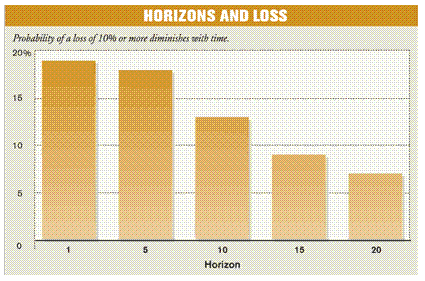
One needn’t look only at the historical results. In that article, I also presented an analysis by Mark Kritzman, the founder and CEO of Cambridge, MA-based Windham Capital Management. Kritzman calculated the probability of a 10% or greater loss for a portfolio, assuming an equity-like distribution based on 7.5% annual returns and a 20% standard deviation:

Loss probability drops off at 10 years and does so more appreciably beyond that. Bear in mind that 529 investors with a 10-year horizon shouldn’t maintain 100% equity allocations for the full 10 years. Investors should shift allocations to more conservative asset classes as the horizon approaches.
As I wrote in my earlier article, “Surz and Kritzman therefore agree that stocks become less risky as investors increase their time horizons, and a key transition is between 10 and 20 years, when the probability of inflation-adjusted loss approaches zero, at least based on historical data.”
A more dire view comes from Boston University professor Zvi Bodie, who has famously argued that the risk (which he defines as the “expected shortfall”) for equity investing increases continuously with one’s time horizon and, therefore, the appropriate investment for all time horizons are conservative vehicles such as TIPS. Bodie’s views have been recently challenged in a Journal of Investing article by Professors Keith Redhead and Karl Shutes of Coventry University entitled “Option Theory Does Not Refute Time Diversification,” in which they refute Bodie’s position and blame it on a flawed option-pricing model.
Municipal bonds and college savings
If you accept Surz’ and Kritzman’s views or even Bodie’s more conservative position, then 529 plans make little sense, since almost all rely on heavy allocations to equities.
A better alternative, which was originally suggested to me by Stan Richelson of the Pennsylvania-based Scarsdale Investment Group, is to employ zero-coupon tax-free municipal bonds, timed to mature when tuition payments come due. Specifically, one can buy highly-rated general-obligation bonds, issued by states, which have historically been very safe – Arkansas was the last state to default on such a bond, and that was in 1933, during the depths of the Great Depression.
According to Richelson, those munis now yield approximately 3.5%, although higher yields are available for Illinois (4.2%) and California (4.5%) bonds. Supply of zero-coupon bonds is limited, and if this strategy were widely adopted it is likely yields would go down further.
Municipal bonds are preferable to corporate (taxable) bonds since they are less risky. Unlike 529 plans, where you must pay a 10% penalty for early withdrawal, funds in municipal bonds can be accessed at any time.
Cash flow needs for a retirement-oriented investor are highly uncertain, both in terms of their timing and their amounts. Not so for tuition payments. When a child is born, the date – almost down to the hour and minute – when tuition will be due is known, and that is why zero-coupon bonds make sense.
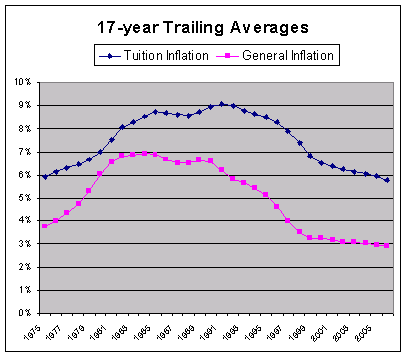
Thanks to the unpleasant, incessant escalation of tuitions relative to inflation, the exact amount of tuition payments is less certain. Tuition, for both private and public schools, has risen nearly twice as fast as overall inflation, according to the Bureau of Labor Statistics and the College Board:
The gap between six-or-more-percent tuition inflation and the 3.5% yield on muni bonds will need to be financed by additional savings by parents. The sad irony is that many will seek to bridge this gap instead by aggressive investing, and they will be the ones who are least able to sustain losses.
In defense of 529 plans
I also spoke with Joe Hurley, founder and CEO of Saving for College, a web site (now part of Bankrate, Inc.) dedicated to evaluating 529 plans and helping individuals save for college. Hurley, as well as AKF’s Feirstein, said the deciding factor in whether to use a 529 plan instead of muni bonds is performance. Those who need to make up for insufficient savings and can’t afford the safety of 3.5% yields will seek more aggressive alternatives.
Unfortunately, they will do so with incomplete and imperfect information. They may be misled by 529 plan performance reporting, or they be victimizing by unrealistic return projections. For example, Hurley’s web site provides a tuition calculator that defaults to 7% returns, and Putnam’s calculator assumes as a default 6% returns. Both far exceed equity returns over the last decade.
Some states offer pre-paid tuition plans for state colleges or state income tax deductions for plan contributions. Those benefits might be sufficient to justify 529 plans for some.
Feirstein provided some sound advice for would-be 529 investors who are not persuaded to buy muni bonds. Use low-cost, direct-sold plans, she said, such as those offered by the state of Utah (which happens to be one of her clients). These plans allow out-of-state assets, use primarily passive funds, do little marketing and, as a result, have expense ratios as low as 0.25%.
Asset allocation and glide paths are what matter to 529 investors, so saving the money on active management fees makes sense. Invest your time and energy toward ensuring that the glide path is optimal. That may not be easy since, for example, many funds have 20% to 40% bond allocations at the horizon date (the rest is in cash), but those bonds are in bond funds that may be risky because of their high durations and resulting exposure to interest rate risk. The alternative is to manage your own asset allocation, but you will be constrained by the fund choices available and by the limitation of one change to your plan assets per year.
Two considerations remain for 529 plans. According to Chris Petruzzi, a professor of accounting at California State University, Fullerton, some advisors mistakenly believe that 529 contributions are limited to $24,000 per year, since that is what (in some past years) a married couple could give to any individual without using some of the credit for the Unified Transfer (estate and gift) Tax. It has no logical link to 529 plans other than that, like any other completed gift, contributions to 529 plans are subject to the Unified Transfer Tax (UTT), according to Petruzzi. Even if the UTT remains in its current form for many years (highly unlikely) a higher present value is transferred for the same credit usage by giving larger amounts early. The maximum funding permitted for 529 plans is $250,000 per plan.
Second, Petruzzi said 529 plans represent what is effectively a loophole in the rules for completed gifts under the UTT. Gifts to 529 plans are considered completed gifts. They are out of the donor’s estate and, at least in some states, they are protected from the claims of creditors in the event of bankruptcy. The loophole is that the donor can change the name of the beneficiary of the 529 at any time for any reason and to any other person, including himself. That is inconsistent with the other rules for completed gifts, Petruzzi said. Hence, parents could make themselves beneficiaries of the 529 plans they created for their children. They could use the proceeds for educational purposes, perhaps to study SCUBA at a university in the Bahamas, without incurring additional tax liabilities. If the funds were used for non-educational purposes, income tax would be due on the gains (over and above the principal), as would a 10% penalty, but because the assets compounded in a tax-sheltered account, they would come out ahead.
College is terribly expensive, and saving for it is one of the most difficult undertakings parents face. It hasn’t necessarily been made easier by 529 plans. Don’t risk your child’s education and their future. Choose an appropriately conservative investment option, such as municipal bonds. Look for ways to make up for shortfalls, other than investing in aggressively in equities over relatively short time horizons.
Read more articles by Robert Huebscher