Luis Viceira
Interest rates, many claim, have bottomed, making bonds the latest asset class worthy of the dreaded “bubble” label. Others counter that deflationary forces will prevail and that bonds offer the best risk-adjusted returns in the market.
Which side of this debate you take matters profoundly, but making that call is not simply a matter of predicting the direction of interest rates, as is the typical focus of analysts. Bonds must be viewed in the context of their likely performance relative to equities under various economic and inflationary scenarios, and those projections should dictate fixed income allocations.
Luis Viceira, a professor of finance at the Harvard Business School, recently spoke about his research on this topic.
When determining fixed income allocations, investors should be most fearful of stagflation – the low economic growth and high inflation that plagued global economies in the 1970s, Viceira said. I will explain why that is the case, but first let’s look first at the evidence of a bubble and the fundamentals of bond valuation to understand the divide between bond bulls and bond bears.
Bubble trouble
Exhibit one in support of the bond bubble: The bellwether 10-year Treasury bond has declined roughly 144 basis points since the start of the year. Fortunate investors in that security have earned 10.5% year-to-date, slightly more than the 9.9% return enjoyed by holders of Vanguard’s intermediate-term bond fund.
As of Friday, the yield on 10-year had fallen to 2.41%, fueled by expectations of another round of quantitative easing by the Fed.
Indeed, the impotence of monetary and fiscal policy in the Fed’s fight to stimulate economic growth has many forecasting Japan-like stagnation and low yields. Gregory Jensen, co-CIO of world’s largest hedge fund, Bridgewater Associates, explains, “the history of deleveraging and deflation suggests that yields can and most likely will remain at low levels until the demand for credit in the aggregate revives.”
Compare that outlook to stocks, among which the 10 largest dividend-payers in the US now yield approximately 4%, or nearly two times the yield on the 10-year Treasury. Stocks must be undervalued, according to Jeremy Siegel and Jeremy Schwartz, who wrote in a recent Wall Street Journal op-ed that called today’s bond bubble the “flip side” of the Dot Com stock bubble. Equity investors, according to the pair, are now “far too pessimistic.”
Bonds have outperformed US stocks over the last 10-, five-, three- and one-year periods. Since interest rates peaked in the early 1980s, bonds have earned the distinction of being in the longest bull market of any asset class in US history.
This has been a global phenomenon, Viceira said. For example, yields on UK bonds have traced a nearly identical path to those in the US over the last 40 years.
Bubble advocates argue, however, that we are due for the inevitable reversion to the mean. The Fed model, they posit, says that yields on Treasury bonds and the S&P 500 should converge over time, and the current state of affairs means either bonds are overvalued or stocks are undervalued, or both.
The Fed model worked in the 1990s and in the Dot Com crash, but it has also failed over long periods of time. Its predictive value today, Viceira, depends largely on bond fundamentals. “If you are going to invest in the bond market,” he said, “you should have a view on the fundamentals to determine whether the price you are paying for bonds is fair.”
Bond fundamentals
Three fundamental factors determine a bond’s value – inflation expectations, real interest rates, and a risk premium – and Viceira examined each in the context of today’s markets.
Inflation is the arch-enemy of the nominal bond investor, but inflation over the next several years will have little impact on the value of the 10-year Treasury. That bond has a duration of 8.6, so roughly 80% of its present value comes from its principal and from its final coupon payment. Forecasting inflation that far into the future is problematic, and therein lies the risk in Treasury bonds today.
Using data from quarterly Philadelphia Fed surveys, Viceira showed that professional forecasters (mostly Wall Street economists) have been reasonably accurate in their inflation predictions. Moreover, the data show that interest rates have moved in response to changes in inflation forecasts.
When inflation was relatively high in the early 2000s, for example, they correctly expected it to come down, as did interest rates. They missed some big moves – like the oil-price-induced inflation of the 1970s – but, overall, their accuracy provides solid empirical support for the foundational view that interest rates reflect inflation expectations.
What are these same forecasters saying now? The latest surveys show very low inflation expectations, averaging approximately 2.3% over the next 10 years, and even lower rates over the shorter term. This data, Viceira said, also demonstrates that forecasters do not expect QE2 to induce higher inflation.
The other measure of inflation expectations is the break-even TIPS rate (the nominal 10-year Treasury rate minus the corresponding TIPS rate), which is now approximately 1.80%. Europe also has an active inflation swaps market, and it is forecasting inflation in the US of 1.52% over the next five years and 2.15% over the next 10 years.
The financial markets, therefore, agree with the forecasters.
Investors should not be merely compensated for inflation, and the second factor driving bond prices is real interest rates, which reward bond holders for the time value of their money and the underlying growth in the economy.
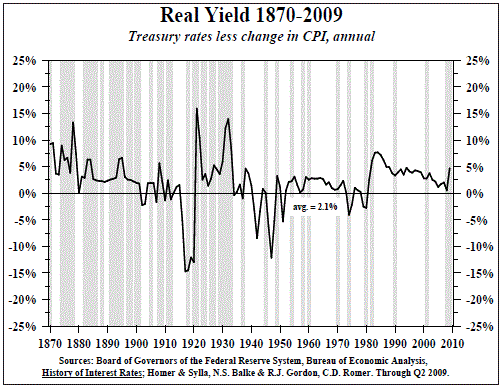
Real interest rates have historically been strongly mean-reverting, averaging approximately 2.1% over the last 140 years:
This chart was given to me by Lacy Hunt of Hoisington Asset Management, whose views on the forecast direction interest rates coincide with Viceira’s (you can read Hunt’s most recent commentary here). Today, according to Viceira, real interest rates are a mere 80 basis points for 10-year Treasurys and are -2.0% for short-term T-Bills. Real rates could rise and converge to their mean, but the data shows that that convergence can take a long time and, moreover, it is unlikely in current uncertain environment.
That’s because the key driver of real interest rates is expected economic growth, and Viceira discussed data from a recent IMF study that looked at recoveries (measured in output and credit growth) following recessions. The data show that recessions following a financial crisis have been characterized by slow growth. The US is clearly tracking this low growth path, not the robust recovery that followed such recessions as the severe one in the early 1980s.
Forecasters as a whole are getting more pessimistic about their economic growth outlooks, Viceira said, although there remains a lot of disagreement among their outlooks. Such high uncertainty serves to increase savings, which further depresses real interest rates. That uncertainty has been reflected in high volatility in the bond markets, which have had a standard deviation of 14 since 2005, nearly equal to the 18-20 values typical of the equity markets.
Given low inflation expectations and meager growth forecasts, Viceira said, “the bond market might not be that unfairly priced, given the fundamentals.”
The bond risk premium
One more factor in bond valuations remains, however, and that is the risk premium that investors demand for uncertainty in expected inflation and real interest rates.
The effect of the risk premium depends on the relationship between interest rates and economic growth and on an understanding of how stock and bond prices behave under a variety of inflationary and economic scenarios. Bonds can be safe or risky, depending on one’s outlook along those dimensions.
Historical data provides a lot of insight, and Viceira said the worst-case scenario for bonds would be a repeat of the 1970s stagflation – low growth combined with high and unexpected inflation. Back then, the Nouriel Roubini of the day was another Dr. Doom – Henry Kaufman – who preached of the dangers of bond investing.
Under those circumstances, both equities and bonds would perform poorly, and bonds would provide little diversification value.
Conversely, under any high-growth scenario, bonds are not risky because, even if inflation causes their value to decline, stocks will prosper and unemployment will fall, both positive developments for investors.
Markets now are expecting a “pro-cyclical” inflationary scenario – inflation will increase if and when growth accelerates, according to Viceira. Moreover, there is a risk of deflation, and all of this is good for bonds.
Even when growth takes off, it will be less painful for bond investors, Viceira said, because bonds will underperform but stocks will outperform and offer compensation. Bonds today should have a low risk premium, Viceira said, due to low growth and inflation expectations.
“If you don’t believe this and you expect 1970s stagflation,” Viceira said, “get out of bonds. But that is not how the market is priced right now.”
Read more articles by Robert Huebscher