Martin Fridson
High-yield bonds are attractively priced – or they aren’t – depending on how likely you think a double-dip recession is and how severe you think it might be. If you think there is a greater than 21% chance that a severe economic downturn is ahead, you should avoid junk bonds.
What drives the high-yield market was the subject of a talk to the Boston Security Analysts Society last week by Martin Fridson, a global credit strategizst with BNP Paribas Asset Management who is a highly regarded expert on distressed debt.
The much-maligned ratings agencies are not as untrustworthy as you think, Fridson said, and their corporate bond ratings provide a reliable measure of default risk.
I’ll discuss why Fridson thinks Moody’s and S&P deserve a second chance, but first let’s look at the fundamentals of the high-yield market.
Default rates drive returns
Low default rates have consistently translated to strong performance for high-yield bonds in recent years, Fridson sad. In 17 out of the last 23 years, default rates and returns (as measured by the Merrill Lynch high-yield index) have moved in the opposite direction. “If you get the default rate right,” he said, “you probably have a pretty good idea of what is going to happen with returns.”
Fridson cautioned, however, that default rates don’t tell the whole story. The overall direction of interest rates and spreads to the Treasury market also play a role, he added, particularly in the short term.
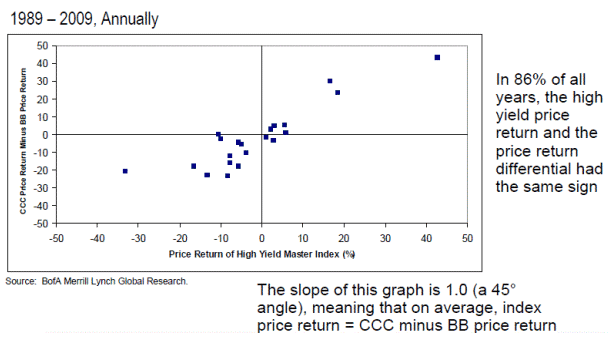
Once you make the decision to invest in the high-yield market, the critical choice is whether to invest in lower- or higher-quality bonds. Fridson showed that there is an extremely close correlation between the tiers in the high-yield market and overall returns, as the figure below illustrates:
The vertical axis is the return differential between CCC bonds (the lowest-quality high-yield bonds) and BB bonds (the highest-quality). The horizontal axis is the return on the overall high-yield market. In both cases, the returns exclude income and represent price appreciation only, which Fridson said provides a clearer measure of the performance differential. The slope of the line is almost exactly 1.0, suggesting that a percentage-point increase in performance in the overall market translates to a percent advantage in CCC bonds versus B bonds.
In other words, if you forecast strong performance for high-yield bonds, you should overweight lower-quality credit.
The same relationship has existed between the performance of B-rated bonds and the high-yield index, which Fridson said is not surprising, because the average quality of the index is B.
This year, however, BB-bonds had better returns than CCC-bonds. The sharp drop this year in interest rates benefited BB-rated bonds more than their CCC counterparts, since the BBs have a longer duration. Issuers with B ratings can borrow for longer terms and with lower coupons.
High-yield bonds have historically provided good diversification when combined with equities and investment-grade corporate bonds. Bonds, Fridson said, can be thought of as an interest-rate position and a put option on whether the issuer will default. Put options on investment-grade bonds are sufficiently out-of-the-money that those bonds are almost a pure play on interest rates. At the other extreme, a CCC-rated bond has a very high probability of default, and its put option plays a significant role in its valuation.
The fact that the implied put option in BB-rated bonds is far less meaningful than it is for CCC-rated bonds further explains the outperformance of BB-rated bonds in 2010.
Fridson also discussed how the spreads between high-yield and Treasury bonds stand relative to their historical means. Valuations for CCC-rated bonds are very rich, he said; their spreads are currently 0.4 standard deviations tighter than their historical mean. The rest of the high-yield market, Fridson said, has spreads that are wider than their average
Those spreads have been consistent for the last few years, and Fridson offered an interesting explanation for that phenomenon. Hedge funds became significant players in the high-yield market starting in 2000, Fridson said. Those funds, particularly those that are levered, invested heavily in poor-credit bonds because of the CCCs’ 20% performance incentive fee structure and lack of clawback provisions. That hedge fund investment has kept spreads tight on CCC-rated bonds.
Fridson said he expected those spreads to widen when the financial crisis hit in 2008, but CCC-rated bonds have continued to trade at rich levels compared to other rated bonds.
Where are default rates going from here?
Fridson looked at several ways of forecasting future default rates. Moody’s has a good model, he said, and for the next 12 months it is predicting a default rate of 2.2% for the US market, based on the universe of issuers in its speculative-grade category.
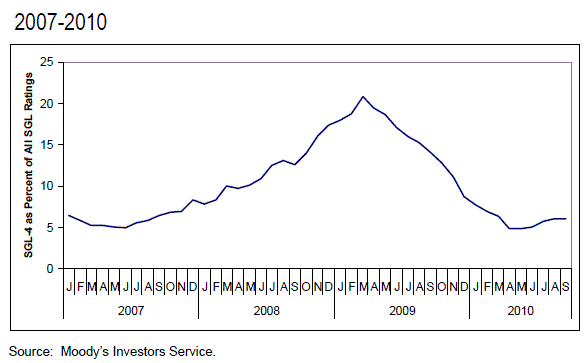
Another way to forecast defaults is through Moody’s speculative grade liquidity (SGL) ratings, which consider various measurements of liquidity in corporate balance sheets. Fridson provided the following data:
This figure shows the percentage of issuers in SGL category 4, which are most illiquid companies. Fridson said that the upturn in this graph indicates that default rates “could be bottoming.”
One can also find out what the market is saying about forecasted default rates by looking at spreads among high-yield bonds. Corporate bonds historically have been divided between those with spreads of 1,000 basis points over Treasury bonds and those with less. (Fridson actually first introduced this delineation in 1991.)
The median probability of default in one year for bonds trading 1,000 basis points over Treasury bonds is 23.53%, versus 1.23% for bonds with narrower spreads. Fridson said you can infer the market’s expectation of default rates from the percentage of issues in each of those two categories. Today, the market’s forecast default rate is 2.97%, slightly higher than what Moody’s expects.
The fact that Moody’s assumes a base scenario that incorporates an economic recovery explains that divergence, Fridson said. Market expectations, on the other hand, reflect a range of possible scenarios, varying from a strong recovery to a double-dip recession.
Fridson has designed a way to infer the probability the market is assigning to a double-dip recession. The historical average spread on high-yield bonds is 487 basis points, but during the average recession spreads widen to 1,083 basis points. Today, that spread is 611 basis points, which, Fridson showed through simple algebra, means the market is assigning a 21% probability to further recession.
If your base case does reflects less than a 21% probability of a double-dip recession, Fridson said, you will be “well compensated” in high-yield bonds. If you see a significant probability of such a scenario, however, Fridson said, “you should be hedged or more conservative.”
Redemption for the ratings agencies
Fridson also shared some of his recent research on the ratings agencies, arguing that they do not deserve much of the criticism that has been leveled at them, at least when it comes to corporate bonds.
Criticism of the rating agencies has focused on the structured finance market. Fridson acknowledged that 89% of structured finance bonds that were rated investment grade were subsequently downgraded to speculative grade, a seemingly prima facie statement of ineptitude on the part of the rating agencies. But Fridson drew a distinction between ratings of structured finance, which proved problematic, and corporate ratings, which Fridson said have been consistently reliable.
The common refrain is that the issuer-pay model is at fault. Fridson said that Senator Al Franken (D-MN) has likened this model to a student who offers to pay the teacher $100 in return for a higher grade on an exam. That analogy, Fridson said, is faulty, because there are many private schools where parents pay to send their children, yet those schools do not hand out grades of A to all students.
Something else is at play, and Fridson noted a key difference between structured finance ratings and those of corporations. In structured finance there is no company, just a deal to be rated. If the senior tranche in that deal is not rated AAA, then there is no deal and no revenue to the ratings agency.
By contrast, companies must be rated and monitored on an ongoing basis in order to ensure their access to the capital markets.
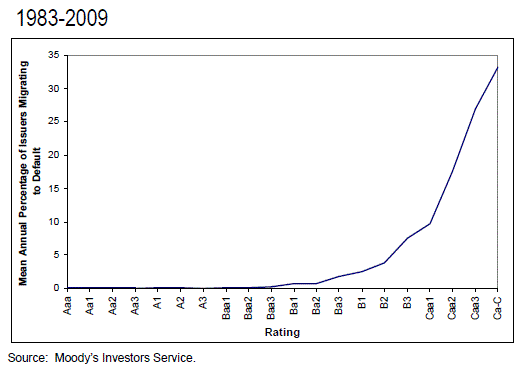
In the aggregate, Fridson said that corporate bond ratings have been consistently good indicators of default probability, and he provided the following data:
These data show that as the rating of the bond decreases, its probability of default increases monotonically.
Fridson also countered claims that the ratings agencies were “asleep at the switch,” failing to adjust ratings in a timely manner as the probability of default increased. He provided data that showed that ratings downgrades for US public finance and financial securities in “stress years” (1991, 2001 and 2008) were reasonable in comparison to those of structured finance securities in those years.
The “poster boy” for the ineffectiveness of the ratings agencies has been Enron, which was rated investment grade a week before massive fraud was discovered and it went bankrupt.
Fridson cited evidence that even in this case the agencies behaved reasonably.
Just prior to its bankruptcy, Enron was rated at bottom of the investment-grade category and was on a ratings watch list, a fact that Fridson said is rarely mentioned. It did not get a speculative-grade rating, according to Fridson, because Dynegy had an offer to acquire it. If Enron had been downgraded and that deal went through, Enron’s sellers “would have been furious,” Fridson said. The ratings agencies were in a no-win situation, and Fridson said they clearly signaled Enron would go to speculative grade if there was no deal.
Two weeks prior to the would-be acquisition, the chairman of Dynegy said he had looked at the “core” of Enron and that that it was “working well.” How could the ratings agencies be expected to detect Enron’s fraud, Fridson asked, if those with better inside information could not see it?
Some have claimed that others, such as short-seller Jim Chanos, foresaw Enron’s failure. According to Fridson, however, Chanos said he thought it was a short but did not see either the fraud or the impending bankruptcy. Likewise, there are stories of a student group at Cornell that supposedly foresaw the failure, but Fridson said that this group made a buy recommendation after its sell recommendation and never indicated it expected the bankruptcy.
Egan Jones, a rating agency which does not use the issuer-pays model, also supposedly outguessed Moody’s and S&P in the case of Enron. That said, they lowered their rating to BB+ 37 days before Enron’s failure, Fridson said, which implied a mere 1% probability of default in the next year.
“I have not found anyone who anticipated the fraud,” Fridson said.
Read more articles by Robert Huebscher