Alternative investments, broadly speaking, and hedge funds, more specifically, have performed as intended over the last 20 years, modestly increasing returns and significantly reducing risk when added to a traditional stock-bond portfolio. Selecting the appropriate vehicle is the challenge, and that task has been made easier by the introduction of new exchange-traded strategies.
Those conclusions, which are not going to silence any ardent hedge fund critics, were offered by Scott Welch, the senior managing director of investment research and strategy at Fortigent, LLC, a Maryland-based investment research and technology provider. Welch spoke last week at a lunch sponsored by the Boston Security Analysts Society.
Fortigent serves financial advisors who typically manage assets for clients with $5 to $25 million in wealth. It uses endowment-style model portfolios with extensive allocations to alternatives.
The rise, fall, and rise of hedge funds
Hedge fund adoption by financial advisors has gone through several distinct phases, according to Welch. Their use in high-net worth portfolios began in earnest in the mid-1990s, mostly beginning with the use of absolute-return and long-short strategies. The former were used to complement and diversify fixed-income allocations, and the latter performed the same task for equity allocations.
Popularity increased as a consequence of the tech bubble collapse, when those funds delivered their promised results – avoiding the significant losses suffered in the public equity markets.
That experience led advisors to allocate more proactively to hedge funds, Welch said, instead of using them merely as a substitute for portions of their equity and fixed-income allocations. Advisors embracing alternatives as part of their investment strategy began to design their asset allocations to include specific targets for various alternative strategies, and some included merger arbitrage, global macro, and other funds in addition to absolute return and long-short equity.
The financial crisis brought a sobering end to the expansion of hedge fund adoption, as their promised results failed to materialize in the 2008 market collapse. Welch attributed these disappointing results to excess leverage, which caused funds to outperform in the bull market but amplified losses in 2008.
In addition, he said, the primary selling point of absolute-return funds – to deliver equity-like returns with bond-like volatility – violated a “law of nature.” Those twin promises were fundamentally incompatible and ultimately impossible, and the financial crisis revealed the fallacy.
Absolute-return funds faced extensive redemptions, revealing another flaw in their implementation. Advisors found that funds-of-funds did not have the same liquidity provisions as their constituent funds. Funds-of-funds had offered more flexible redemption privileges than their underlying funds offered and, when redemption notices arrived, they were forced to put up “gates” to conserve cash and to reallocate investments to underlying funds that were more liquid. Welch noted that liquidity issues were mostly limited to absolute-return funds and did not affect either long-short or commodity-trading advisors (CTAs).
The result was poor performance for absolute-return funds. Their popularity was further tainted by the Madoff scandal – even though Madoff did not operate a hedge fund.
Net outflows from hedge funds began in 2008 and continued until about three months ago, Welch said. The use of leverage has “dropped significantly” and many funds – which he called the “pretenders” because of their over-reliance on leverage – have gone away. Talented hedge fund managers, Welch said, were “humbled” and have renegotiated fees and increased transparency.
They are now launching mutual funds, which, Welch said, has sparked renewed interest in alternative strategies, countering the aversion many advisors and investors have to the limited partnership structure.
I’ll return to the rise of these new exchange-traded vehicles, but first let’s look at the track record of common hedge fund strategies over the long term.
The long-term record for hedge funds
Welch provided data showing the 20-year performance record for several classes of hedge funds.
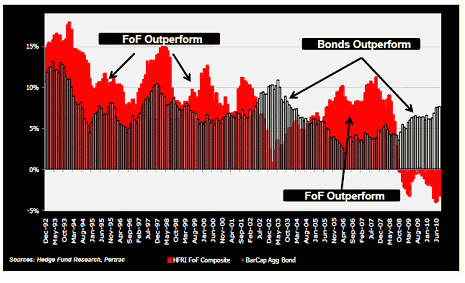
Below is a comparison of rolling three-year performance for the HFRI funds-of-funds index (which Welch said is an accurate proxy for absolute-return strategies in general) and bonds, represented by the Lehman/Barclays aggregate bond index:

The red-shaded areas indicate outperformance by funds-of-funds relative to bonds, and the grey areas indicate the reverse. Over the 20 years ending in 2010, these data show that absolute-return outperformed in regimes of rising rates, Welch said, and provided the desired diversification to the equity component of a portfolio and the right complement to the bond portion.
This bodes well for the future, Welch said, since “rates have nowhere to go but up.”
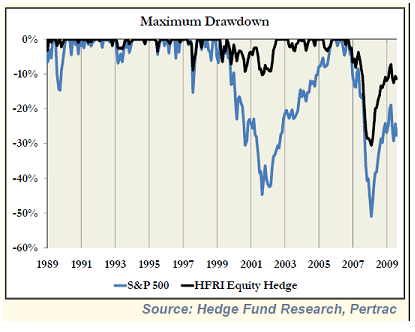
Long-short funds have provided similar protection for the equity portion of a portfolio. The data below show the maximum drawdowns for the HFRI equity hedge index (in black) and the S&P 500 (in blue) over the last 20 years:
Long-short strategies have “cut off the bottom” in down markets. They have also underperformed in up markets, Welch said, but the gains have offset the losses “by a long shot.” Similar results have been the case for non-US markets.
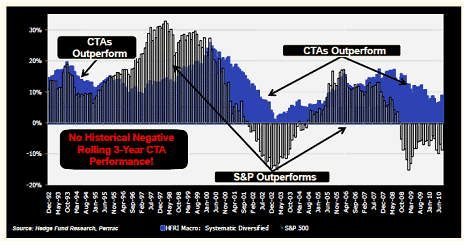
Welch also noted the remarkable track record of CTA funds (also known as managed futures), providing the data below for the HFRI macro systematic diversified index (in blue) and the S&P 500 (in grey):
Although CTAs have not consistently outperformed equities, the remarkable aspect of their performance is the absence of negative returns for any rolling three-year period in the last 18 years.
The future of hedge fund strategies
Is it time for all advisors to embrace alternative strategies? Not so fast, Welch said. Since the financial crisis, the requirements for due diligence on hedge funds are much higher and a lot more expensive, partly due to the Madoff scandal, which made the understanding of the operational and back-office mechanics of a fund extremely important. In fact, Welch said, researching and monitoring hedge fund operations is now a growth industry of its own.
Analyzing hedge funds is more difficult because the weaknesses revealed during the crisis (e.g., reliance on leverage) can be hard to identify and assess. Indeed, Welch wanted to rename absolute-return strategies “levered credit” strategies for internal purposes, but he decided against this – when persuaded by his team that nobody would invest in a strategy with that name.
For advisors willing to wade into alternatives, Welch advocated a core-satellite approach. The core should consist of “cheap and liquid” products, he said, such as long-short, managed futures and hedge-fund replication mutual funds. These mutual funds are likely to underperform their limited partnership brethren, because they will use little, if any, leverage.
The selection among these mutual fund products is sparse, and many have limited track records, he warned. That said, according to Welch they represent the next generation of hedge fund strategies, and they offer the promise of bringing the benefits evident in the 20-year track record to a vehicle that has complete liquidity, near-complete transparency, and the absence of onerous minimum investment requirements. For now, though, the limited track record of these vehicles makes the assessment of their long-term viability problematic.
The satellites can be individual strategies selected based on their perceived ability to produce alpha, according to Welch. These can be funds-of-funds or they can be individual funds – assuming, he said, that you have a better-than-average ability to pick active managers that will deliver alpha.
Hedge fund critics can respond to many of Welch’s claims. They will note, as Welch acknowledged, that reported hedge fund data is notoriously unreliable. It is riddled with survivorship bias (funds stop reporting when their performance deteriorates) and backfill bias (new funds don’t report until their performance reaches an acceptable threshold).
Perhaps more importantly, a primary vehicle for advisors – funds-of-funds – does not completely align the interests of underlying funds with investors. A fund with a mandate to provide superior long-term performance should – and will – put up barriers to prevent individual investors, who typically cannot endure short-term volatility, from redeeming their investments. This discourages the best hedge fund managers from participating in funds-of-funds.
Undoubtedly, the hedge fund universe has attracted the most talented managers. Compensation is much higher at hedge funds than in the mutual fund industry, and managers do not have to deal with the pressures of daily redemptions. Whether that translates to superior performance for advisors and their clients, net of fees, will depend on a number of factors – which must be uncovered through the due diligence process that firms like Fortigent undertake.
Skeptics will claim that it is no easier to identify an outperforming hedge fund manager than it is to identify an outperforming mutual fund manager – and the latter is notoriously difficult. But the benefits evident in the 20-year track record make it difficult to dismiss alternatives as a valuable addition to any portfolio.
Read more articles by Robert Huebscher