An Uncertain Future for Housing Prices
Membership required
Membership is now required to use this feature. To learn more:
View Membership Benefits
Laurie Goodman
Few metrics mirror the rise and decline of the national economy over the last decade as closely as the Case-Shiller Housing index: steady growth peaking in early 2007, a precipitous decline over the ensuing two years, and a feeble recovery since.
It should come as little surprise, then, that renewed decline in housing prices would surely impede economic growth.

Karl Case
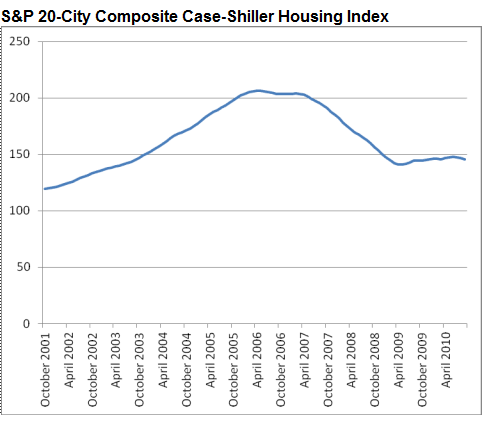
Source: standardandpoors.com
Case said housing prices will remain unchanged for the next year and a half and that there is little chance of a steep increase or decrease, because the large number of sellers and buyers waiting on the sidelines would mitigate a large move in either direction.
Goodman, however, was decidedly more pessimistic, predicting a 5% to 10% further decline in home prices. “I actually see a huge problem,” she said, as excess supply and weak demand will combine to drive down prices.
I’ll first review Goodman’s analysis of supply and demand in the housing market, then return to consider why Case does not think things will be as bad as Goodman predicts.
Five million more foreclosures?
Goodman focused on the dynamics of distressed and foreclosed properties. Approximately 5.2 million loans are non-performing, out of a universe of 55.5 million agency and private-label loans, she said. A loan is typically considered non-performing if payments are overdue by more than 60 days.
To determine the probability that one of those loans will eventually liquidate, she looked at all loans that were non-performing 24 months ago. She noted that 15% of those were modified though a mortgage-assistance program. Nonetheless, only 8.4% of all private label non-performing loans had a “favorable outcome” 24 months hence, and only 6.7% of prime loans in distress had a favorable outcome. She defined a favorable outcome as a loan that either is current on payments or was repaid.
It usually takes another two years for a non-performing loan to be liquidated, and Goodman said that time line has been stretched out very dramatically over the last four years. Timing also varies considerably by state, depending primarily on whether a foreclosure must go through a judicial procedure in the courts. In California, a non-judicial state, the time to foreclosure has increased from seven to 21 months over the last four-plus years. In Florida, a judicial state, it is now approximately 27 months.
That doesn’t tell the whole story, though, since loans are taking longer to liquidate. For example, there is now a 3% chance that a loan 24 months delinquent will have already been liquidated; in 2008, that probability was 10%.
Nonetheless, she said there are 5.2 million loans in the non-performing category. “We estimate that 95% of these will eventually liquidate,” she said.
Even that figure understates the severity of the problem, though, according to Goodman. Many more loans that are currently performing have loan-to-value ratios greater than 100%. In other words, they are underwater. For example, slightly more than 1.3 million loans are currently performing despite having loan-to-value ratios greater than 120%. Among prime loans, 15% of those will default, as will a higher percentage of private-label loans.
All told, Goodman said, 11.6 million units are in jeopardy – one borrower among every five.
“If the default rate and voluntary repayment rate remain unchanged, you would have huge, huge unrealistically high numbers of defaults,” Goodman said. At the end of the day, you can't foreclose on that many borrowers, she said. “What this means is that there could be governmental program after governmental program after governmental program until something succeeds.”
Indeed, there has been a lot of emphasis on loan modification programs, such as the Home Affordable Modification Program (HAMP), to help the supply side and keep homes off the market. Though large numbers of homeowners benefit from this program, a majority of them re-defaults very quickly, she said.
That program focused on reducing payments, and Goodman said the government must go a step further and reduce principal for future programs to be successful. To date, principal reductions have represented less than 10% of all modifications, but they have been measurably more effective in reducing defaults.
“Eventually we are going to have to make principal reduction mandatory,” Goodman said. This will not be easy, since it will create a moral hazard – underwater borrowers will default in order to have their principal reduced. Goodman said the hazard could be alleviated by, for example, taxing the housing benefit the borrower receives if they benefit from such a program.
Is more optimism justified?
On November 30, two days prior to the panel discussion, S&P announced that the Case-Shiller national home price index had fallen 2% in the third quarter after having risen 4.7% in the second quarter. Case added that the volume of home sales has dropped off significantly, from 6.4 million a year ago to approximately 4 million now.
Those declines roughly coincide with the expiration of the first-time home buyers’ tax credit at the end of April, since the Case-Shiller index reports data with a three-month lag.
Case said that home “production” (new construction) is down a lot. According to Case, we typically produce 2.3 million units per year at the peak of a housing cycle, but now it is approximately a half-million units annually, the lowest rate in the last 50 years.
He also cited a number of factors inhibiting housing demand – less immigration and more people “doubling up” (e.g., moving in with their parents), for example – although the extent of those effects can’t be quantified until the census results are released.
Case fears that census data might reveal that there are five million fewer people than were otherwise thought; such a reduction would imply further downward pressure on housing demand.
“The vacancy rate is a terribly hard thing to figure out,” Case said, but he added that it is a “big number” and is not coming down. Considering the low number of housing starts, Case’s conclusion is that there must be fewer households being formed.
Both speakers agreed that affordability is the primary positive factor in the market today, thanks to low interest rates and lower home prices. “You can buy a property now for about half of what you paid for it on monthly terms three years ago,” he said.
Ultimately, Case said consumer confidence has to turn before housing prices pick up. “You've got a whole lot of people – potential buyers, potential sellers – sitting there, staring at each other across the bid-ask spread, trying to figure out who's going to make the first move.”
But, he added, even he has no magic insight into what will happen with the housing market. “It is an uncertain future,” Case said. “Everybody hates uncertainty, but that is where we are.”
Housing, unemployment and the broader economy
Both speakers addressed the close interplay between housing and the broader economy.
Even the economy growing at a modest 2.5%, the unemployment rate coming down, and the stock market continuing to rally, Case said, might not motivate enough people to drive housing prices up.
Goodman has studied the relationship between unemployment and default rates, and she found that when unemployment is high, borrowers who have equity in their home typically do not default. Conversely, when the loan-to-value ratio is over 120%, then unemployment will trigger higher defaults. And, in that case, job loss is not the only trigger – a cutback in hours, a divorce, or another strategic change in one’s life can lead to default.
Overall, Goodman said homeowner’s equity is the single most important determinant of whether or not a borrower will default.
Even if unemployment decreases, aggressive government stimulus measures will still be necessary to stave off crisis in the housing market, according to Goodman. She said that a measure similar to the Public-Private Investment Program (PPIP) would be needed. The government would provide leverage for investors to buy homes and rent them out, she said, possibly targeting specific distressed areas.
Given the gridlock in Washington and the lack of support among both parties for major spending, an effort along the lines Goodman envisions may gain momentum only if the housing crisis deepens. Unfortunately, if you believe Goodman, that deeper crisis may soon be upon us.
Membership required
Membership is now required to use this feature. To learn more:
View Membership BenefitsSponsored Content
Upcoming Virtual Events View All