Advisor Perspectives welcomes guest contributions. The views presented here do not necessarily represent those of Advisor Perspectives.

This essay is excerpted from the most recent version of the HCM Market Letter. To subscribe directly to this publication, please go here.
“[T]he signal crisis – that is, the switch from trade and production to financial intermediation and speculation – is a sign that the possibility of continuing to profit from the reinvestment of capital in the material expansion of the world economy has reached its limits. Although financialization enables its promoters and organizers to prolong their leadership in the world economy, historically it has always been the prelude to the terminal crisis of the dominant regime of accumulation, that is, to its collapse and supersession by a new regime.”
Giovanni Arrighi (2009)
2010 – A year of policy failures
As we approach the end of 2010, the global economy remains captive to a boom-and-bust cycle resulting from years of pro-cyclical monetary, fiscal and regulatory policies. With very limited exceptions, the same policies that contributed to the 2008 financial crisis remain in place. The only difference is that government balance sheets are far more leveraged than they were heading into that crisis. Alternatively, corporate balance sheets are in better shape, while banks in the United States and Europe continue to harbor a great deal of bad debt on their books that has yet to be dealt with.
While there is a lot of talk in Washington about renewing efforts to impose budget discipline, it is going to take radical action to change the self-destructive economic course on which this country is bound. President Obama’s debt reduction commission has brought forth some promising suggestions for reform that can be considered radical within the confines of contemporary American politics. In particular, eliminating the home mortgage deduction and altering the tax code to eliminate deductions and significantly lower rates are important proposals. Other proposals, however, were disappointing. In particular, delaying an increase in the retirement age for Social Security eligibility to 2050 and beyond is laughably lax in view of changes in life expectancy and the crying need to limit entitlements. The failure to gain approval of the commission’s proposals suggests that the group’s work will likely end up as little more than an interesting intellectual exercise rather than a project that will bear fruit.
Congress – lame duck as it is, but certainly not lame enough – is still playing games with the extension of the Bush tax cuts. The latest iteration of a possible deal seems to be an extension of all of the tax cuts in exchange for extended unemployment benefits for the long-term unemployed. Both sides of this deal are budget busters and poor public policy, regardless of how the unemployment crisis pulls on our heartstrings. It is questionable whether extending unemployment benefits into what is approaching a permanent entitlement serves any segment of society, particularly the unemployed. With respect to taxes, HCM remains of the view that it is a political and moral error to extend the tax cuts for the highest paid Americans. And by highest paid, we do not mean those with annual earnings of $250,000, but those with annual earnings of $1,000,000. Not only is it patent nonsense that raising taxes on million dollar earners will temper their spending or their appetite for risk, but it feeds the growing disillusion with the entire political and economic system. Had the government not bailed out the big banks and then allowed them to return to their asymmetric compensation practices so quickly, perhaps this approach to taxes would be palatable. But the failure to impose slightly higher taxes on the wealthiest Americans at the same time that the Federal Reserve revealed (against its wishes) the billions of dollars it loaned to Goldman Sachs, Morgan Stanley and foreign banks during the financial crisis only rubs the electorates’ faces in the unfairness of the system. The argument that “things would have been worse” In view of the free passes handed out to those who were principally responsible for the credit crisis, the refusal to ask these individuals to pay slightly higher taxes on a portion of their income (pending proposals only apply higher rates to levels of income above the threshold income level) is unconscionable.
HCM would also remind readers that this nation is at war, and as the Washington Post’s Matt Miller recently pointed out in an interview with Larry Kudlow on CNBC, this may be the first time in American history that the richest Americans have not been asked to contribute additional revenue to support the federal budget. Of course, most wealthy Americans probably don’t even realize that we are at war because the war has virtually no effect on their lives. It is not the sons and daughters of the elite that are risking life and limb on the battlefields of Iraq and Afghanistan; it is the children of the disenfranchised. Add to this the refusal of Congress to eliminate the moral scourge of the carried interest tax for private equity – and the silence of the Obama administration on this issue – and it is clear that this country doesn’t need to travel halfway around the world to uncover its worst enemies.
It too often seems that monetary, fiscal and regulatory policy is judged by how the financial markets perform. Perhaps this error is attributable to a continuing belief in efficient markets, or perhaps it is due to the mindless short-term focus on money. HCM would not look to the markets to evaluate the efficacy of policy. Markets are short-sighted animals. The fact that the markets are stabilizing is far from an endorsement that monetary and fiscal policy are on the right course. These policies are decidedly wrongheaded and are trapping the economy in a boom and bust cycle that is unnecessarily disruptive and destructive of economic value. In terms of policy, 2010 was an extremely disappointing year that pushed the United States further to a bad economic ending. Despite all the noise over the last week about an improving economy and rising markets, 2011 will likely prove no better in dealing with the problems that still loom over the American landscape.
The U.S. economy
While recent economic data in the United States suggests that the economic recovery is gaining some momentum, it remains to be seen whether this momentum can be maintained once the stimulus provided by state and local government spending starts being withdrawn in early 2011. Furthermore, if Congress begins to cut spending, that will further limit GDP growth (a $100 billion cut in spending is equivalent to 0.7 percent of GDP). Those arguing that the recovery is becoming self-sustaining may be jumping the gun since it is uncertain whether demand will continue to grow in the absence of government stimulus. At the very least, the rate of growth – self-sustaining or not – is unlikely to exceed the bare minimum of 3 percent that is required to give this country a chance of growing employment and absorbing some of its massive overcapacity. For the first time since the beginning of this recession, the economic data is beginning to offer some hope that the hand-off from government stimulus to private sector growth may be taking hold. Let’s hope that this is not a case of government stimulus finally starting to gain traction at the moment when it will start to be withdrawn.
Those looking for a significant improvement in the employment situation, however, are going to require patience. Job growth is far short of the number required to reduce the unemployment rate to a politically palatable level. Nonetheless, every job that is added is a welcome human story and we should value it as we enter the season of giving. Despite a promising ADP number on Thursday, December 2, the government’s November payroll report released on Friday, December 3 was again extremely disappointing. Non-farm payrolls were up a negligible 39,000 versus expectations of 150,000 and actual gains of 172,000 in October. Revisions to September and October were a paltry 38,000. Private sector payrolls increased by only 50,000 in November versus expectations of 160,000 and actual gains of 160,000 in October. This was the smallest gain since January 2010 and less than half the year-to-date average of 110,000. While other parts of the economy seem to be improving, labor is not yet participating to the extent one would hope. Those of us who opposed QE2 in part because we did not think it would help the employment situation take little pleasure in being proved correct so far on this point.
Other indicia of economic health are beginning to show some color in their cheeks, although as usual the media and the markets are likely overreacting. The U.S. manufacturing sector has enjoyed 16 consecutive months of growth (from seriously depressed levels), which is certainly a promising sign. Automobile sales have been improving not only for General Motors and Ford but for the imports (with the exception of Toyota), although this does not change our opinion that GM stock is overvalued and that the company should not have been brought public with a qualified accounting opinion. We would also note that November’s annualized unit sales of 12 million units is nothing to write home about. This is a level that barely meets replacement demand and is only back to the levels of the early 1980s. The ISM manufacturing index dropped slightly in November to 56.9 from its October level of 56.6, with 10 of its 18 sectors improving. The survey tells a tale of two economies. Those industries tied to the housing market are still lagging, while those tied to manufacturing are improving.
1 David Rosenberg notes that the number of sectors improving - down from 14 in October - was the lowest number of industries showing growth in four months. Finally, the most recent Federal Reserve survey of regional economies showed more widespread strength across the country than we have seen since the start of the recession. Twelve of the bank’s fourteen districts reported anecdotal evidence of improving economic conditions heading into 2011, a far better footing than the one on which they entered 2010.
1. The “glass is half empty” crowd, of which HCM is a charter member, would note that the ISM report showed a drop in orders and increase in inventories that is troubling. As David Rosenberg noted, echoing the LEX column in the December 2, 2010 Financial Times, when ISM orders drop below the inventory sub-index, it usually foreshadows a coming recession. HCM would expect the next recession to be preceded by a credit crisis, not by the continuation of a below par recovery.
The dominoes fall in Europe
James Joyce must be rolling over in his grave. Of course, his grave is located in Zurich, not in Dublin, so the novelist who was able to see the future in so many ways was also able to anticipate where all the money in the world would end up as well – and that place certainly isn’t Ireland. Had he been born a century later, no doubt he would have ended spent his exile in Asia, which is rendering Europe yesterday’s economic news with increasing rapidity every passing day.
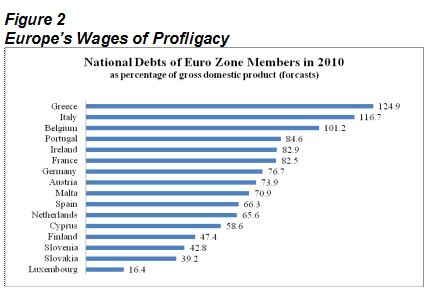
The Irish bailout is a clear warning sign to the world that the European debt crisis is still in its early innings. The current crisis in Europe is a banking crisis masquerading as a sovereign debt crisis. The authorities are bailing out themselves and their friends at the expense of the disenfranchised (we would say the “taxpayers” but many Europeans have a different attitude about paying their taxes than Americans apparently). If that sounds suspiciously similar to what occurred in the United States during the financial crisis, that is because it is. The Irish bailout – and those to follow in Portugal and likely Spain, Italy and Belgium - is a scheme to bail out those European banks that made imprudent, mostly real estate-related loans during the credit bubble.
Promises from the European Central Bank, IMF and Federal Reserve (which seems to love to spend American taxpayers’ money bailing out non-U.S. financial interests because “things will get worse if they don’t”) that they would do everything in their power to prevent the European sovereign debt crisis from growing were bought hook, line and sinker by the financial markets. This is another example of markets’ short memories and obsessive focus on the short-term. We have all seen this movie before, and it has an unhappy ending. The monetary authorities – who happen to be largely responsible for this mess – can temporarily stem the contagion, but ultimately the markets will determine how far this crisis will spread. While it is true that the monetary and fiscal authorities were able to derail a global depression in 2008, one has to question whether there are sufficient tools left in their tool box to prevent defaults from spreading from Greece and Ireland to Portugal, Spain, Belgium and Italy (the most vulnerable countries in order of vulnerability). The primary monetary policy tool remaining is quantitative easing, something that the European Central Bank is rightfully reluctant to use (the German influence appears to be strong). As argued in this publication last month (“Keynesian Confusion”), quantitative easing is unlikely to work in economies that suffer from high levels of structural unemployment and are governed by flawed fiscal policies that favor speculation over productive investment.
In a world where political leaders and their business amanuenses choose to kick problems down the road rather than solve them, the return of the European debt crisis is an object lesson in the adage that “you can run but you can’t hide.” The crisis also renders a mockery of some of the so-called pre-emptive steps that were taken to prevent further problems in the banks. For instance, it is clear (as many of us warned at the time) that the so-called “stress tests” that were performed on the European banks were a bad joke. The regulators who gave passing grades to those banks make the jokers who missed the Madoff fraud look like geniuses.
On another front, non-European markets are largely pretending that the problem is confined to Europe, but that is delusional in today’s interconnected global economy. The exposure of European banks to Greece and Ireland is serious enough, but add to that their exposure to Portugal and Spain and the problem begins to have serious systemic repercussions. A Portuguese restructuring is virtually a foregone conclusion, and Spain is not far behind. Spain’s economic officials have been issuing strong statements that the country will not default. But those assertions are the equivalent of the votes of confidence given to NFL coaches by team owners in the days before their dismissal. Spain protests too much, and the country’s fate no longer lies within its own control.
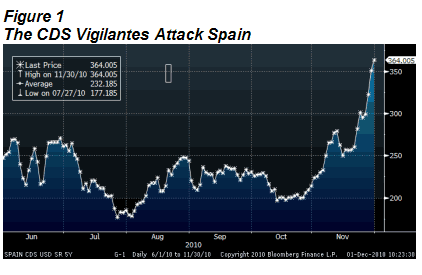
The CDS vigilantes are busy running up the cost of Spain’s debt, and with the country facing significant refinancing needs in early 2011, it will take more than bold statements to avoid a default. The cost to insure Spanish debt rose by more than 140 basis points during the month of November to 385 basis points by November 30. 2 These levels dropped sharply in early December after the European monetary authorities talked it down, but Spain’s financing costs remain too high for the country to avoid a restructuring. . Spreads on Spanish bonds widened by more than 100 basis points during November (to 166 basis points from 63 basis points at the end of October.) The pain has spread to Spain’s banks as well, which are now paying higher borrowing costs than the banks of other countries. There is little Spain can do to break the momentum of widening spreads given today’s market realities. The market will decide Spain’s fate, and the markets are driven by two things: psychology and speculation, and their appraisal of economic conditions. Spain is currently vulnerable on both counts.
Spain had a relatively successful bond auction on December 2 and has another on December 16. The country then has to refinance €85 billion in debt in 2011. Spain’s banks have about one-third of their own medium and long-term debt maturing by 2012, according to the Bank of Spain’s October financial stability report (it is considered a good thing that a majority of their debt matures after 2013). It is fair to say that right now that debt would be very expensive to refinance, but 2012 is forever in today’s panicking markets.
Investors should not be looking at each country within Europe as a separate credit event. Such an approach is best considered an example of magical thinking. The economies in Europe are linked, not only with each other, but with the other regions of the world. While the degree of linkage differs among regions, the impact of sovereign defaults and bank failures can no longer be confined within individual borders. Europe and the rest of the world need to take their medicine now, while the medicine still has time to heal the disease. Pain deferred can only lead to greater pain in future days.
Unfortunately, Europe’s leaders continue to shy away from adopting the necessary measures to break the cycle of moral hazard that led to the current crisis. Germany has been pushing for bondholders to share the pain with taxpayers, but much of the rest of Europe is resisting the imposition of this type of necessary discipline. Originally, Germany demanded that a system be put in place by 2013 that would require bondholders to take losses if fiscally troubled countries were forced to restructure. While the outlines of such a regime are being discussed, it seems like pulling teeth to try to force anybody to take responsibility for their bad investment decisions. As we have noted in this publication many times, Karl Marx famously wrote that history tends to repeat itself: the first time as tragedy, the second as farce. If the burden repeatedly being heaped on the backs of taxpayers is a tragedy, the bailout of private investors through the course of bailouts both in the United States and Europe can only charitably be termed a farce. A hard-hearted assessment would properly term it theft of taxpayer dollars to bail out special interests. The perpetuation of the moral hazard regime that has presided over the debauching of fiat currencies and the destruction of sovereign finances on both sides of the Atlantic is only lent further legitimacy by the plan to spare the senior bondholders of Ireland’s banks any losses for their bad judgment.
2. This means that the cost of insuring $10 million of Spanish government debt increased from $140,000 at the beginning of November to $385,000 at the end of the month.
China
There is a serious ongoing debate about whether China will be able to maintain its economic boom or whether it will suffer the same fate as every other developing economy that has preceded it in the history of the world and experience a bust sooner or later. As readers will be able to discern from the preceding sentence, HCM is clearly in the camp that expects gravity to return to the Chinese economy sooner or later. Short seller Jim Chanos is perhaps the most prominent investor who has made the case that China is going to experience a bust in the relatively near future. We tend to agree with Mr. Chanos that a bust is inevitable, although the timing is anybody’s guess since China remains a command economy whose fate lies in the hands of a highly secretive, opaque and non-democratic government. What puzzles HCM, however, is the willingness of U.S. investors to basically take on faith the economic data that is fed to them by Chinese authorities.
We all know that U.S. government statistics are, to put it politely, grossly distorted by a variety of factors, including statistical adjustments that create jobs out of thin air and the like. But at least there is a huge industry of fact checkers that tries to keep the government in this country honest when it issues economic data. Where are these suspicious minds when China releases its data? In China there is far less transparency regarding government economic data, and the Chinese government is notoriously reluctant to tell the truth about anything that diverges from the narrative it wants to impart to the world. Accordingly, it is laughable when investors get all hot and bothered about something like China’s November Purchasing Manager’s Report coming in at 55.2 versus an expected 54.7. To be blunt, both numbers are probably bullshit, and the statistical “beat” of 0.5 is a non-event. But global investors grab onto this nonsense like it’s the coming of the Holy Grail, the media wags its tongues like dogs in the desert, and global stock markets rally immediately. We acknowledge that investors – actually we should say traders – are supposed to be picking the least ugly girl out of the crowd, so their job is to anticipate what other traders will think about such non-data, not what the data itself means. Nonetheless, this kind of mindless kneejerk reaction to a single meaningless and likely inaccurate data point is a classic example of market action that is nothing more than a great deal of sound and fury that signifies nothing.
Investment recommendations
It is fair to say that 2010 has been an extremely difficult year in which to handicap the financial markets. Despite an extremely disappointing economic recovery, the equity and fixed income markets have performed extremely well and have correlated very strongly. As we approach the end of the year, however, the correlation is starting to break down a bit, although the schizophrenic nature of the equity market sometimes makes it difficult to determine where it is going to trade on a particular day. In general, stocks remain more attractive than bonds, but that reminds us of the adage that “in the kingdom of the blind, the one-eyed man is king.” Despite the fact that such respected observers as ISI Group (from 2.0 percent to 3.0 percent) and Goldman Sachs (from 2.0 percent to 2.7 percent) are increasing their U.S. GDP projections for 2011, their expected growth rates remain far below what one would normally expect in the wake of a recession as steep as the one that we experienced. The reason for this is that the detritus of debt still hangs around the neck of the U.S. economy and acts as an enormous counterweight to growth.
HCM does not like to make short-term recommendations, but we understand that we are in a short-term oriented world and that readers like actionable ideas. Accordingly, we will provide some short-term guidance before outlining some longer-term suggestions.3
Short-term investment recommendations
- In the near-term, we continue to believe that corporate bank loans remain a very attractive asset class for investors looking for reasonable returns and relatively low risk. Bank loans offer a return in the high single digits and are floating rate instruments that protect investors from interest rate volatility. Our two favorite ways to play the bank loan market are not bank loan mutual funds (known as “Prime Funds”) but two stocks: KKR Financial Holdings LLC (KFN) and Tetragon Financial Group Ltd. (TFG1).
- While HCM always prefers investments that provide a current yield, there is a reason why so many fixed income investments do not provide a current yield today – the wrong-headed policies of the world’s central banks. That is why dividend-paying stocks that offer appreciation potential are far more attractive than corporate bonds, which are trading at increasingly tight spreads. Mutual funds or ETFs that focus on large-cap dividend paying stocks are a good investment today.
- BP plc (BP) stock is very cheap (and will likely resume paying a dividend in the first quarter of 2011), and Chesapeake Energy Corporation (CHK) is significantly undervalued at its current price of about $22.00/share.
- On the short-term macro front, I recommend that investors short the euro against the dollar and even more against Asian currencies such as the Singapore dollar. The euro should suffer continued weakness as the European sovereign debt crisis unfolds. The euro can be shorted against the dollar through two leveraged ETFs, EUO and DRR.
Long-term investment recommendations
- Everyone should keep buying gold because central banks and governments keep debauching their currencies. Investments should be in the form of physical gold but the gold ETF (GLD) is also an easy way to gain exposure. Gold mining stocks are a far less effective way to gain exposure to gold since the investment is diluted by all of the issues involved in the company.
- The dollar is a long-term short, particularly against Asian currencies (my favorite remains the Singapore dollar) and the Swiss franc. As noted above, the dollar is a long against the euro as the Federal Reserve and the European Central Bank compete for the title of Chief Currency Debaucher.
- Treasuries (and investment-grade bonds and other fixed income instruments that track Treasuries) remain a long-term short because global investors will sooner or later demand a higher return for lending to the U.S. government as long as it refuses to get its fiscal house in order. Treasuries can move either way in the short-term, which is why I am not making any short-term recommendation regarding them.
- At some point – and that point is a few years off, but not infinity – there will be massive inflation as a result of the unprecedented monetization exercises being undertaken by the world’s central banks. For that reason, hard assets such as real estate, art, agricultural land, and precious gems are attractive for wealthy investors looking to protect their long-term wealth.
Holiday greetings
As I do at this time every year, I want to thank my readers with genuine humility for your readership, friendship, criticism and support. I pray for health and wisdom and peace of mind for all of you in the year ahead, and from the bottom of my heart wish you Godspeed in your travels through this life.
Michael E. Lewitt
[email protected]
December 6, 2010
3. Readers should assume that Michael Lewitt and accounts managed by Harch Capital Management, LLC have positions in these securities that are consistent with these recommendations.
Disclosure Appendix
This publication does not provide individually tailored investment advice. It has been prepared without regard to the circumstances and objectives of those who receive it. This report contains general information only, does not take account of the specific circumstances of any recipient and should not be relied upon as authoritative or taken in substitution for the exercise of judgment by any recipient. Each recipient should consider the appropriateness of any investment decision having regard to his or her own circumstances, the full range of information available and appropriate professional advice. Harch Capital Management, LLC recommends that recipients independently evaluate particular investments and strategies, and encourage them to seek a financial adviser’s advice. Under no circumstances should this publication be construed as a solicitation to buy or sell any security or to participate in any trading or investment strategy, nor should this publication or any part of it form the basis of, or be relied on in connection with, any contract or commitment whatsoever. The value of and income from investments may vary because of changes in interest rates or foreign exchange rates, securities prices or market indexes, operational or financial conditions of companies, geopolitical or other factors. Past performance is not necessarily a guide to future performance. Estimates of future performance are based on assumptions that may not be realized. The information and opinions in this report constitute judgment as of the date of this report, have been compiled and arrived at from sources believed to be reliable and in good faith (but no representation or warranty, express or implied, is made as to their accuracy, completeness or correctness) and are subject to change without notice. Harch Capital Management, LLC and/or its employees, including the author, may have an interest in the companies or securities mentioned herein. Neither Harch Capital Management, LLC nor its employees, including the author, accepts any liability whatsoever for any loss or damage arising from any use of this report or its contents. All data and information and opinions expressed herein are subject to change without notice.
The HCM Market Letter
Michael E. Lewitt, Editor
The HCM Market Letter is published on a monthly basis by The HCM Market Letter, LLC. Offices at 751 Park of Commerce Drive, Suite 118, Boca Raton, FL, 33487. Telephone (561) 226-6199; Fax (561) 995-4946. Delivery is by electronic mail. Annual subscription rate is $395 for individuals and $995 for institutions. Visit our web site at www.hcmmarketletter.com. Copyright warning and notice: It is a violation of federal copyright law to reproduce or distribute all or part of this publication to anyone (with the exception of individuals within the same institution pursuant to the subscription agreement) by any means, including but not limited to photocopying, printing, faxing, scanning, e-mailing, and Web site posting without first seeking the permission of the publisher. The Copyright Act imposes liability of up to $150,000 per issue for infringement. Information concerning possible copyright infringement will be gratefully received.
Read more articles by Michael Lewitt