A broadly diversified emerging market investor would have earned nearly 12% annually over the last five years, far outpacing investors in the US and other developed markets. Over the next five or even ten years, investors relying on emerging economies will not be as fortunate, however, according to Louis-Vincent Gave, CEO of the Hong Kong-based research and investment management firm GaveKal.
Asian economies will grow faster than those in the developed world, Gave predicted, but that won’t be enough to compensate for high current valuations and excessive liquidity. Indeed, Asian debt and US equities offer far better investment opportunities, he said.
“The situation in Asia is 180 degrees from where it was five or six years ago,” Gave lamented, referring to the paucity of attractively priced stocks. He has lived in Asia for most of the last 20 years while investing in the Asian markets, and he spoke last week at his firm’s annual research conference in Dallas.
GaveKal’s investment approach centers on the thesis that every bull market needs three ingredients – excess liquidity, economic growth and low valuations. I’ll explain the vulnerability Gave sees in Asian equities through the lens of these metrics and then turn to his more optimistic outlook for other asset classes.
Balancing on one leg of a three-legged stool
The excess liquidity in Asian markets is coming from institutional investors, whose single largest overweight is now Asian equities, Gave said. This is the first recovery since World War II that is not being led by the US. Recognizing that, institutions are favoring Chinese equities at the expense, most notably, of the Japanese and UK markets.
Quantitative easing by western central banks is pushing investors into riskier assets, Gave said, but the opposite is true among Asian central banks, which are tightening to restrain asset price growth for fear of inflation. The net result has been a record flow of money into Asian markets, driving prices higher to the point where risks are no longer justified.
With Asian central banks tightening and the Fed and the ECB easing, Gave is surprised that his clients – which include major institutions, sovereign wealth funds, and big insurance companies – are favoring Asian equities. In this environment, he said, “you want bonds in Asia and equities in the US.”
Company risk is much greater in Asia, he said, because Asian firms lack independent boards and extensive track records. Gave said half the companies he follows have been listed for less than 10 years and have not experienced a full business cycle.
More than two-thirds of the listed market capitalization in China consists of companies in which the government is a majority shareholder. Very often, Gave said, the first priority of such firms is not profits or providing returns for minority shareholders. Instead, companies like Petro China, China Mobile and the Bank of China are run to look good for the government.
In addition to heightened company risk, investors must also confront additional policy risk. “In America, policy is typically the result of a long, drawn-out consensus of elections,” and legislative, executive, and judicial actors all typically have well-defined goals, powers, and limitations, Gave said. “So everybody works within a fairly well-established framework.”
“In Asia this is simply not the case,” Gave said.
Policy boundaries are much wider and far less predictable, he said. For example, several unexpected moves took place in the past month, including China raising its reserve requirements and Hong Kong announcing 15% duties on real estate values and stricter requirements on mortgage lending.
Indeed, Gave said, policy risk is so great that successful investing in Asian boils down to one factor: country selection. Returns for individual countries vary greatly from year to year, despite the fact that – at least on paper – the companies domiciled there are remarkably similar, with similar valuations.
To illustrate his point, Gave pointed out that in 2009 China moved from being a coal producer to a massive coal importer, as its domestic resources were depleted. The implication before 2009 was that coal mining stocks in China and Indonesia would both be good investments. Over the next year, Indonesian stocks did well but those in China lost money, which Gave said demonstrates that even with a global commodity like coal, investment results can be very country-specific.
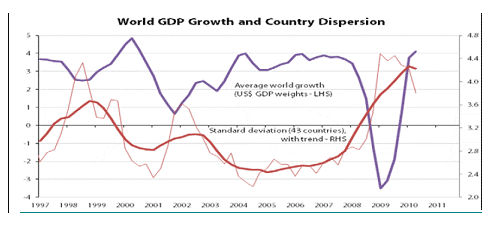
Country-specific risk is apparent when you look at the characteristics of the global recovery:
Although growth has been strong, it has also been more uneven than at any time in Gave’s career. This record dispersion of growth is contributing to the unevenness of policy measures across the world.
Country- and company-specific risk have traditionally caused Asian equities to trade at a discount relative to developed markets, but Gave said the “reality today is that is no longer so.” Those risks have combined to produce unattractive valuations, leaving just one leg – economic growth – of the three-legged stool that supports strong Asian investment returns.
Wagering on economic growth
“If you are making a bet on emerging markets,” Gave said, “you are in essence making a bet that economic growth is going to be so strong in emerging markets as to downplay the other two concerns, valuations and excess liquidity.“
Moreover, Gave said, you are making a bet that, instead of reverting back toward the mean, the dispersion of growth among countries is going to continue accelerating. There are reasons to believe that might be the case, he said, “but if the growth differential between emerging markets and developed markets does not accelerate in the coming year, then the excess liquidity and the valuations indicate that you would be much better off in investing in developed markets.”
With one exception, Gave said no Asian country has the potential for a strong bull market in the next six to 12 months. South Korea is the exception he cited, thanks to its currency and equities – both of which are “massively undervalued” in Gave’s eyes – and a central bank that is easing.
Even deep value strategies are unlikely to succeed in Asia, Gave said. As recently as 2003, he said, virtually all stocks were trading at “rock bottom” valuations and “gains were easy.” That is no longer so, and he doubts whether value-oriented managers will produce acceptable results. He compared the Asian markets today to the US in 1996, when being a value manager “started becoming a real misery.”
Gave said Asian companies are likely to generate strong revenue growth but will have difficulty producing bottom-line growth of the same magnitude. Demographics and infrastructure improvements will lead to higher wages, he said. Over the next 10 years, China will undergo a transformation no country has faced in peacetime: the number of 15- to 24-year-olds will fall by 30%. That, along with improvements in areas such as transportation, will lead to a higher standard-of-living among Chinese workers and, with that, higher wages.
“Business models in Asia were built on the premise that labor costs were going to be very cheap, and this is a big change,” he said.
Gave’s concerns about profit growth don’t end there. Asian CEOs – who he said are far more accessible and willing to talk than US CEOs – are now uncharacteristically worried about production costs – not just labor, but raw materials and energy as well.
Whatever opportunities exist in Asian stocks are now in the growth sector, but the downside to growth is high volatility – which Gave said can be “quite sickening” – and that is true for emerging markets in general. Volatility cannot be reduced with a long-short approach, he said, because shorting across countries exposes investors to unacceptable country-specific risk.
Gave has chosen to reduce volatility by overweighting Asian bonds, specifically long-dated high-quality government securities in countries like Singapore and Malaysia. He also likes short-dated bonds in Australia and New Zealand as a hedge against inflation.
“As you look to Asia today, there are undeniably tremendous growth opportunities,” he said. “But the question is what price you must pay for these growth opportunities. And, how can you hedge away some of the inherent risks that come with investing in Asia? For me, Asian bonds today are probably one of the greatest diversifiers you can find.”
Read more articles by Robert Huebscher