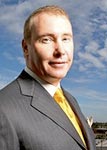
One way to avert the crisis posed by growing fiscal deficits is a significant tax increase, according to Doubleline’s Jeffrey Gundlach. Although he did not advocate this policy, in his conference call with investors last week he said the strain of fiscal deficits poses as yet unanswered challenges to the economy and the markets.
“An economy that is fueled by debt, a society that is fueled by debt, a government that is fueled by debt cannot succeed during rising interest rates, ,” he said. “It is incredibly brutal to be servicing a huge debt burden against a rising interest rate environment. “
I’ll discuss the reasons for Gundlach’s bearishness, which extends to munis and TIPS, but first let’s look at his view of the debt problem and its effects on the capital markets.
Taxes are too darn low?
Those who follow Gundlach know that a recurring theme in his presentations has been the multi-decade buildup of leverage in the financial, household and government sectors (see here for example). He expects the government deficit to be approximately $1.6 trillion next year.
Tax revenues are about 20% of GDP – a percentage that has been relatively stable over the last 50 or 60 years. Growing deficits, however, must be serviced by tax revenues, and Gundlach focused on the percentage of those revenues relative to the federal debt.
That percentage will drop to unsustainable levels if the deficit grows as many fear it will. The US faced a similar problem in the early 1940s, when tax receipts dropped to 10% of debt. It took World War II (and the economic growth fostered by the war effort) and substantial tax increases to avert crisis
Tax receipts as a percentage of debt improved steadily until the 1970s, when it got to about 60%, which Gundlach called a “healthy level.” Since then it has fallen precipitously and is now back to 10%.
A radical hike in taxes would solve the problem, and while Gundlach said that would be politically impossible, some increase in taxes may be unavoidable, he argued. “Certainly one should expect an attempt somewhere down the line to approach the debt problem with tax increases,” he said.
Income inequality would motivate a policy of tax increases, he said. In 1980, 2% of national income went to the top 0.1% of income earners, but now 8% does. “One can well imagine that this could motivate a third party as their campaign theme, saying taxes are too darn low on the top 1% or top .1% of the population,” he said. “So maybe we are going to see a big tax increase sometime in the next several years.”
Big themes for the capital markets
In addition to higher taxes, consumer deleveraging will be an ongoing big theme for the capital markets. Gundlach noted that household debt went from the 40% to 60% from the 1950s through the 1980s, but it exploded to 130% prior to the financial crisis.
“One of the things you can bet on is that this is headed way, way down,” he said. “And that means we are in a protracted period of secular reduced consumer spending.”
Another trend will be the struggles of the dollar, which Gundlach said is “absolutely in a long-term bearish position” due to quantitative easing (QE), which is “almost certainly a debasement of the currency.” He likes dollar-based investments over the short term, partially because of the debt problems in Europe, but longer-term he is negative on the dollar.
Gundlach spoke of the reaction of the markets to the Fed’s QE policies, and he noted that, notwithstanding their rise of approximately 100 basis points in the past six weeks, bond yields have declined over the course of this year.
Early this year, Gundlach accurately predicted that the benchmark 10-year note would drop to approximately 2.5%. In October, he presciently advised selling Treasury bonds, which he did in his fund, buying corporate bonds and non-agency mortgages instead.
The recent increase in Treasury rates is “running out of gas,” he said, and he expects stability or improvement in the bond market for the weeks ahead. “Short-term timers should be buying Treasuries,” he advised.
“Gross complacency” by investors in their belief that the Fed could maintain 10-year yields at 2.5% was the underlying cause of the increase in rates that began on November 4, according to Gundlach. He said that investors became fearful that there was no position in the market that was immune to manipulation by the Fed.
Once rates started to rise, investors started to hedge their positions, accelerating the rise of rates. Bernanke’s appearance on 60 Minutes, some better economic data (albeit not in the unemployment numbers), and increased consumer buying and borrowing for Christmas shopping all made for a “cocktail for higher interest rates.”
Further increases in interest rates would greatly endanger the equity markets, he said. “I don’t think the economy can take much of a rate rise above 3.5% on the 10-year.” The housing market would also suffer if rates headed higher.
Chinese equity performance has been a consistent harbinger of the US market, Gundlach said, and it has sold off substantially since November 4, when interest rates began to increase.
A crisis of confidence for munis, unattractive real yields, and a long-term outlook
According to Gundlach, historically the fundamental reason to own municipal bonds was for their tax advantage. Now, however, muni yields exceed those of Treasury bonds and are attracting investors with other motives.
The problem in the muni market, which he called a “crisis of confidence,” is too much supply relative to demand. Excess supply is coming from states, cities and counties, all of which face fiscal deficits and need to extend their credit.
Munis may look cheap now, but Gundlach said they are going to get cheaper.
Many wealthy investors, Gundlach said, are fully invested in munis and are no longer active buyers.
The muni market is also vulnerable to policy changes, and he said one ominous possibility is that munis could become taxable at the state level. “If you really want to tax the rich, taxing munis is a direct way to get there,” he said.
Pension funds could even become muni buyers, given the yield premium they offer relative to Treasury bonds. That would create a seemingly perverse cycle, with borrowers, such as the State of California, buying their own assets. He said it would be as if individuals paid their credit card bills to give the money to themselves, yet they lacked the money to pay those bills.
TIPS are another asset class to be avoided, Gundlach said. They are “grossly misunderstood” by investors, he said, and their linkage to the CPI belies the true inflation faced by many Americans. He said real interest rates need to be above 3% for TIPS to be attractive. “At approximately 2%,” he said, “it is very uninteresting for the volatility and risk relative to what you are getting paid, which is not very much.”
Indeed, one reason to avoid TIPS is Gundlach’s forecast of deflation, despite higher rates over the long term. The economy “simply cannot handle 10-year Treasury rates even at 4%,” he said, which would cause problems in the consumer economy and lead to a difficult fiscal debt burden. “Interestingly, higher interest rates are more likely to cause deflation.”
Deflation, he said, is the likely scenario over the next two years.
Longer term, Gundlach said, “interest rates are going to rise over a multi-year period.” For a bond manager, that creates the ultimate challenge. He said he will manage that risk by shortening duration and allocating to floating rate securities at the appropriate time.
Read more articles by Robert Huebscher