Advisor Perspectives welcomes guest contributions. The views presented here do not necessarily represent those of Advisor Perspectives.
As Shakespeare noted, the past is always a prologue to the future. Hence, investors should not have been surprised by the paltry 1.4% annualized return from U.S. stocks over the past decade. Lengthy spans of moribund or even declining prices have always followed periods of rapid ascent in stock prices, as was experienced from 1982 through 1999. This is illustrated in the following graph that depicts the cumulative appreciation in large company U.S. stock prices since 18251. The eight periods of price stagnation are highlighted with dark lines.
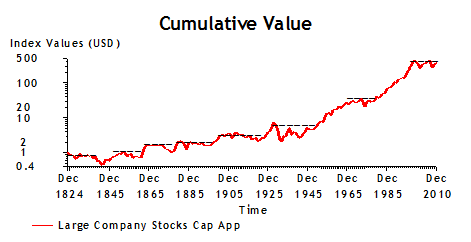
Prior to World War II, bull markets typically ended in ferocious bear markets trigged by financial panics and recessions. The market’s recovery to the previous cycle high was always lengthy. For example, the Civil War stock boom was followed by the Panic of 1873 and it wasn’t until 1879 that stock prices exceeded their prior 1864 high. Similarly, the Panic of 1893, that was caused by railroad overbuilding, dicey financing and bank defaults contributed to an 18-year price plateau that ran from 1881 to 1899. History is replete with such examples; the U.S. housing bubble is just the latest culprit.
More recently, the post-WWII stock market boom reached a plateau in the late 1960’s and was followed by over a decade of price stagnation before the bull market of the 1980’s. By historic standards, the duration of the current period of moribund prices is still somewhat below norm; patience is likely still in order.
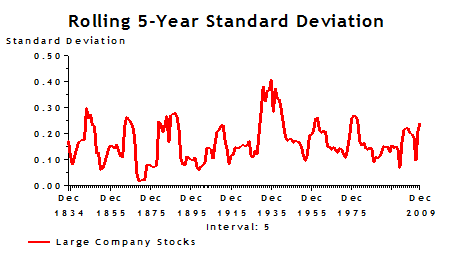
History’s lessons on market volatility are also instructive. The reputedly “unprecedented” market volatility of the last decade is in fact a recurrent phenomenon. As illustrated in the following graph depicting the standard deviation – a measure of volatility – of large company stocks, the market has always oscillated between periods of relative calm and extreme instability.
1. Large company stock returns are from the 2010 Ibbotson SBBI Classic Yearbook (Chicago: Morningstar, Inc., 2010).