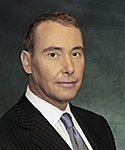
Doubleline’s Jeffrey Gundlach was one of the first to warn investors that sub-prime mortgages were “a total unmitigated disaster, and they are going to get worse.” That was in June of 2007, against a backdrop of strong equity and corporate bond performance.
In an equally bold statement last week, Gundlach identified the asset class he considers the greatest investment opportunity for the next two years. Again, it was one for investors to avoid: municipal bonds.
The problem, according to Gundlach, is that muni bonds are owned by wealthy individuals for a single purpose – tax avoidance. With the fundamentals of state and local governments deteriorating, the risk of adverse news triggering a selloff is too great to justify today’s yields on muni bonds.
Gundlach spoke in Los Angeles at a forum sponsored by the Maryland-based investment consulting and technology provider Fortigent, LLC. I’ll look at his forecasts for a range of fixed-income sectors, but first let’s look at his view of the economic recovery – and the two things he considered the greatest disappointments in the fourth quarter of last year.
A debt-laden economy
Gundlach’s followers know that he has been consistently critical of the growth in public and private debt levels and its inhibitive effect on economic growth (see here and here, for example). Last week, he called that debt the “elephant in the kitchen” – an unavoidable burden on our recovery.
Gundlach said that, historically, we have created new forms of debt to rescue the economy – more credit cards, home equity mortgages, or the government itself running up its debt. “Put it all together, and we got to this situation,” he said.
According to Gundlach, the last time the federal budget was actually balanced was in 1948. (The budget surpluses in the 1990s were mythical, he said, because they include tax revenue for Social Security and Medicare that should be counted in their trust funds and not toward reducing the deficit.)
In a tongue-and-cheek comment, Gundlach said fears stemming from foreign government ownership of US debt – mostly China and Japan – are overblown, especially in light of the Fed’s QE2 program. “We don’t have to worry any more about the foreigners buying our bonds, because we are now the No. 1 buyer,” he said.
Gundlach said the good news for the debt situation is that net interest payments “aren’t that bad,” thanks to low interest rates. Those payments are 2% of GDP, compared to 3.5% of GDP in the late 1980s and early 1990s.
The trend is not good, though. Gundlach said the CBO forecasts that interest expense will grow to $600 billion in the next five years – an unsustainable level that makes it likely the Fed will continue quantitative easing.
One way to resolve the debt problem is to increase taxes, and Gundlach said it is inevitable that the ultra-wealthy will face higher tax rates, based on data that the share of income earned by the top 1% of wage-earners (those making more than $380,000) rose dramatically over the last three decades. “A large shift in government policy must occur,” he said. “What we have is unsustainable.”
Two events that occurred in December were exceptionally disappointing to Gundlach. The first was the tax package that was passed by Congress. Gundlach said the November “sweep of the House of Representatives” by Republicans was a sign that society understood it cannot borrow its way to prosperity. However, the extension of unemployment benefits in the tax package was “bad fiscal policy” because it increased spending to achieve what will be only short-term benefits. Moreover, the decrease in the payroll tax for Social Security, from 4.6% to 2.6%, will only serve to increase the unfunded liabilities in that program.
Disappointment No. 2 was the “lies” that Fed Chairman Ben Bernanke told on a 60 Minutes interview. Gundlach said Bernanke appeared scared – “he was twitching” – when he looked right in the camera and said “we are not printing money.” Bernanke, according to Gundlach, was relying on a semantic argument: we are not printing money, but rather creating it electronically. That was an “awfully cowardly thing to hide behind,” Gundlach said, since we are unquestionably monetizing our debt.
An overall bearish view
Those disappointments reflect a theme that, in Gundlach’s view, underlies bear markets: an overall lack of cooperation. “Bull markets are all about cooperation,” he said, such as when the EMU was created in 1999, at the very top of the equity market.
Today, he sees the opposite, as demonstrated in the lack of consensus between the periphery and the northern European governments. European sovereign problems are “absolutely, positively not resolved,” he said, “and we are going to have great volatility, particularly in the euro, thanks to the problems that are emerging in Spain.”
European debt spreads, which have not shrunk since the EMU bailout was announced in mid-2010, show that sovereign problems “are as bad as they have ever been,” he said. “The euro is a horrible thing to own. You should own none of it.”
A similar lack of consensus is evident in the US, particularly among states. States like Arizona and California disagree over immigration, and when Illinois recently raised its personal income tax rate, neighboring states immediately began advertising to attract businesses and residents.
Within the US and globally, few asset classes are attractively priced, according to Gundlach.
Gold “looks toppy,” he said, owing primarily to the fact that it has become “awfully faddish and popular to own.” Although he generally likes real assets, he said the case for gold was difficult to make at today’s prices. All the gold in the word could be traded for the all the agricultural land in the US, along with 10 Exxon-Mobils, and one would still have a few trillion dollars left over. That’s a trade Gundlach said he would make.
Equities are due for a 10% correction, he said. Although it is generally a good idea for one to dollar-cost-average their investing, he said that “sometimes I want to skip a month or two.” He noted that the Shanghai index typically leads US equity markets, and it is signaling weakness in the S&P 500.
Interest rates are “carving out a bottom,” he said, although he doesn’t expect them to rise sharply. “In this consumer debt-logged economy, deflation will cause the 10-year to find its way to 4% or so while we are having slow economic growth from the payroll tax cuts.” As he has said in the past, he doesn’t think the economy can tolerate higher interest rates, and monetary policy will keep rates from rising unacceptably.
Gundlach has his own metric for evaluating relative valuations in the bond market. Instead of looking at static spreads relative to Treasury bonds, he determines what the average excess return, relative to Treasury bonds, is likely to be. When asset classes deviate from their historical averages, by either one or two standard deviations, he considers them to be rich or cheap.
Based on this metric, investment-grade corporate bonds are priced at fair value, and those bonds now comprise 20% of this fund. Emerging market bonds are slightly more attractive.
Junk bonds, by contrast, are very expensive. Defaults were negligible in 2010, and junk bonds are now priced as if that default rate will continue. It won’t, Gundlach said, and other asset classes offer similar yields with less risk. “The road to riches will not be paved by high-yield bonds,” he said.
The housing market has “no chance of improvement in the months ahead,” Gundlach said, due to oversupply and higher interest rates. “The default trends in the housing market have not changed one bit.”
Unlike the junk bond market, however, mortgage securities are priced to reflect that scenario. “There is a cushion of safety,” he said. “It’s when things are bad and you think they are good that you lose money.”
Returning to Gundlach’s best idea for the coming two years, he said he has met with many billionaires since starting his Doubleline funds. “Every single time,” he said, “the centerpiece of their portfolio is muni bonds.”
Those investors often have their entire portfolio in munis, he said. And for them, “All is a lot.”
The problem, according to Gundlach, is that they don’t own those bonds because the love the fiscal situations in Illinois or California. They own them for the tax break, and that creates the potential for systematic risk across the muni market, similar to the problems in the housing market that befell the mortgage-backed securities market.
There will come a time to buy munis. “You’ll know when to buy munis when your hand quivers when you write the buy ticket,” he said.
Referring to his relative valuation metric, he said, “Average is the new overvalued when it comes to munis. I would bet dollars-to-donuts that munis will take out the two standard deviation line.”
Read more articles by Robert Huebscher