Advisor Perspectives welcomes guest contributions. The views presented here do not necessarily represent those of Advisor Perspectives.
This essay is excerpted from the most recent version of the HCM Market Letter. To subscribe directly to this publication, please go here.

"In principle, public debt can operate as an instrument of collective rationality, a mechanism through which political power claims the economic resources it needs to enact its decisions. In current practice, however, it works the opposite way: as a mechanism through which the costs of collective irrationality – rampant greed and recklessness, exorbitant externalities, perverse incentives, and systemic dangers – are imposed on everybody. We face something more enveloping than the classic contradiction between the privatization and the socialization of risks: public debt has shouldered the burden of sustaining an economic system whose leaders and ideologues have consistently repudiated the very idea of public responsibility."
Richard Dienst1
The HCM Market Letter is now on Twitter - @HCMMarketletter
The news cycle has given short shrift to the fact that Congress and the Obama Administration are struggling to pass a budget for the 2012 fiscal year. Admittedly events in Japan and the Middle East have distracted both the government and the media from this issue, but America’s public finances continue to rot away. The failure to tackle entitlement reform is eroding confidence in American leadership and the U.S. dollar. Investors should be disturbed that the dollar did not rally during the Japan crisis but instead traded down against the feeble Euro. The dollar is decreasingly seen as a safe haven as the world watches U.S. monetary and fiscal policy continue on their self-destructive courses.
Bill Gross’s most recent Investment Outlook (“Skunked,” April 2011) highlights just how dire the situation is becoming. Mr. Gross points to the $65 trillion discounted net present value of entitlement liabilities of current spending if it continues at the projected demographic rate. This off-balance sheet, unrecorded debt burden is equivalent to more than 500 percent of current GDP, and it is growing at a faster rate than GDP. No wonder the world is losing confidence in the dollar. When it comes to public debt, Japan’s got nothing on us.2
The budget crisis is a crisis of leadership. There is no intellectual mystery involved in cutting the budget – entitlement spending must be reduced through the adoption of tighter eligibility standards (age and wealth). The other major area of potential budget savings is the military budget. The U.S. cannot afford and cannot win the Afghan war and should start winding it down immediately. But Congress and the Administration can’t even agree on modest cuts for next year’s discretionary budget (which are wholly symbolic and will not make a dent in the deficit). This is no longer simply a case of fiddling while Rome burns; our politicians are striking the matches and fanning the flames.
Europe
Portugal
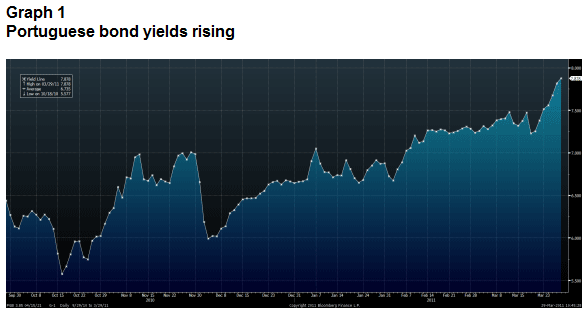
The U.S. markets’ complacency concerning Europe’s sovereign debt crisis is also striking. The crisis continues to run the course HCM expected, with Portugal now on the cusp of a forced debt restructuring. Portugal’s 10-year bond yields have surpassed the 7.5 percent level that many observers consider unsustainable. On March 31, the Portuguese government announced that last year’s budget deficit was equivalent to 8.6 percent of GDP, missing its target of 7.3 percent. Despite raising taxes and sharply cutting expenses, the country did not come close to meeting its self-imposed budget target. Naturally, Portugal was downgraded twice by Standard & Poor’s during the last week, telling the world what it already knew – the country is going to default. The rating agency also downgraded the credit rating of four Portuguese banks and left their outlook negative. As bad as things are, however, Standard & Poor’s is still maintaining an investment grade rating on the country (barely – it rates the country BBB-), suggesting once more that the credit rating agencies are the last ones to know what they are supposed to be know. Not to be outdone, S&P’s evil twin Moody’s Investor Service jumped on the belated bashing bandwagon shortly thereafter (and mini-me Fitch joined in the act by downgrading the country to a still investment-grade BBB- on April 1). Portugal’s two-year bond yield jumped to 8.75 percent on the S&P news, surpassing the yield on its 10-year debt of 8.41 percent. The country’s 10-year yield now exceeds Germany’s by a record 490 basis points, but it is still not high enough to compensate holders for the coming restructuring. The country was able to sneak in a €1.6 billion auction of 15-month bonds at 5.79 percent on April 1, 2.5 percent higher than its borrowing costs a year earlier. Portugal’s dilemma is accentuated by the resignation of its prime minister, which renders it unable to request aid from the European Union until after new elections are held.
Making matters worse, it appears that the restructurings of Greece and Ireland are not yet complete and will require additional EU support. The €700 billion European Stability Mechanism, which will replace the temporary €440 European Financial Stability Facility in 2013, is viewed by many as sufficient to handle the restructurings of these three countries as well as whatever comes next. Consistent with our “cup-half-empty” view of the world, HCM disagrees. The new fund is not as robust as the headlines suggest. European nations will contribute only €80 billion in five annual installments, with Germany’s share expected to be €22 billion between 2013 and 2017. Moreover, the payments are in the form of guarantees, some of which may not be deliverable if economic conditions deteriorate further during the period of payment. If Spain, for example, were to default, that country would be in no position to honor its guarantee. The expanded emergency fund is best considered an idea rather than a reality at this point, although financial markets looking for reasons to rally are clearly looking at it in reverse.
Irish Eyes Are Crying
Ireland is also far from resolving its debt problems as well. On April 1, S&P again reared its ugly head and downgraded the country’s debt to a still investment-grade BBB+ but revised its outlook to stable. Ireland is asking the European Union for an addition €60 billion of medium-term funding to replace emergency temporary support from the Irish Central Bank. This money is required after the completion of another series of stress tests showed that the banks remain undercapitalized. The EU is balking until Ireland completes a recapitalization of its banks, which appears to be heading in the direction of asking bondholders to finally accept responsibility for their bad judgment and take some losses. Ireland’s big four lenders – Bank of Ireland, Allied Irish Banks, Irish Life & Permanent and the Education Building Society – are reported to need an additional €34 billion of capital after the completion of stress tests performed by Blackrock. Irish 10-year bond yields are now parked above 10 percent while its two-year notes are only slightly lower at 9.87 percent, levels that render the country unfinanceable without EU support. The ECB is currently providing about €100 billion of short-term loans to Irish banks, with the Irish Central Bank kicking in another €70 billion. The amount of support required by Ireland’s banks alone should give pause to those who continue to believe that even the enlarged emergency fund is going to be sufficiently large to fund the Continent’s credit losses or prevent additional defaults and restructurings. HCM expects that the markets will continue to shrug off the reality of Europe’s debt crisis until it hits Spain, which is too large to ignore.
1. Richard Dienst, The Bonds of Debt: Borrowing Against the Public Good (New York: Verso 2011), p. 59.
2. And those who believe that China will continue to defy the laws of economics should keep in mind that China’s sovereign debt, which includes the obligations of its banks, is much higher than commonly believed. China desperately needs its high single digit GDP growth to prevent its own debt crisis at some point in the future.
Germany
Germany remains the economic heart of Europe. Accordingly, the recent defeat of Chancellor Angela Merkel’s Christian Democratic Union (CDU) in last Sunday’s Baden-Wurttemberg state election is of some importance. This election was likely lost on a combination of Euro and local issues as well as nuclear energy fears fanned by the Japanese crisis. This was a serious defeat for Frau Merkel, though not entirely unexpected. Observers are still left asking how much Germany will be willing to contribute to a solution of the Continent’s debt problems, which are getting worse by the day. It is unlikely that any such solution will occur without significant German contributions; the question, however, is what Germany’s political landscape will look like after this occurs. For the moment, the one thing it does not look like is stable.
The European debt crisis is a tsunami about which investors have been duly warned, but investors continue to insist on staying on low ground until the very last second. Hedges against a deepening of the debt crisis should be maintained or instituted before they are too expensive or the global credit markets get spooked because credit is currently being priced as though the damage from the 2008 financial crisis has been fully absorbed. The reality is that enormous debt burdens have only been moved from the private sector to the public sector, but the systemic damage remains deep and ongoing. European sovereign interest rates remain far too low in view of the risks that holders are running that these countries are not going to be able to repay their debts. Moreover, the strength of the Euro against the dollar is unlikely to hold if the U.S. recovery remains on course, and the Euro remains a short against Asian currencies and the Swiss franc. In HCM’s view, the only reason the Euro is strong against the dollar is that it is the only currency large enough to absorb significant non-dollar flows. There is absolutely nothing intrinsically attractive about the European economy or its currency. Europe – like the United States - is mired in a long-term trend of debauching its currency and its balance sheet.
Japan
The biggest casualty of the natural disaster in Japan is increasingly likely to be the nuclear power industry. HCM is far more concerned about this than about the manageable damage to the global economy resulting from the tragedy. Despite the crisis in Japan, HCM continues to believe that nuclear power must remain a viable energy source for the United States and the rest of the world. Nuclear power can be produced safely if proper precautions are taken in terms of locating nuclear facilities and building them to withstand reasonably foreseeable natural disasters. And make no mistake about it – there is a significant difference between an unlikely event and an unforeseeable event and a 9.0 magnitude earthquake falls into the latter category. While most of the hand-wringing around Japan’s nuclear disaster is focused on the poor performance of TEPCO and the poor quality of information being provided to the public, few people appear to be asking a more basic question: should nuclear facilities ever be built in areas that are subject to high earthquake and tsunami risks?
The debate about nuclear power also ignores the fact that there are other kinds of risks associated with relying on fossil fuels for most of the world’s energy needs. Fossil fuels involve three types of risks – first, the exploration risk that was evidenced by the BP oil spill in the Gulf of Mexico; second, environmental risk in the damage they mete out to our planet; and third, geopolitical risk involving in transferring so much of world’s financial resources to regimes that are decidedly hostile to the form of liberal democracy that most Westerners view as the best form of government (or, to say it differently, the worst form of government in its current manifestation other than all other forms of government). Given the choice between buying oil from hostile regimes and forging a safe and sound nuclear energy policy, HCM would choose the latter in a heartbeat. Nuclear energy has been pushed to the sidelines in the United States by enormous regulatory burdens and a great deal of political hysteria that needs to be reexamined in light of the long-term risk of relying on fossil fuels. The reality is that no form of energy is fool proof from a safety standpoint, but nuclear facilities should be able to be built safely. The world – and the United States – cannot afford not to use nuclear and other forms of clean power if the human race wants to sustain itself without destroying the planet.
Banks and financial reform
Financial reform in the United States has run off the tracks. The Dodd-Frank Wall Street Reform and Consumer Protection Act remains stuck in the mud with respect to many of its substantive provisions. Moreover, the banking industry has not stopped lobbying for relief from reform. Having survived the 2008 financial crisis on the backs of American taxpayers, the industry believes it is entitled to continue calling the shots on its own regulation. Unfortunately, Congress appears to be listening.
The most recent salvo in this effort was made by JPMorgan Chase’s Chairman Jamie Dimon, who engaged in a major bout of whining in a recent speech to the United States Chamber of Commerce. Mr. Dimon argued that a 7 percent capital ratio is sufficient for banks, not the much higher levels that European regulators are considering. Mr. Dimon is decidedly wrong on this issue. A 7 percent capital ratio would imply leverage of more than 14:1 for U.S. banks, which the financial crisis clearly demonstrated is insufficient. Mr. Dimon’s claim might bear more validity (but still be misguided) if banks were operating within a system that did not encourage speculation instead of productive investment, but that is not the case in America. From our housing policy to our tax policy, the speculative use of capital is encouraged.
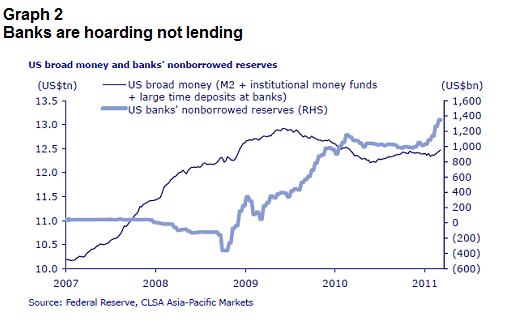
Moreover, banks are continuing to court risk even as they rein in lending to all but their most favored (and politically powerful) customers. See Graph 2 above. Mr. Dimon’s own bank recently committed $20 billion (equivalent to approximately 16 percent of its Tier 1 capital) to a single bridge loan to AT&T to facilitate the purchase T-Mobile. Although JPMorgan Chase intends to sell off pieces of this loan, it is on the hook for the entire $20 billion amount and would not be able to reduce its exposure quickly if another financial market dislocation were to occur. While virtually nobody thinks that such an event is in the cards, risk management should be designed to deal with 9.0 earthquakes. It appears that even the most highly-respected banker in the United States has learned little – or has already forgotten – the lessons of the very recent past.
Mr. Dimon’s argument also ignores the fact that the financial system is populated today by fewer large institutions than before the crisis. Even more troubling, these firms are more interconnected than ever before through their web of trading relationships (which are largely in the form of derivatives – another lesson that hasn’t been learned). The “too big to fail” doctrine not only remains intact; regulators will be under greater pressure than before to rescue troubled firms with fewer of them around. Greater banking concentration requires more regulation, not less. Do we need to exacerbate the risks by allowing a smaller and more concentrated number of institutions to maintain inadequate capital cushions? Responsible and forward-looking regulation would do precisely the opposite with the understanding that the only thing knowable about the unknowable future is that there will be more systemic crises that require robust, well-capitalized institutions.
In his Chamber of Commerce speech, Mr. Dimon also raised the tired and discredited argument that subjecting U.S. banks to stricter regulation than other jurisdictions will send business overseas and hurt America’s competitive position. This argument could just as easily be applied to monetary policy to justify the continued debauchment of the dollar. Dumbing down our regulatory system to make it weaker than its competitors is not only a bogus rationale for public policy but also plainly suicidal because looser regulation virtually guarantees that leverage and risk will migrate to the system with the fewest constraints. We already saw the effects when the heads of the five largest investment banks convinced the U.S. Treasury to lift leverage limitations on their institutions in 2004. Three of the firms who fought for higher leverage did not survive the financial crisis. Do we really need to refight the last war, which we lost and lost badly?
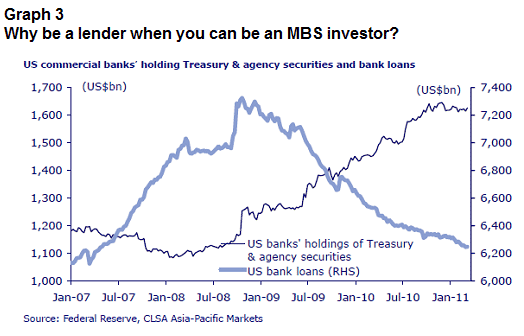
Our friend Christopher Wood points to another area in which U.S. banks are showing a stunning lack of memory. Rather than make productive loans, U.S. banks have been ramping up their purchase of mortgage-backed securities. See Graph 3 below. HCM can only echo Mr. Wood in saying that “investors…are insane to own MBS, agency or otherwise, given the growing percentage of negative equity in the housing market, given the political morass that is the US housing market and the not insignificant risk at some state of mortgage debt relief, and given the legal reality that Fannie and Freddie are still not explicitly guaranteed by the Federal Government.”3 During the second half of 2010, commercial banks increased their holdings of MBS by 7.3 percent to 1.23 trillion. This represented 18.7% of the $6.6 trillion of “single-family” MBS outstanding at the end of the year and was even larger than the $1.15 trillion owned by the Federal Reserve and U.S. Treasury. The last HCM checked, the single family housing market for the types of residential loans held in MBS structures was either still at the bottom or experiencing a double-dip recession. This is another object lesson in the fact that banks are almost genetically programmed to wander into areas that are likely to hurt them. Higher interest rates will only make this housing bet look worse.
The Wall Street Journal added some color to this story with a front-page article on April 1 describing the revival of subprime mortgage bonds. “Subprime and other residential mortgage bonds that helped trigger the financial crisis,” wrote the Journal, “are back in vogue with long-term investors, in the latest sign that American credit markets are healing after the worst downturn in a generation.”4 Non-agency mortgage bonds (those not backed by Fannie Mae or Freddie Mac) that yielded 20 percent at the nadir of the financial crisis are now yielding 5-7 percent, and investors can’t seem to get enough of them. The rationale is that these bonds yield much more than Treasury bonds. The good news about these bonds is that they generally pay a floating rate, but rising rates will still hurt them by retarding a housing market recovery and likely reducing the value of their collateral. Speaking for itself, HCM would want to be paid far more than 5-7 percent for assuming the risk of the U.S. housing market today. This phenomenon is typical of what occurs when interest rates are kept artificially low for an extended period of time and investors grow desperate for yield. These investments are finding their way into the portfolios of ostensibly conservative institutions such as banks and REITs. Banks generally serve as contrary indicators of what makes good investment sense, and this time is unlikely to turn out differently than those in the past.
If readers have any doubt that Mr. Dimon and the banks are again on the wrong track on financial reform, they need only look at the latest voice to join their cause – Alan Greenspan. In arguing that Dodd-Frank will likely result in many negative unanticipated consequences (a point with which HCM agrees), Mr. Greenspan once again confirms that his greatest error was studying Ayn Rand instead of Hyman Minsky. Writing in the Financial Times on March 30, Mr. Greenspan argued the following: “The problem is that regulators, and for that matter everyone else, can never get more than a glimpse at the internal workings of the simplest modern financial systems. Today’s competitive markets, whether we seek to recognize it or not, are driven by an international version of Adam Smith’s ‘invisible hand’ that is unredeemably opaque. With notably rare exceptions (2008, for example), the global ‘invisible hand’ has created relatively stable exchange rates, interest rates, prices, and wage rates.” 5 In other words, today’s financial system is more opaque than ever so we should regulate it less! In addition to this logical lapse, Mr. Greenspan also appears to be suffering a memory lapse because 2008 was hardly the only time in which markets exhibited extreme instability. How about 1994, 1998, and 2001-2? How about the gross misallocation of capital that resulted in the Internet Bubble as a result of Mr. Greenspan’s ill-advised monetary policy. The financial system must be built to include redundancies and margins of error in order to achieve stability and serve society. A more opaque system requires greater regulatory safeguards, not a loosening of already vague standards. While Mr. Greenspan correctly pointed to some of the serious flaws in Dodd-Frank, he seems to suggest that the increasing complexity of the financial markets weighs against regulation when in fact it is precisely the reason for more enlightened and structured regulation. While many of us warned that the financial practices of the early and mid-2000s were going to lead to disaster, Mr. Greenspan was the last to know. For that reason, he should be the last voice anybody should be listening to on this subject now.
Employment
The March employment report offers hope that the U.S. jobs picture may be entering a sustained recovery although at a relatively flaccid level. The economy gained 216,000 jobs in March and 194,000 in February. There are still 7.5 million fewer jobs today than there were in 2007, so 200,000 per month job increases look good primarily in comparison with the carnage that preceded them. Private sector payrolls have increased by 188,000 per month in 2011, up significantly from 100,000 per month in 2010. The average increase over the past six months was 167,000 jobs, which is nothing to write home. The dynamic of shrinking public payrolls and expanding private payrolls is likely to accelerate in coming months as state and local governments begin to institute the cuts necessary to balance their budgets.
One weak spot in the report was hourly earnings, which held at $22.87 month-to-month. Increases in hourly earnings have slowed from 1.9 percent a few months ago to 1.7, suggesting that wage pressures remain muted and that employers’ are still calling the shots. The underemployment rate – U6 – declined to 15.7 percent from 15.9 percent in February, and the official unemployment rate dropped to 8.8 percent. The percentage of long-term unemployed also increased to 45.5 percent of all jobless. The size of the labor force increased by 160,000 in March while overall employment grew by 291,000 jobs, bringing the share of the population in the labor force up to 58.5 percent from 58.4 percent (still a near record low number).
The real question remains whether the end of QE2 will reverse these employment gains. There is no question that public sector employment is going to decline through the rest of the year as states and municipalities wrestle with budget problems. Whether the private sector will continue to add a sufficient number of jobs to counteract this headwind remains to be seen. Despite the promising March numbers, employment remains a weak spot for the economy. A failure of employment to increase meaningfully will also maintain pressure on the deeply distressed housing sector, which is unlikely to show a strong recovery as long as the numbers of unemployed remain high (and mortgage rates continue to inch up).
Stocks
Apollo Global Management (APO) went public this week at $19.00 and saw its shares quickly drop to $18.00 per share. Readers of this publication are well-acquainted with HCM’s negative views of private equity and the perils of investing in the public stock of private equity firms (see, for example, Chapter 5 in The Death of Capital6). These companies are conflict of interest laboratories in which investors are the rats. Most of these stocks are trading far below their offering prices, leaving holders with large losses while the principals of these firms have continued to gorge themselves on their egregious fees. We would avoid APO just like we advise investors to avoid similar stocks – The Blackstone Group (BX) and The Fortress Group (FIG). KKR & Co. (KKR) seems to be a much better prospect, and KKR Financial Holdings LLC (a manager of Collateralized Loan Obligations that I own personally) remains very attractive (KFN just completed a new CLO). The other stocks I own personally are Tetragon Financial Group Ltd. (TFG1/EU), BP plc (BP), and Citigroup Inc. (C). I am also short the Euro versus the dollar through the Proshares Ultrashort Euro ETF (EUO).
General Motors Co. (GM) is now trading below its IPO price as HCM predicted. GM’s IPO was priced at the margin and the company was brought to market prematurely (it went public with a qualified audit opinion). We would want to see the stock drift significantly below $30 per share before biting (and we believe it will get there).
We continue to expect the stock market to ignore the long-term warning signs and continue to rise over the next couple of months. The market is likely to shrug off the end of QE2 despite all of the media noise because the Federal Reserve will continue to support the markets through low interest rates. The equity market is only likely to sell-off based on monetary policy concerns when it becomes convinced that a Federal Reserve interest rate hike is imminent. HCM does not expect this to occur until late 2011 at the earliest because economic growth remains anemic. Even after the Federal Reserve starts raising rates, it will do so gingerly. For these reasons, HCM believes that monetary policy is likely to remain highly accommodative for a prolonged period of time and should not create a significant headwind for the equity market for the foreseeable future (certainly not this year). (We also believe, as do many others, that Treasuries are to be avoided at all costs and investors should continue to buy gold and move their holdings out of the U.S. dollar and euro into Asian currencies and the Swiss franc.) The real challenge for equities will be whether the combined force of the withdrawal of QE2 coupled with public budget cuts and higher oil prices will start to impair economic growth. The markets will also have to evaluate whether Congress and the Obama administration can make any meaningful progress on budget reform, which will mean tackling the entitlement issue. The failure to rein in federal deficits remains a profound threat to the dollar and interest rates.
Dumbest comment ever?
As the 2012 presidential election season picks up steam, we are likely to be exposed to any number of gaffes and downright idiocies from the candidates. It is unlikely, however, that there will be a comment that can rival in stupidity the statement made by Mississippi Governor Haley Barbour on the subject of gays in the military, which we caught on The Daily Show with Jon Stewart. In an interview with Bryan Fischer, Governor Barbour said that he is in favor of reinstating the “don’t ask, don’t tell” policy for the military because (he really said this) “when you’re under fire, and people are living and dying on split-second decisions, you don’t need any kind of amorous mindset that can affect saving people’s lives and killing bad guys.” We had always heard that all is fair in love and war, but this comment puts a whole new spin on that old saying. Perhaps the Governor knows something we don’t about being in the heat of battle. All we know is that it is going to be a long election season if public discourse is already devolving into this type of drivel.
Michael E. Lewitt
April 2, 2011
3. Christopher Wood, GREED & fear, 31 March 2011, p. 8. We would only add that Freddie and Fannie might as well be explicitly guaranteed by Uncle Sam because they are too big to fail – way too [expletive deleted] big!
4. The Wall Street Journal, “Subprime Bonds Are Back,” April 1, 2011, p. A1.
5. Alan Greenspan, “How Dodd-Frank fails to meet the test of our times,” Financial Times, March 30, 2011, p. 9.
6. We must also give a shameless plug to the book by noting that La muerta del capital will be published in Spain in June. A formal announcement will be forthcoming shortly.
Disclosure Appendix
This publication does not provide individually tailored investment advice. It has been prepared without regard to the circumstances and objectives of those who receive it. This report contains general information only, does not take account of the specific circumstances of any recipient and should not be relied upon as authoritative or taken in substitution for the exercise of judgment by any recipient. Each recipient should consider the appropriateness of any investment decision having regard to his or her own circumstances, the full range of information available and appropriate professional advice. Harch Capital Management, LLC recommends that recipients independently evaluate particular investments and strategies, and encourage them to seek a financial adviser’s advice. Under no circumstances should this publication be construed as a solicitation to buy or sell any security or to participate in any trading or investment strategy, nor should this publication or any part of it form the basis of, or be relied on in connection with, any contract or commitment whatsoever. The value of and income from investments may vary because of changes in interest rates or foreign exchange rates, securities prices or market indexes, operational or financial conditions of companies, geopolitical or other factors. Past performance is not necessarily a guide to future performance. Estimates of future performance are based on assumptions that may not be realized. The information and opinions in this report constitute judgment as of the date of this report, have been compiled and arrived at from sources believed to be reliable and in good faith (but no representation or warranty, express or implied, is made as to their accuracy, completeness or correctness) and are subject to change without notice. Harch Capital Management, LLC and/or its employees, including the author, may have an interest in the companies or securities mentioned herein. Neither Harch Capital Management, LLC nor its employees, including the author, accepts any liability whatsoever for any loss or damage arising from any use of this report or its contents. All data and information and opinions expressed herein are subject to change without notice.
The HCM Market Letter
Michael E. Lewitt, Editor
The HCM Market Letter is published on a monthly basis by The HCM Market Letter, LLC. Offices at 751 Park of Commerce Drive, Suite 118, Boca Raton, FL, 33487. Telephone (561) 226-6199; Fax (561) 995-4946. Delivery is by electronic mail. Annual subscription rate is $395 for individuals and $995 for institutions. Visit our web site at www.hcmmarketletter.com. Copyright warning and notice: It is a violation of federal copyright law to reproduce or distribute all or part of this publication to anyone (with the exception of individuals within the same institution pursuant to the subscription agreement) by any means, including but not limited to photocopying, printing, faxing, scanning, e-mailing, and Web site posting without first seeking the permission of the publisher. The Copyright Act imposes liability of up to $150,000 per issue for infringement. Information concerning possible copyright infringement will be gratefully received.
Read more articles by Michael Lewitt