The Japanese scenario haunts US policy makers, who recall that country’s two-decade miasma of lethargic growth and escalating fiscal deficits with apprehension. What scares them most, perhaps, is the potential endgame Japan now faces: an insolvent government crippled by uncontrollable inflation.
While Japan’s current situation closely parallels the experience of other countries that went on to confront hyperinflation, according to Dylan Grice, we shouldn’t expect a crisis in the near term.
I spoke with Grice following his presentation on this topic at the CFA Institute’s annual investment conference in Scotland last week. He is a global strategy research analyst at the French bank Societe Generale and, along with his coworker Albert Edwards, writes the research newsletter Popular Delusions.
Japanese hyperinflation in the next five years is very unlikely, according to Grice.
In the meantime, he identified an inexpensive way to hedge against this risk and said that Japanese equities are now undervalued.
I’ll review the factors that contribute to Grice’s outlook and whether he believes that Japan represents a cautionary tale for the US.
Japan’s unique problems
Among developed economies, Japan is the most indebted. Its ratio of gross government debt to GDP (based on projected 2011 data) is 229%, compared to 100% for the US. Greece, at 152%, and Ireland, at 114%, are both more solvent than Japan.
According to IMF data, Japan would need a roughly 14% annual reduction in its fiscal spending to achieve a 60% debt-to-GDP ratio by 2030, which is the target for the Eurozone. Its planned change over the next five years is only a 1% reduction.
Japan, of course, is not unique in this respect. “By any kind of reasonable definition of solvency,” Grice said, “most developed-market governments are bust.”
But Japan faces several key threats in the short-term that set it apart from other countries, and for those reasons Grice said it is the “farthest advanced towards some kind of default.”
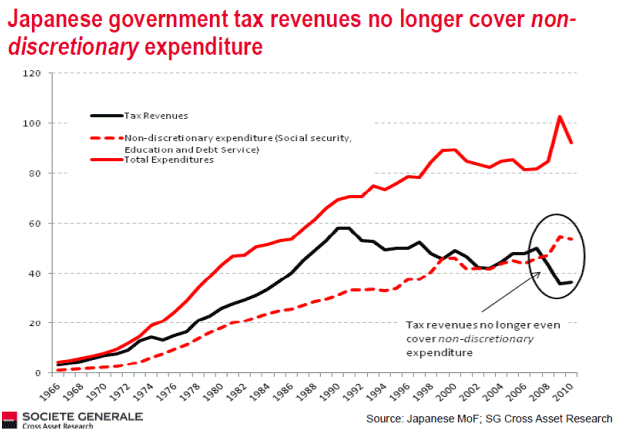
First, tax revenues in Japan are unable to pay for non-discretionary expenditures – including Social Security, education, and debt service. Grice called this a dangerous and unstable situation.
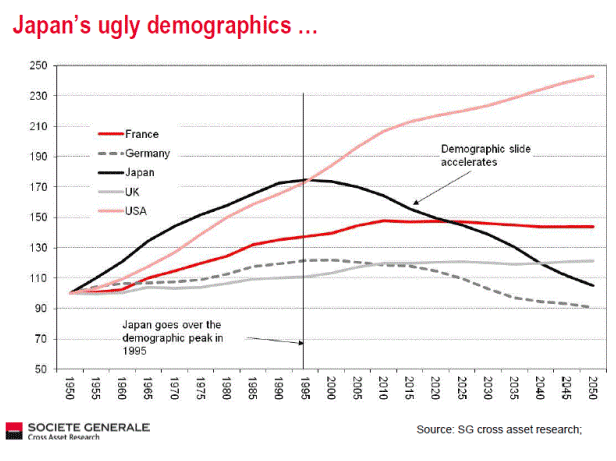
Second, Japan has an aging population, which Grice said is increasingly recognized as one of the most important drivers of its fiscal problems. Japan’s dependency ratio (the ratio of its working age population to those either too young or too old to work) has declined since 1995. Only Germany faces worse demographics, as shown in Grice’s graph below:
Japan’s impending demographic implosion “dwarfs anything seen in any other country,” Grice said.
Some European countries are struggling with similar demographic issues and have tried to deal with that by increasing retirement ages. Japan does not have that option, because it has already done that, Grice said. The median age of retirement for construction workers in Japan is now 67 years, according to Grice.
Japan currently spends 50% of its tax revenues on Social Security, according to Grice, who said that would rise to between 80% and 90% over the next decade. Forty years ago, the figure was roughly 17%.
“This is clearly an unsustainable trajectory,” he said. “You have a bankrupt government and historically, that means you have inflation.”
The historical precedent
Past episodes of hyperinflation share a number of characteristics, Grice said, and a pronounced fiscal deficit is the most prominent.
The second is a lack of an independent central bank, which allows the decision to monetize debt and print currency to be politicized.
“You put those two things together, and you find them in every single hyperinflation episode,” Grice said.
Grice acknowledged that the Bank of Japan is independent, and he said that it has strived to avoid deficit monetization. The risk, he said, is that the central bank eventually gives up.
Debt monetization, he said, is a necessary but not sufficient condition for hyperinflation. I asked Grice what would be the sufficient condition.
“Persistence” of monetization, he said.
Japan has benefitted from unprecedentedly low bond yields over most of the last 20 years. The yield on benchmark Japanese Government bonds is now roughly 1.5%, far below the average of 5.8% for comparable US bonds over the last 200 years.
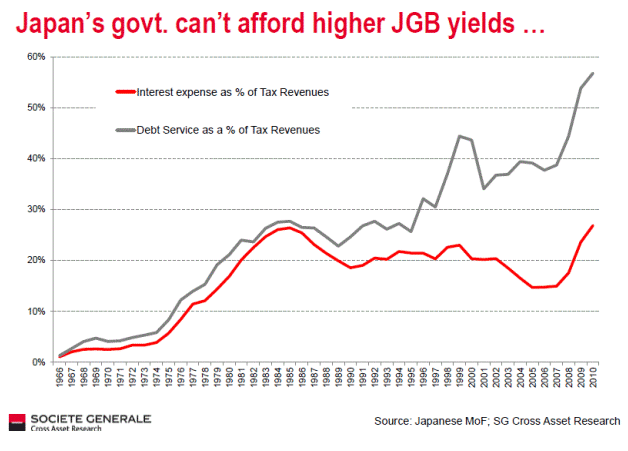
The chart below lays out the most ominous implications for Japan.
Grice said that if JGP yields rose to only 3%, it would mean that Japan would be spending more than half its revenues on interest payments.
“The Japanese cannot afford higher JGB yields,” he said.
The buyers of JGBs have been the Japanese household sector, he said, many of whom are or will soon be retired. They will be running down their debt, rather than accumulating more, and Grice said this will force yields higher. Grice said the IMF expects the debt absorption capacity of the Japanese household sector to be exhausted in 2013 or 2014. The state-run Japanese pension system is already a net seller of JGBs.
The only way for Japan to avoid higher yields, Grice said, is for a buyer to emerge who would be less price-sensitive than the capital markets would otherwise dictate. Historically, that has been the central bank, and that equates to debt monetization.
One counterargument to Grice’s thesis is that Japan can temper rising inflation by relying on its huge current account surplus. Grice dismissed that logic, arguing that higher interest rates would come with a loss of confidence in the Yen, which would trigger a capital flight that would deplete the surplus.
Moreover, he said the two biggest catastrophes of the 20th century – the Great Depression in the US and the Japanese crash of 1989 – occurred when those countries were the world’s biggest creditor nations.
Investment implications
While fear of hyperinflation has not affected the Japanese debt markets, the Japanese equity markets are now trading at a historically cheap level, Grice said.
His firm determines valuations using a proprietary measure called the Intrinsic Value to Price (IVP). Grice said the IVP on Japanese equities is at its most attractive level in over two decades, with the exception of a brief period during the financial crisis in 2008. The Shiller P/E ratio for the Japanese Topix index is similarly attractive at 16-times earnings.
By contrast, Grice said his IVP model indicates the S&P 500 is highly overvalued.
Grice expects Japanese equities to perform well in an inflationary environment. In the inflationary 1970s, he said equities roughly returned the same as cash on an inflation-adjusted basis. Overall, the valuation one pays is the most important determinant of performance, he said, and today that bodes well for future returns.
If Japan is able to navigate through a period of moderate inflation, it would be a boon to its economy, as well as to equity valuations. The economy would benefit from higher tax receipts, and equities have typically performed best during moderate inflation.
Japanese equity investors can hedge against possible hyperinflation relatively inexpensively, Grice said. You can buy 10-year futures contracts to protect against a rise in rates at a cost of approximately 40 to 50 basis points annually. In addition, a US investor would need to hedge against currency risk. The cost of that hedge would be another 50 basis points per year, depending on the currency (Grice’s choice would be the Norwegian Krone). But an investor might not need to hedge their entire currency risk, he said, and he advocated hedging only 10% of that risk at a cost of 4 to 5 basis points per year.
The bigger question, though, concerns the implications for the US economy. On this point, Grice was surprisingly optimistic.
He said Japan is clearly a “leading indicator” for the debt problems facing the US, but our problems may be a lot easier to fix, and we have a lot more time to fix them.
Grice said the problems in the US are closely linked to our entitlement programs – specifically Medicare – and could be fixed “with the stroke of a pen,” for example by means-testing benefits.
Nonetheless, Grice said he is surprised that the breakeven inflation rate on 30-year TIPS is 2.6%. This reflects an optimistic view of the ability of policy makers to contain inflation over a very long time horizon, he said, and indicates that the bond markets are mispricing risk. Investors should take advantage of these market conditions and buy protection now, when inflation expectations are low.
By the same logic, Grice said gold is undervalued, and its current price reflects unrealistically low inflation expectations over the long term.
Grice would buy 30-year TIPS over 30-year nominal bonds. But, in the event of hyperinflation in the US, he said investors should prepare for the possibility of an outright default on TIPS.
Ultimately, the hyperinflation risk for the US is political, not economic. “Inflation risk is the path of least political resistance,” Grice said. The US can easily avoid the nightmare scenario, provided the necessary measures are taken by policy makers to deal with entitlements.
Read more articles by Robert Huebscher