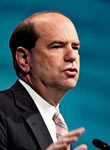
Only entitlement reform can bridge the federal deficit, and your clients should prepare for changes to Medicare and Social Security, according to Andy Friedman. Cost-sharing and means-testing are among the big changes that Friedman sees on the horizon.
Don’t expect much progress in the near term, though, as Friedman forecast continued gridlock on the budget at least until the 2012 elections are decided. Ultimately, he said, rising interest rates – brought on by a lack of buyers for Treasury securities – will be the catalyst to entitlement reform.
Friedman spoke at IMCA’s annual conference in Las Vegas last week. His firm, Washington Update, provides political analysis focusing on how various outcomes will affect advisors and investors.
I’ll review Friedman’s predictions for what legislation will and will not be passed in the coming year, as well as the implications for investment decisions.
I’ll also look at a challenge to Friedman’s position on entitlement reform. According to Michael Kitces of the Pinnacle Advisory Group in Maryland, Medicare and Social Security can be “fixed” with modest increases in personal tax rates, eliminating the need for means testing.
What will and won’t happen
Friedman said the limitations of our split government are “painfully obvious” and that neither party will make headway on its major initiatives in the next two years.
The Democrats’ two key initiatives – climate change policies, such as limiting greenhouse gas emissions, and immigration reform – are too contentious to yield compromise, he said.
The Republicans have their own two issues – repealing health care reform and altering planned reforms to the financial services industry. Those won’t happen either, Friedman said. But those initiatives could move forward if the Republicans take both houses and the presidency in 2012, he said.
Friedman said there are 11 court cases challenging health care reform, and eventually the Supreme Court will decide them in May or June of 2012.
A number of other initiatives won’t move forward, Friedman said. Those include additional stimulus funding, because the Republicans oppose any further government spending. That, he said, puts the responsibility of reducing unemployment on the Fed.
Some legislation will move forward, according to Friedman, most important among it a compromise on reducing to some degree the budget deficit, which is now 11% of GDP – the highest percentage since World War II.
Friedman dismissed the argument that the economy can “grow” its way out of the deficit though increased tax revenues as business profits and individual income rebound.
“That is not what the bipartisan deficit reduction panel found,” Friedman said. “That panel said our nation is on an unsustainable fiscal path.” Even after the economy recovers, Friedman said that federal spending will increase faster than revenue. Even if federal discretionary domestic spending were reduced by a third, it would mean a savings of $150 billion – barely a dent in a $1.6 trillion deficit, he said.
Friedman said that federal entitlement spending is approximately equal to total federal revenue – about $2.2 trillion. “We finance two wars, every government agency, social programs, and stimulus by borrowing money,” he said.
Three key issues
Friedman said three topics will dominate the political discourse in the coming months: spending cuts, entitlement reform and tax reform.
Ironically, spending cuts will be the easiest, according to Friedman, both parties and the president support them. A consensus is emerging to cut some defense spending, he added.
Entitlement reform will be a lot tougher, he said, because there are two competing constituencies. First are working Americans who are not particularly close to retirement. That constituency will not want to pay more money to support those already or soon to be retired, who are the second constituency. They will not want to see their benefits reduced.
The first solution, Friedman predicted, would be more patient cost-sharing. Those on Medicare will have higher co-payments and premiums. The next solution will be means-testing: Wealthy Americans will pay “substantially more,” he said, than those in the middle class.
Means testing will extend to Social Security, he said, and the limit on FICA taxes will be raised from the first $100,000 of income to $200,000, as per the panel’s recommendations. Indeed, Friedman said, “we would be lucky if we get away with that – if it doesn't end up some higher number.” As the panel recommended, the retirement age will be increased from 67 to 69.
The good news for some, Friedman said, is that there will be generous grandfathering. “If you are 55 or older, you are going to get all your social security right when you expect to get it,” he said. “But as you are doing retirement projections for clients under 55, I am not sure I would include Social Security.”
I’ll return to the debate over the entitlement program reform, but first let’s look at tax reform, Friedman’s third element. He said the government will eliminate certain deductions and credits and might drop the highest marginal rate as low as 23%. Everybody will be paying taxes, he said – whereas currently 45% of American families paid no income tax at all.
“Regardless of your income level, you have to expect that after 2012 you will be paying higher taxes, whether it is because Congress manages to eliminate deductions, or Congress stalemates and we watch the Bush tax cuts expire at the end of 2012,” he said.
The Republican position, which is not to raise taxes on anybody for any reason, is untenable, according to Friedman.
Similarly, the Democrats will fail in their promise to not take away retirement benefits from anyone, no matter their age, he said.
The path to progress
With those deeply entrenched positions, how does Friedman say there will ever be progress? “We are going to see it because it is going to be forced upon us,” he said.
At some point China is going to look at our fiscal situation, and it is going to slow down its purchases of Treasury bonds, according to Friedman. When that happens, interest rates will rise in order to attract additional buyers of federal debt.
That will be “terrible” for the deficit, he said, and it will spur a compromise on the deficit. The International Monetary Fund, when it issued a report two months ago chastising the US for its deficit, was an early warning sign, and S&P’s move to put the US on its credit watch list was further evidence this process is unfolding already, according to Friedman.
No Republican or Democrat will allow the US to lose its AAA rating, he said, and that threat could be the external event that forces Congress to solve the budget problem – well before there is any chance the US would default on its debt.
Given that Congress barely eked out $38 billion in budget cuts a month ago, and that tax increases are out of the question, Friedman said there will be “severe brinkmanship” in regard to the debate on raising the debt limit.
Congress, which could barely figure out what to do about the expiring Bush tax cuts before an off-year election, stands no chance of making important changes now, coming into the 2012 presidential election, according to Friedman.
“We are going to see this thrown into a lame duck session where you have a lame duck Congress and maybe a lame duck President deciding where our taxes are going,” he said. “That is not a good way to be running the country.”
What it means for your clients
Given this macro picture, Friedman identified a number of implications for advisors and their clients.
The obvious consequence of high deficits will be higher interest rates, he said, and muted growth. Ultimately, we should expect higher taxes. He recommended hedging against rising rates and a declining dollar, possibly by buying emerging market debt denominated in local currencies.
Friedman said state-issued municipal bonds will be safe investments. States will not default, he said, and the federal government will bail them out if necessary – without forcing bondholders to take a haircut.
The same is not true, however, of municipal bonds issued by local governments. Those entities can declare bankruptcy, and Friedman said that has already happened in a few cases. He doesn’t expect many such bankruptcies, but if they do occur, Friedman said bondholders should expect something slightly less than full payment.
Friedman said the Build America Bond (BAB) program will not return, and he put the blame on the Republicans. He said they considered the subsidies paid to states under that program a form of spending, and in their zeal to cut all spending BABs became a misguided casualty.
The extension of the Bush tax credits means that the most generous estate tax regime ever will continue until the end of 2012. The first $5 million of an estate is exempted from tax, and any excess is taxed at 35%. If Congress doesn’t extend those rules, Friedman said, we go back to a $1 million exemption and a 55% estate tax rate.
If you don’t have the misfortune of dying before 2013, you still have an “unprecedented opportunity” to transfer wealth by giving away up to $5 million (or $10 million for a married couple) to one’s children or grandchildren before any changes take effect. Any growth in those funds would not be subject to tax, provided it is done through an irrevocable trust.
Friedman said there is some chance that if the exemption is reduced from $5 to $1 million, there will be a “claw-back” requiring retroactive tax payments on the amount over $1 million. Even if this is so, he said, clients will still benefit by making those gifts now because of the opportunity to avoid tax on the future growth in those assets.
While irrevocable trusts are the best way to transfer wealth, Friedman cautioned that their retained earnings are taxed at the highest rates. He advised considering municipal bonds for those investments, as well as life insurance. Annuities work very well, he said, for those who do not qualify for life insurance.
For businesses, there is an opportunity through 2012 to immediately write off expenditures on capital assets, without limitations.
Retired clients have an opportunity to take money out of an IRA and have it go directly to a charity, and it will be treated as meeting their qualified required minimum distribution, he said. They will pay no tax on that amount. That applies only in 2011, and only up to $100,000.
The debate on entitlement reform
While Friedman said means testing and cost sharing are on their way, Michael Kitces presented a different view of what it will take to put Medicare and Social Security in order, based on the recently released reports from the boards of trustees of the entitlement trust funds.
Those reports say that the Social Security trust fund will be depleted in 2036 and Medicare’s in 2024. Kitces said that those dates, and the implied “bankruptcy” of the two programs, are not as ominous as most people think. Even if the funds are depleted, he said that ongoing tax revenues from the two programs will be sufficient to pay 75% to 90% of scheduled benefits. More importantly, he said that the gap in both programs can be bridged with a modest increase in payroll taxes – a 2.22% increase for Social Security and a 0.79% increase for Medicare.
Friedman disagreed with Kitces. He said the assumption that Social Security and Medicare taxes will be used to pay the benefits under those programs is false. The government has been using those taxes to pay for other programs (defense, interest on the debt, etc), since the entitlement programs use their revenue to purchase government bonds. If, in the future, those taxes go to pay benefits, then other revenue will be needed to pay those expenses.
“Either way,” Friedman said, “we need more revenue and fewer expenses. Since Medicare and Social Security account for almost 60% of government outlays, cuts in those programs have to be part of the equation.”
Kitces said the trust funds’ government bond holdings are assets of those funds, and not an accounting legerdemain. If those holdings were corporate instead of government bonds, everybody would agree that the funds were using tax revenues to pay for the benefits of the programs.
To the extent people claim there has been a “redirection” of Social Security and Medicare funds to other spending, Kitces said they talking about the trust fund, which means they’re only talking about the excess tax revenue that wasn’t needed for current benefits. The overwhelming bulk of the revenues go directly to pay the benefits.
Friedman said the key point is that the government is putting IOUs into the trust fund, and it must either raise revenue or lower expenses in order to pay those IOUs. “It's like you saying your wife hasn't spent money because she gave you an IOU,” he said. “The family is still out the money. “
The two agree on two points: The programs will not be allowed to go bankrupt, and something needs to be done to fix them. Whether that fix will come as a modest tax increase, as Kitces suggests, or as means testing and cost sharing, as Friedman suggests, will be a hotly debated topic over the next several years.
Read more articles by Robert Huebscher