The multi-billion dollar endowments of elite institutions like Harvard, Yale, and Princeton are supposed to never be strapped for cash, but that’s not how things played out during the financial crisis, when all those schools and many others were forced to raise liquidity under adverse market conditions. The endowment model, despite those failures, is still basically sound, according to Luis Viceira, but it needs several key improvements before institutions and individuals can rely on it.
Viceira is a professor of finance at the Harvard Business School. He was the keynote speaker at last week’s annual meeting of the Boston CFA society.
The first decade of the 21st century will be remembered as what Viceira called the “golden age of alpha,” an era that began to expose the weaknesses of the endowment model. The unfavorable equity valuations and low interest rates that prevailed in early 2008 should have been a clear warning that endowments faced severe risks.
Investors face those same dangers today, Viceira warned.
I’ll discuss challenges the endowment model Viceira’s saw emerge over the past decade, and then I will turn to the three changes to the model Viceira recommended. Lastly, I’ll look at how Viceira said one of those changes – separating a portfolio’s risk into discrete components – should be applied today.
The golden age of alpha
Over the last two decades of the 20th century, large endowments prospered with a strategy that allowed them to graze the “green valleys of the investment world undisturbed,” Viceira said. They were able to easily generate excess returns by broadly diversifying into alternative asset classes.
Institutional investors shunned equities and fixed income, reduced their emphasis on asset allocation and risk management, and instead adopted unconstrained mandates that increased their exposure to commodities, real estate, private equities and hedge funds, according to Viceira.
Suddenly, though, in the early 2000s endowment managers found “elephants” in those valleys, Viceira said, who were eating the same grass. Those elephants – other institutional and high-net worth investors – needed to eat a lot of grass to get fat. Endowments were forced to thinner pastures farther up the mountainsides, where easy opportunities to graze heartily grew increasingly sparse.
Thus began the golden age of alpha, as a broadening class of investors searched deeper and wider for excess returns, and by 2008, these excess flows into hedge funds and other alternative asset classes had created bubble-like conditions, Viceira said.
Investors had nowhere to go, according to Viceira, and that fueled overcrowding in alternative asset classes. Nominal interest rates were around 3.5%, he said, and real interest rates, as measured by TIPS, were just above 1.5%.
Equity valuations were similarly unattractive. The Shiller P/E, which normalizes earnings over 10 years, was 24, Viceira said, a level at which inflation-adjusted returns project to only 3.8% over a 10-year horizon.
With the capital markets projecting such meager returns, endowments simply could not earn enough to support spending while still keeping up with inflation and growing their underlying asset base.
Lessons from the crash
One lesson from the crash, Viceira said, could be that the endowment model is “very frail.” Harvard, Yale and other adherents should “go back to their ivory towers.” While sound in theory, the endowment model could be destined to fail in practice.
Another lesson could be that diversification did not help in the face of extreme events.
A third lesson could be that risk management doesn’t work and is useless.
“Those would be the wrong lessons to learn from the crisis,” Viceira said, and those three concerns should instead be looked upon as ways to improve the endowment model.
Viceira defined the endowment model as an approach to asset management based on growth and diversification across traditional asset classes, enhanced by the pursuit of alpha using judicious risk management with a long investment horizon. That basic approach, he said, is financially sound.
One change that endowment managers must embrace is a new outlook on their investment horizon. The correct measure, he said, is the duration of one’s spending needs, analogous to the duration of a bond. Institutions that fund a high percentage of their operating budget with endowment draw must invest with a shorter horizon, or else they will be trapped in illiquid securities.
Taking a lesson from the experience of endowment investors, individuals should consider their spending needs in the context of their financial wealth, he said, and know what kind of tolerance they have to adjust those on a short notice. If an investor needs to finance 50% of his or her spending with financial wealth, and he or she lacks much tolerance to reduce spending on a short notice, clearly that investor should consider a very liquid portfolio that includes instruments that guarantee they will get those dollars out of their yield. “The asset that comes to mind is obviously TIPS or, even better, a portfolio of zero-coupon TIPS with maturities that correspond to the investor’s liabilities,” Viceira said.
He said it would be a mistake to reject the basic tenets of endowment investing, such as diversification. The alternative, he said, would be to be very costly in terms of lost opportunities. Investors would be forced to concentrate in low-risk asset classes, such as cash.
“If you decide not to fish or hunt,” Viceira said, “then you get salad for dinner – and you get it forever.” Eating salad – the equivalent of concentrating in low-risk assets – might be very healthy, he explained, but the opportunity cost of abandoning more aggressive assets classes is too painful.
Confronting today’s challenges
Today, investors face the same conditions that prevailed in early 2008 – rich equity valuations and low interest rates.
To illustrate how inflated equity valuations are, Viceira said that for Shiller P/E ratios to return to their historical average of 17, either prices would need to fall by 40% or earnings would have to grow by 62%. It would take 10 years of 5% annual growth to expand earnings that much.
Alternative asset classes are no more attractive than traditional ones. Viceira said that leverage is not as readily available or as cheap as it was in early 2008, and an even bigger problem is that overcrowding – all those elephants in the valley – remains a big problem when it comes to alternatives. While the hedge fund industry has been consolidating and fees have come down some on funds-of-funds, private equity still suffers from “a ton” of overcrowding, Viceira warned.
The implication, according to Viceira, is that investors must consider risk management more carefully.
Viceira rejected simplistic risk measures, such as value-at-risk. Risk management, he said, requires understanding the likely behavior of portfolio holdings in different market environments.
One key to understanding risk is to properly measure the beta of asset classes. During the financial crisis, investors discovered that the beta of long/short funds – which in theory should be zero – was actually close to 0.5. Those funds lost approximately 17% when the market fell nearly 40%.
Viceira said investors should identify a number of “buckets,” each of which constitutes distinct beta exposures: fundamental growth risk (whether the global economy will grow), discount rate risk (how investors are discounting that prospective growth), real interest rate risk, inflation risk and liquidity risk.
Inflation risk
To illustrate how investors can decompose risk exposure into those five categories, Viceira examined one of them – inflation risk – and how it should be assessed under today’s conditions.
Inflation risk grows with time, he said, and its obvious victim is nominal Treasury bonds. By contrast, real interest rate risk is less severe than inflation risk, and its victims are cash instruments: CDs, Treasury bills and money market funds.
If you are a long-term investor, the only way to protect against both inflation risk and real interest rate risk is with TIPS.
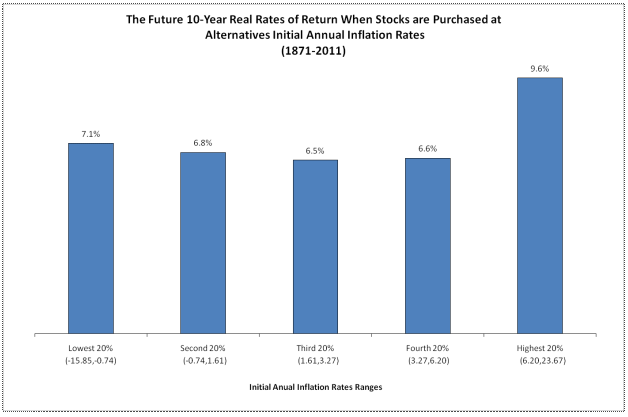
Conventional wisdom holds that stocks fare poorly under high inflation, as they did in the 1970s. But Viceira presented evidence to the contrary.
“The long-run inflation risk of stocks is very, very small,” he said, offering the following data:
This graph uses all 140 years of Shiller’s data, and it shows that returns have a u-shaped pattern, depending on inflation rates. Returns for stocks are highest at the extremes – low inflation and high inflation.
The critical message from this figure, Viceira said, is that stocks still deliver at least 6% real returns over 10-year horizons, regardless of inflation.
Investors must also consider macroeconomic conditions when assessing inflation risk, Viceira said. Investors should contemplate the projected performance of a portfolio of stocks and bonds under a mix of inflation and economic growth scenarios. I discussed this topic in a previous article, so I won’t repeat the details here.
The key consideration for investors today is to weigh the risk of stagflation against that of deflation. Deflation benefits nominal bonds but poses some dangers for equities. Stagflation, on the other hand, is a far greater threat. The combination of slow economic growth and high inflation bodes poorly for both stocks and bonds.
Commodities, Viceira said, will hedge against equities in an inflationary scenario, especially if it is caused by a supply shock. They will not do well in stagflation, when there is low growth and low demand.
One key to assessing the risk of stagflation is China. Viceira said its true inflation is close to 20%, well above its reported level of 5.3%. Its central bank is trying to stem inflation by raising reserve requirements, but those measures are reaching their limits, he said. The danger is that inflation from China will be imported into the US.
The only way the US can avoid importing this inflation is to substitute its dependence on China for other Asian economies, like Vietnam. But, he cautioned, such a shift is unlikely to be viable over the long term.
Monetary policy in the US doesn’t offer much hope, according to Viceira. He said investors are now betting on the “Bernanke call” – that the Fed can tame inflation once quantitative easing and other extraordinary measures are wound down.
Both professional forecasters and the TIPS market are betting that inflation will remain controlled and in the 2% to 3% range.
Our fiscal deficits, however, worry Viceira. He said he fears that the Chinese will become unwilling to finance our deficit, in which case there would be inflation and low growth.
“The market right now is pricing a lot more deflationary risk than stagflationary risk,” Viceira said, but he worries that stagflationary risk is greater than most fear.
Read more articles by Robert Huebscher