If you don’t have a copy of The New Wealth Management on your bookshelf, you should. From gauging the risk tolerance of your clients to measuring the performance of their portfolios, this book provides comprehensive guidance for virtually every aspect of a financial advisory practice. Harold Evensky, the lead author, spoke with me last week and highlighted some key themes in the newly released second edition.
Stephen Horan and Thomas Robinson co-authored the book with Evensky. Both are affiliated with the CFA Institute, and this edition is part of the CFA Institute Investment Series.
As Roger Ibbotson noted in the foreword, 14 long years have passed since the original edition of this book came out. But as I will describe, very little has changed since then. I’ll look at some of those changes, as well as at what Evensky said about a controversial issue – annuities – and how it will play a critical role in financial planning. Lastly, I’ll explore a couple of topics you won’t find in this book.
Bridging a 14-year gap
The overarching message of this book is one that our readers already intimately understand: Advisors should act as fiduciaries, following well-documented precepts such as placing client needs first and avoiding conflicts of interest. That message resonates as clearly now as it did in the original edition.
Evensky and his co-authors have introduced some new concepts in this edition to strengthen fiduciary relationships. One is the life balance sheet. It differs from a traditional balance sheet, where one compares client assets to liabilities, in that it includes implied components. Human capital is an implied asset that represents one’s earning potential, and one’s implied liabilities are determined based on one’s desired retirement goals.
Another concept that Evensky said underwent significant updating is in the retirement stage of planning. He incorporated a concept called “squaring the curve” to account for the fact that people are living longer and healthier lives.
“The assumption that as you get older, you’re going to spend less, may not be credible,” Evensky said.
When the original version of the book was written, expectations for returns from the capital markets were much higher than they are today. In this edition, Evensky has stressed the importance of adopting the context of lowered returns.
“We’ve got some control over expenses and taxes,” he said. “We have no control over returns.
Investment expenses don’t go down with returns, Evensky said, and he advocates planning with the assumption that returns will be more modest than they have been for the last 70 years. Evensky expects real returns on equities to be 3% to 6% over the next decade. Evensky added a discussion to his book’s new edition about core-and-satellite investing – a discipline he introduced to the financial planning community over a decade ago.
With this approach, advisors can construct the core portion of a portfolio based on lower return expectations and invest the remaining satellite portion once essential liabilities have been funded through core investments.
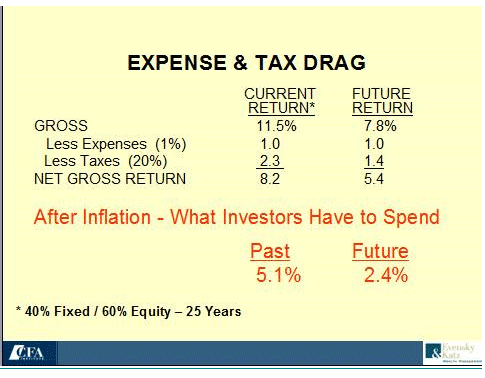
He provided the following table to illustrate how clients’ inflation-adjusted spending will suffer, once expenses and taxes are considered in a low-return environment:
Practitioners agree that returns will be more modest than in the past, Evensky said, but very few look at the consequences.
The most important products for financial planning
Evensky said that when wrote his original edition, he would wash his mouth out with soap before even talking about immediate annuities.
He has completely changed his mind and now thinks two products – fixed-immediate annuities and longevity insurance are going to be “the most important vehicles over the next decade, largely because the products are now reasonably priced.”
With a fixed-immediate annuity (also called a single-premium immediate annuity), the investor pays a fixed sum today and receives fixed payments for life.
A ”longevity insurance” annuity is one where the investor pays a fixed sum today and then receives fixed payments for life, which typically begin 10 or 20 years later. We reviewed one such offering here.
Evensky said longevity-insurance annuities should be viewed as tax-deferred CDs, particularly because there are no hidden expenses in the product.
Payout rates have decreased on both types of annuities, and Evensky said he does not currently recommend them; however he believes that as interest rates return to more historically normal levels, they will play a critical role in planning.
As for variable annuities, Evensky said he only uses them in his practice for asset protection. That’s because in Florida, where his practice is based, they are considered an insurance product and are protected from creditors. He said the expenses on variable annuities generally make them unappealing, and clients have to have a long accumulation and distribution period before they become cost effective.
“That’s true even for low-cost annuities,” he said.
The bucket approach
One trend that has gained popularity among advisors is a “bucket-based” approach to financial planning, in which separate asset accounts (the buckets) are set aside to fund aspects of the client’s retirement. These aspects can be goal-oriented, such as for children’s education, living expenses and bequests, or they can be age-based.
Evensky criticized this approach, saying that it has some “really serious fatal flaws.”
He said these approaches may carry a lot of initial appeal for both the planner and the client, but the implementation is problematic. For example, if the buckets are age-based, some will be invested in equities and some in fixed income. Over time, however, those buckets need to be continually rebalanced, and asset allocations must be shifted as the client ages. Transaction expenses and tax drag will be too costly, he said, and there are too many moving parts for the approach to be effective.
“It just does not seem practical or feasible, and no one has explained to me how it can be done,” he said.
In his own practice, Evensky uses what is essentially a two-bucket approach – one that he can effectively implement and monitor. He maintains a cash reserve for clients that is sufficient to handle liquidity needs over a five-year period and invests the remainder of client assets with a longer-term horizon.
What you won’t find in this book
I asked Evensky about a couple of topics that were not addressed in the book.
One is how to deal with inflation. There is a considerable discussion of TIPS, which Evensky uses in all his client portfolios. He manages his fixed-income allocations by keeping duration relatively short, and he uses a laddered approach with actively-managed bond funds. The book presents its analysis in terms of real, inflation-adjusted returns, but it does not discuss hedging against extreme events, such as very high inflation.
Evensky said if he were to anticipate higher inflation or even hyperinflation, he would increase his allocations to commodities and natural resources.
“We don’t plan for Armageddon,” Evensky tells his clients. “If it comes, all bets are off anyway.” Most clients just don’t have enough money to plan for Armageddon, he said. It is very easy to say you will protect against certain events, he said, but the problem is that after a crash, there will not be enough money for clients to achieve their goals.
Another topic not discussed in the book is macroeconomic analysis and how it should be incorporated into the planning process.
“We think the news that affects the media is noise for the most part,” Evensky said.
He said that his firm makes some basic assumptions about where the economy is in the business cycle – for example, he said that his view now is that inflation will go up. He said he also looks at whether asset sub-classes like value or growth are undervalued and adjusts allocations accordingly.
He only employs tactical investing in the satellite portion of his equity allocation and assimilates economic forecasts into his portfolio-construction primarily as part of a long-term strategic planning process. His required reading list includes publications such as the
Journal of Investing, the Journal of Portfolio Management and white papers from firms such as iShares and DFA. He reads consumer publications such as
Money Magazine and Kiplinger’s, mainly because he believes it’s important for he and his staff to understand what their clients are reading.
“At the bottom of my list, although I read it and pay attention to it, are things like Barron’s and the Wall Street Journal,” he said. “They are interesting and fun, but they’re less pertinent to me than the others.”
Looking ahead
Evensky suggested that advisors should read the first six chapters of his book, which will help them think through the planning process. Those chapters convey the core of how his firm operates. From there, readers can pick and choose chapters based on their interests or where they have the least knowledge.
One topic that Evensky recommended is the risk-coaching process, which is discussed in chapter four. He said his firm has employed it for a long time and it has been very effective.
Evensky is already planning the next edition.
“It’s going to be the whole world of managing the process of distribution,” he said. There is a constantly evolving array of choices for how clients can invest and protect wealth while in the distribution phase, Evensky said.
One example he gave are of reverse mortgages, which have been maligned in the media and by many advisors. They are a tool that he is now reconsidering. Evensky teaches at Texas Tech University, and he’s been working with his colleagues and graduate assistant on a paper advocating the use of standby reverse mortgages as a way for clients to create additional “standby” liquidity, analogous to a home equity loan.
“It looks like this is going to be an immensely powerful tool,” he said.
Tools such as reverse mortgages solve the problem that his cash-flow reserve approach often requires clients to keep money in low-interest accounts. A reverse mortgage, even if it is not drawn down, can reduce the amount of cash that is invested in that way.
In addition to the emergence of immediate annuities as a key planning tool, Evensky expects mutual funds to come out with various types of built-in guarantees on their products to help clients manage longevity risk and hedge against other adverse events.
Unfortunately, he said, there’s also going to be a lot of expensive “junk” offered, but that will also create opportunities for advisors to add value by steering clients clear of bad investments.
“Eventually advisors are going to wake up to the fact that they can’t afford to have all the fun and manage all the moving parts — buying and selling stock and being big Wall Street mavens,” he said. “There’s just too much cost in it and not enough return to justify it. So simplicity is going to be one of the stories.”
Read more articles by Robert Huebscher