Brian McMahon is the chief executive officer and chief investment officer for Thornburg Investment Management, where he is responsible for the company’s overall investment activity. Brian is also a co-portfolio manager for the $3.8 billion Thornburg Investment Income Builder Fund (TIBAX). The fund’s goal is income production, and it is in Morningstar’s World Allocation category.
Christopher Ryon is a managing director for Thornburg Investment Management and co-portfolio manager of the Thornburg Municipal Bond Funds. Chris specializes in the trading, monitoring and structuring of municipal bond strategies.
Advisor Perspectives interviewed McMahon and Ryon on July 18, 2011.
Assuming a municipal bond investment allocation between $1 million and $5 million, when would you recommend an investor use your funds rather than have you manage an individual portfolio as a separate account?
Ryon: It depends on the individual and their goals. Below $5 million, I would suggest a fund versus a separate account, although we run separate accounts smaller than $5 million. With a fund, you’re going to get instant diversification and daily liquidity.
What are the advantages of a separately managed account?
Ryon: A fund is going to maintain a maturity of, say, five years throughout its life. Whereas if you have a separate account, your securities are going to be aging and rolling down the yield curve. You also control your own destiny in terms of capital gains and capital loss recognition, and you don’t have to worry about other people influencing the performance of your investments. For example, if the market is going lower in yield, you may find people coming into the fund, which could dilute your income stream.
McMahon: Let’s say you’ve got a million-dollar muni portfolio, and it’s in 20 pieces, maturing in two-year installments per year. Over the next 10 years, you’ve got a portfolio anyway. It doesn’t all mature on one day. It’s no different than a fund. This is something that I have had many discussions about with clients over the years. A fund is an individual portfolio with a little bit less visibility on its holdings. It is being rolled and managed for you. But as far as what’s going on under the covers, it’s the same thing.
Say you want to know your money is going to be worth X on July 1 of 2023. You can have all your bonds mature on or near that date. You will be stacking up all your reinvestment risk on that date, and you know that 12 years from now, it’s all going to be worth X. You don't know what it’s going to be worth in the meantime, but on that day, you know it’s going to be worth X.
There are people who want that or maybe even need that if they’re investing against a known liability. But most people don’t want or need that. Who knows what the reinvestment environment will be then! It’s a bit of a myth to say it’s different than a fund, if you are running a portfolio – and we run portfolios for rich people who have $10 million – it’s no different than the fund, except, as Chris said, clients can control when gains and losses are realized.
Ryon: Depending on the size of a separate account, the transaction costs can be lower for the fund, because it’s bigger.
The fundamental difference, though, is what you said originally – that in the fund you have, to some degree, a rolling maturity, whereas in a separately managed account you have a fixed maturity.
McMahon: With the separately managed accounts we manage, we do laddered maturity portfolios. So I ask you, if we’re doing a laddered maturity portfolio, “On what date does all your money mature?” It matures over time, the same as in the fund.
Clients tell me, “Every time something matures, just let it go to cash,” so that in 10 years they will have everything in cash. But, on average, that means for the majority of the next 10 years, we’re going to be running a money fund for you, not a laddered portfolio.
There’s no difference in terms of maturity between a laddered-maturity diversified portfolio and what’s going on in a fund, which is another kind of laddering.
The only difference is in the case of the individual portfolio, where you don’t see the price every day if you happen to be so inclined. You don’t have regulators sticking their noses in. You don’t have independent trustees or auditors sticking their noses in. And you can dictate that some levers get pulled, with respect to individual positions in the portfolio, for gains or losses. You can’t do that in a fund. You have to accept that we’re trying to do that for your benefit. And our record is pretty good as tax-efficient managers.
Are you really saying that in both cases, the laddering effectively gets the investor the same duration over the course of their investment horizon?
Ryon: The duration on our municipal fund is 3.85. We have any number of individual managed accounts that have very similar duration.
We have a couple of investors who are very, very concerned about the state of the world. They don’t want to do anything and have said for the last couple of years, “Don’t buy anything. When something matures, just have it go to cash.” They’re having actually less and less of a portfolio and more and more of a bank account at this point.
You could do that in the funds too. Say every July 1st for the next five years, you sell 20% of your holdings in the fund. You come out the same place. That would let their portfolio wind down over time into cash. Economically it’s the same.
Do you still believe laddering is the best approach to fixed-income investing?
Ryon: Absolutely. Laddering works more often and has a greater return than the alternative of a barbell. It’s the most tax-efficient way to manage municipal bonds.
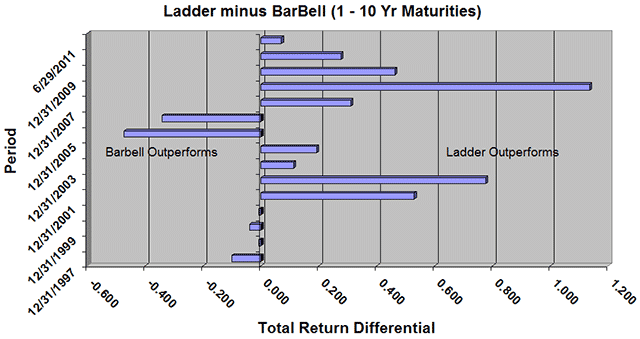
I've constructed a time series of a theoretical barbell using the Merrill Lynch one-to-two-year and seven-to-10-year indexes and compared their returns since 1997 to the Merrill Lynch Bank of America one-to-10-year index, which would represent a ladder. Looking at that data (shown below), a laddered portfolio outperformed the barbell portfolio eight out of 14 times. Three of the six times that the barbell outperformed, it did so by less than four basis points. Over the last 14 years, a ladder outperformed a barbell portfolio by 25 basis points annually.
Why is a ladder more tax-efficient?
Ryon: Because you don’t have as much turnover. If you go into a barbell structure, you have to sell to reposition the portfolio.
The major difference is that a barbell structure typically yields less than a laddered structure yields.
McMahon: You don’t get the dollar roll from aging in a barbell. If you have to buy a 10-year bond for seven and a half or eight of those years, it’s rolling down the yield curve, and it’s going up in fractions.
Does the homogeneity of municipal bond ownership – the fact that muni bonds are owned mostly by wealthy individuals –make them more vulnerable to herd behavior and a potential selloff?
Ryon: Yes, we saw that in the fourth quarter of 2010. The municipal market is about 70% owned by the retail investor, whether in individual bonds, mutual funds, ETFs or money market funds. That’s more than twice the percentage the retail investor holds in any other fixed-income market. In the corporate bond market, retail ownership runs about 30%.
In the fourth quarter, as some pundits came out and were bashing the status of municipal credit, investors pulled money out of the mutual funds. It was an old-fashioned run on the bank. Between November of 2010 and May of this year, municipal bond mutual funds lost about 9% of their assets. That has since turned around. Those pundits did a great disservice to investors.
In the last quarter, the municipal bond market has had one of its best quarters in the last couple of years. If you use the Merrill Lynch Muni Master Index as a measure, it was up about 4.5% and wiped out almost all of the loss incurred in the fourth quarter of 2010, which was about 4.5%. Overall, for the 12 months that ended June 30th, the municipal market was up 3.7%. Those investors who panicked, left the market in the fourth quarter and are coming back into the market left a lot of return on the table.
Let me ask you about another concern that’s been raised about the muni market. One prominent investor said that muni bonds face a dual risk from the Treasury market. If Treasury rates go up, muni prices will go down simply because of their duration. If Treasury rates go down, it would signal a weakening of the economy and deteriorating municipal finances, which would adversely affect muni prices. How do you react to that?
Ryon: Let’s look at the state of municipal finance right now. States and localities have seen their fifth straight quarter of quarter-over-quarter growth. In the first quarter of 2011, revenues were up almost 9% versus the first quarter of 2010. The state of municipal finance is improving.
Another point that people bring up is the state of pension plans. Well, the Pew Center on the States reported in its recent study that on average, state and local pension plans are about 78% funded. That’s down from 84% the last time it published its report, but its actuaries suggest that these plans should be about 80% funded.
It’s something to be concerned about, but a lot of states are making significant changes to their pension plans to address these issues, so the state of municipal credit is pretty good.
Now if Treasury rates go up, municipal rates will go up, because they’re an alternative investment. They will go up as much as their duration dictates.
The one thing that people should be cognizant of right now is the slope of the municipal yield curve. The difference between short-term rates and long-term rates is the greatest it’s been since 1991. Between one-year and 30-year rates, you have a slope of about 400 basis points. That’s greater than it’s been at any time since 1991. That slope may give investors in longer bonds a little bit more protection if the Fed starts raising short-term rates.
What would a Treasury default mean for the muni market, the stock market and the Treasury market? Is there any safe haven if that were to occur?
Ryon: You’ll see higher rates across the board. Investors will value municipal bonds versus Treasury bonds and choose the best alternative. You’ll see all fixed-income markets go higher in yield with the move in the Treasury market. But a default is a very low-probability event.
If there is an impasse on the budget ceiling, will the Treasury stop paying interest or principal on its debt?
Ryon: Probably not. It has enough cash flow, but that still doesn’t mean rates won’t go up. Because now the AAA rating of the government backing will be brought into question, so there’s more risk.
What might that mean for the stock market?
McMahon: If bond yields go up for that reason, I would expect stock yields would go up too. You would see compression in stock prices and in price-earnings ratios, an increase in uncertainty and a shortening in investor time horizons or how far they’re willing to look out to see growth and success.
The possibility of all this happening is not zero, but it’s pretty low.
In the Investment Income Builder (IIB) fund, you steadily decreased your bond holdings after the beginning of 2009 as 10-year Treasury rates increased by about 75 basis points. Is this something you plan to continue? And what metrics are you looking at to consider the relative value in stocks versus bonds for the fund?
McMahon: We just call them as we see them. In this particular fund, we have two goals. One is to provide an attractive current income today. The second is to grow it over time, and the most significant driver is equities that are raising their dividends. We expect as a starting point that we are going to have a majority of our portfolio in dividend-paying stocks.
On day one, when we set our benchmark, we said, “On average, we will probably be about 25% bonds and 75% stock.” It’s been as low as just under 10% in interest-bearing debt, and it’s been as high as about 50%. Over the last nine years, it’s averaged out — amazingly enough — pretty close to 25% bonds.
Today, the average dividend yield on the stocks we own is about 6%, and our average yield to maturity on the bonds we own is about 6%. They’re pretty close.
When Lehman Brothers was liquidated, and hedge funds, debt investors and insurance companies started dumping interest-bearing debt of various descriptions, debt yields got completely out of whack relative to reasonable long-term expected returns on equity, with dividends being a subset of that. When you could buy an A-rated mortgage utility bond at 10% yield just because the fixed-income markets were having a fire sale, stocks like Kraft looked a whole lot less interesting relative to bonds.
We come in every day, look at the buffet table, see what looks good and head in that direction.
Given that the yields on bonds and stocks in your portfolio are roughly equal, wouldn't you prefer the bonds?
McMahon: Not necessarily, because the bond yields won’t grow, and we hope that the equity yields on average will grow as dividends are increased. Over time those increases have happened. One unit of the S&P 500 paid a dividend of $3.14 in 1970, and today it’s going to be approximately $26, and bond yields are lower than they were in 1970.
Chris and I would like to see higher bond yields. There might be a lot of people who would get upset if Treasury yields went up 150 or 200 basis points, but not us.
We’d get a little short-term pressure on the NAV, but we know that on every dime we get to reinvest for the next five years, we will earn another 200 basis points. Big deal if our NAV goes down 4% temporarily. It would be very, very helpful to us in our Income Builder Fund to get yields up across the board.
Today is challenging because of lower bond yields and tough terms on bonds. Bond investors are on average more lenient than we are in the new issue corporate market, so we see pretty lenient terms like covenants, call protection and collateral.
Is the IIB positioned towards an economy that's recovering or one that's decelerating, and do your investments favor one scenario over the other?
McMahon: We keep our eyes on the prize here, and the prize is current income and being able to grow it over time. The businesses that do that are pretty big companies. They’re not necessarily too choppy a ride when you start to get swells. It’s not like we’re in little tiny skiffs.
Having said that, they tend to be businesses that don’t have big ups and downs. So if you’re talking about bull market conditions, is that going to make a difference to AT&T? Yeah, it’ll help. They’ve been hurt on their enterprise business a little bit. It might help their broadband business if they had more new homes connecting. But at the margin, it doesn’t make a big difference to the S&P 500 as a whole.
Some managers — for example, PIMCO and JP Morgan — have undeveloped, unconstrained bond funds. Is that something that you have plans to do or do something similar to? If so, when? If not, why not?
McMahon: We have a strategic income fund and a strategic municipal fund that are not completely unconstrained but that have pretty broad charters for being able to invest. The degree of constraint or freedom for the portfolio manager to be short or long is what we're talking about here. But we have what I consider to be relatively unconstrained products. In the case of our funds, there’s still a high priority placed on being able to produce income. The guys that are shorting the bond market, covering somebody else's income and paying an additional premium on top of that are digging themselves a pretty deep hole for the ability to produce income. It remains to be seen how well investors and advisors really understand what they’re getting into with those types of products.
Ryon: For example, the intention of our strategic municipal fund is to go where the value in the market is. In this environment, with the yield curve so steep and credit spread so wide, it has the longest duration of any of our funds — close to nine — and has the lowest credit quality of any of our funds because those are great opportunities. That fund is not a laddered portfolio because of the mandate to go to where the value is.
McMahon: At the end of the day, our attitude about bonds is they aren’t really about excitement. After 27 years, I’m happy to say that what looks like a boring concept in bonds is still chugging along. Many advisors that did business with us back in 1984 are still with us. We’ve missed out on some of the excitement, and we’ve missed out on raising some of the easy money. But we’re still in business after 27 years of good results.
From the perspectives of an income investor and a muni bond investor, what should advisors be most concerned about today?
Ryon: Being too conservative. Everybody’s concerned about when the Fed will begin raising short-term rates. They’re not diversifying their holdings along the yield curve. I mentioned the steepness of the yield curve – 400 basis points from short- to long-term rates. Many investors are keeping their durations very short.
If you were to take a simple diversified portfolio — one-third our limited-term fund, one-third our intermediate-term fund and one-third our strategic fund — and compare that portfolio to our limited-term fund alone, it exceeds the yield of the limited-term fund by 100 basis points. Over the last 12 months on a total-return basis, it would have underperformed by 16 basis points. But if an investor has an investment horizon of two to three years, the diversified portfolio outperforms the limited-term portfolio by 165 basis points annualized over two years.
By being diversified along the yield curve, you’re picking up extra income immediately, and you’re getting some of the protection we think a very steep yield curve will give investors going into the future.
McMahon: If maintaining ultimate flexibility is optimal, you should have all your money in cash. You’d be getting no income, and so your opportunity cost is huge. Weighing the cost and the risk of having to reinvest is something that people underestimate. We’re now several years beyond the financial crisis, and people really are being smacked around. Anybody who had excessive investment risk has really felt the pain.
Is that pain sharper pain than the pain of having your NAV move up and down 3% or 4% or 5% over a period of a few years? A lot of people would look back and say no. I can take a little NAV risk as long as I understand where it comes from.
Chris and I have been in the business about the same number of years, which is a bunch of years. The pattern we see is at exactly the wrong time — when it just becomes excruciating to continue to take reinvestment risk — people become victims of various schemes, and the Street is always happy to accommodate them. They invest in these things because they’re desperate for the income, not because anybody thinks these are smart programs. What Chris said about ladders, which we’ve been passionate about for 27 years, is it takes the emotion out of that decision.
Ladders are like a low-calorie diet. It’s easy to go on for the first week or month. It’s hard to stay on month after month, year after year. And if there’s one thing that we bring to the table with our limited term funds and our limited term municipal fund, it’s that you contract this out to us. We’ll keep you on the diet. People may be talking about European banks, Barack Obama, Rupert Murdoch or whomever; we’ll keep you on the diet, and you don’t have to worry about it.
Read more articles by Robert Huebscher