Advisor Perspectives welcomes guest contributions. The views presented here do not necessarily represent those of Advisor Perspectives.

Shortening the duration of a fixed-income portfolio is often considered the default option, but it is not the only way to hedge against a potential rise in interest rates. This article provides investors with a framework to analyze and implement a range of fixed-income strategies, and highlights various investment considerations that should carefully be taken into account.
Short-term interest rates in the US have been pegged at near-zero levels for almost three years, and two rounds of quantitative easing (QE) have been completed (and speculation has begun over whether QE3 will be undertaken). US economic growth, however, has only shown a glimmer of rebound. The housing market downturn, sustained high unemployment and restrained credit lending are all headwinds we still need to navigate. Furthermore, enduring political brinkmanship in the US and spreading contagion from sovereign debt crises in the euro area are further compounding the obstacles to overcome to return to a more normal economic environment.
We expect that the US economy will continue to improve, although we will likely need to overcome more hurdles in the future. Once we achieve more sustainable growth and rising inflation expectations, thoughts will inevitably turn toward rate normalization. Fiscal retrenchment (already in the works), quantitative tightening and rate increases will occur. How then should investors position their fixed income allocations? What fixed income strategies are likely to perform better while also preserving capital and fulfilling operating and liquidity needs?
Branching out from the core
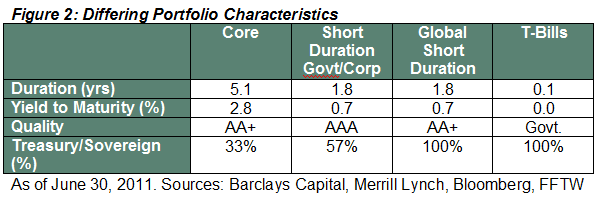
We find today that a mainstay in many investors fixed income portfolio is an allocation to Core / Core Plus1 strategies or their global counterparts. Closely monitoring this allocation over the last few years, investors have noticed shifting portfolio characteristics – increasing portfolio duration and higher Treasury allocations. Owing to relatively heavy, longer-dated recent Treasury issuance (which is expected to continue), the Core bond index2 not only has a higher Treasury allocation of 33% but also a longer duration of 5.1, up from 22% and 4.6 three years ago. This trend is exactly opposite to the positioning needed to be defensive in a rising rate environment, as the safe-haven status of US sovereign credit quality comes under increasing scrutiny.
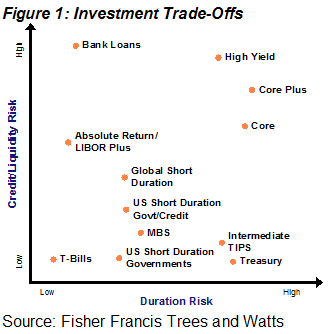
What then are the options outside of Core? Figure 1 below illustrates different investment options along duration and credit spectrums.
1. Core strategies are those benchmarked to the Barclays Capital Aggregate Bond Index; Core Plus strategies are also benchmarked to the same index but also allow off-benchmark investments in high-yield markets, international bonds, foreign exchange markets and emerging market debt.
2. Barclays Capital Aggregate Bond Index as of June 30, 2011
The different strategies emphasize varying degrees of investment risk – duration, credit, volatility, prepayment, real interest rate, liquidity, etc. Investors must assess which risks they are willing to assume, depending upon their investment objectives and the purpose of the funds.
To hedge against rising interest rates, the first strategy typically explored is reducing duration. Differing portfolio characteristics of Core versus three often-considered shorter-duration strategies — Short Duration Government/Credit (SD G/C), Global Short Duration (GSD) and Treasury Bills (Bills)3 — can be seen in Figure 2 below.
While Core has a higher duration of 5.1 versus the 1.8 of SD G/C, it yields close to 2% more, due to (i) the additional yield picked up by investing further out on the (upwardly sloping) yield curve and (ii) in higher yielding credit and securitized sectors. This higher yield provides a buffer during periods of rising rates. If rates were to rise 1% (100 basis points) in a parallel move over the course of a year, all else being equal, the price of a Core portfolio will fall 5.1%, while a SD G/C portfolio will fall only 1.8%. But the Core portfolio would have earned 2.1% more during that period. Hence the return shortfall for the Core portfolio is only 1.2%.
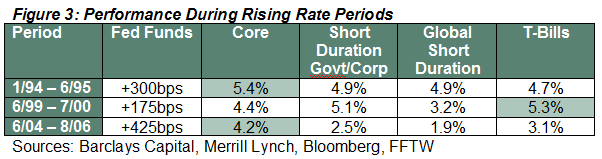
We next examine how these four strategies have performed during periods of rising interest rates over tightening cycles in the past two decades, with the best-performing strategy highlighted in Figure 3.
Core strategies performed better than the other three short-duration portfolios during two of the last three tightening cycles. This can be primarily attributed to (i) the higher yield of Core investments providing a buffer to lower price returns, and (ii) rising rate environments creating bear-flattening yield curves that disproportionally affect the short-intermediate sector.
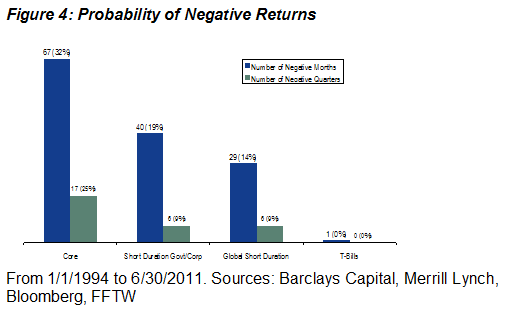
Longer duration portfolios, even those with higher credit weightings, are not only more volatile but also have a higher associated probability of delivering negative absolute returns. The frequency of negative returns for the same four strategies can be seen in Figure 4 below.
Any investment decision cannot be made solely on the basis of total returns. Preserving wealth is more important if the purpose of the funds is to meet spending needs or serve as dry powder for future opportunistic investments.
3. As represented by the following indices: Barclays Capital Aggregate Bond Index, Merrill Lynch 1-3 year Government Corporate Index, Merrill Lynch 1-3 year G7 Global Government Index and 3-month Treasury Bills.
Timing is everything
Spot yields today are at historically low levels. The next move in interest rates is most likely going to be higher, but it is uncertain when this will occur and what the trigger might be. Despite S&P’s US sovereign credit downgrade and the end of QE2, virtually no upward pressure on yields has materialized. Strategies premised on an upward rate move have thus far been frustrating, as the opportunity cost of going short is high. The steep yield curve and high forward yields provide a buffer against rising rates. In the near-term, we expect that Treasury yields will remain low and the yield curve will stay steep – the Federal Reserve has clearly communicated that rate increases will be on hold until mid-2013.
While it is virtually impossible to forecast the exact timing and magnitude of future interest rate movements, investors should prepare to reposition their fixed income portfolios should interest rates begin to rise. Shortening the duration of the fixed income portfolio is not the only option available. Actively managed strategies that investors should consider to hedge against interest rate risk include:
-
Actively managed duration and yield curve positioning: Given the steepness of the yield curve, carry-and-roll-down strategies are very attractive, and going short today can be costly. Reducing duration exposure is only likely to pay off if rate increases are greater than those priced into (already high) forward-yield curves.
-
Increased credit or prepayment risk: Investing in these spread sectors provides an incremental yield that can buffer against rising rates.
-
Global investment: Owing to diverging economic and monetary policy cycles, global investing provides greater opportunity today for active managers to capitalize on these differences and potentially deliver higher excess returns.
-
Absolute return approach: Don’t let the constraints of following a changing Core benchmark drive your investment portfolio. A low-duration, floating-rate strategy that combines three or four high-quality alpha trading styles (e.g., currencies) can deliver targeted and customized returns.
Reducing the duration of the fixed income portfolio is often seen as the default way to hedge against an imminent rise in interest rates. There are, however, a number of alternative strategies and related investment considerations that should be carefully taken into account. Investors should carefully weigh the costs and benefits to determine the fixed-income strategy that works best given their unique investment objectives.
Jayant Kumar, CFA, is responsible for sales and marketing efforts within the endowment, foundation and non-profit marketplace at Fisher Francis Trees & Watts, a New York-based institutional fixed income asset manager. He is also the product manager for inflation-linked and alpha strategies. Jayant can be contacted at
or at 212.681.3143.
Additional Disclosures
The information and opinions expressed herein are current only as of August 15, 2011 (or such earlier date or dates indicated herein). This document is confidential and may not be reproduced or redistributed, in any form and by any means, without FFTW’s prior written consent. Past performance is not indicative of future results which may vary. There can be no assurance that the investment objectives of any investment strategy or portfolio will be achieved or that any targeted or expected returns, or targeted or future tracking volatility, will be achieved. A portfolio may suffer loss of principal, and income, if any, may fluctuate. This document is not to be construed as an offer to buy or sell any financial instrument and is for information purposes only. FFTW has no obligation to update this document and any views expressed herein may change at any time. FFTW provides no assurances as to the completeness or accuracy of the information contained herein. Statements concerning financial market trends are based on current market conditions, which will fluctuate. The information contained herein includes estimates and assumptions and involves significant elements of subjective judgment and analysis. No representations are made as to the accuracy of such estimates and assumptions and there can be no assurance that actual events will not differ materially from those estimated or assumed. Investment advice or recommendations, if any are set forth herein, may not be suitable for readers or any portfolio. Readers should independently evaluate the information and opinions presented herein and reliance thereon is at their sole discretion. Fischer Francis Trees & Watts, Inc. is registered with the US Securities and Exchange Commission as an investment adviser under the Investment Advisers Act of 1940. Fischer Francis Trees & Watts Limited is authorized and regulated in the UK by the Financial Services Authority. Products and services of FFTW are directed exclusively at professional clients as defined by the rules of the Financial Services Authority. Products and services are not available to retail clients. FFTW UK Limited is also registered with the US Securities and Exchange Commission as an investment adviser under the Investment Advisers Act of 1940. FFTW Singapore Limited is registered as an exempt investment adviser with the Monetary Authority of Singapore. FFTW Singapore Limited is also registered with the US Securities and Exchange Commission as an investment adviser under the Investment Advisers Act of 1940.
Read more articles by Jayant Kumar of Fisher Francis Trees & Watts