Few financial planning topics have garnered as much attention as safe withdrawal rates (SWRs), but a key question remains unanswered: Can retirees sustain a 4% withdrawal rate with minimal risk? With the recent introduction of 30-year TIPS, the answer is now yes.
Retirees can withdraw up to 4% per year (on an inflation-adjusted basis) over a 30-year period from a portfolio consisting of solely 30-year TIPS with very high success rates. Unlike a traditional stock-bond portfolio, a TIPS portfolio is not exposed to risk from the equity or fixed-income markets or from unanticipated inflation. The only source of risk is from volatility in real interest rates.
The implications of these results are clear. If a retiree has sufficient funds to support a 4% withdrawal rate over 30 years, then those funds should be invested in TIPS. Funds should only be invested in stocks and bonds if the required withdrawal rate is greater than 4%.
I will discuss how we modeled the TIPS portfolio and then compare it to the results of a 60/40 stock/bond portfolio. I will analyze the performance of a 60/40 portfolio assuming stock and bond returns based on historical averages and show how it performs if more modest “new normal” stock returns are assumed. Lastly, I will look at the results of the 60/40 portfolio if inflation is modeled as a random variable instead of as a constant rate.
Louis Mittel, a member of our research staff, designed and built the Monte Carlo simulation model used in this analysis. Michael Edesess, an economist and mathematician and an advisor to our company, designed the framework for this analysis.
Modeling the all-TIPS portfolio
When we constructed our model in mid-July, 30-year TIPS yielded 1.57%, and that was the basis for our analysis. This portfolio is nearly completely protected from inflation, since coupon payments from TIPS are indexed to the CPI-U rate reported by the government. Only to the extent that inflation associated with the retiree’s expenses differs from the reported CPI-U rate is the investor exposed to inflation risk. There is no risk from equity or bond market performance.
Assuming no change in real interest rates, a portfolio of 30-year TIPS can sustain 4% withdrawals, leaving the retiree with $53,220 in present value at the end of 30 years. A slightly higher withdrawal rate of 4.13% would leave the retiree with no remaining principal.
One important source of risk must be considered, however, and that is the volatility of TIPS interest rates (the “real” or inflation-adjusted yield). Increases in real yields will decrease the value of the portfolio and threaten the sustainability of the projected withdrawal rate. Conversely, a decrease in real yields will provide the retiree with additional funds.
We used Monte Carlo simulation to examine the effect of volatility in real interest rates on withdrawal rates in an all-TIPS portfolio. The key assumption in our model was the standard deviation of the annual return for TIPS contracts. We used three sets of assumptions, beginning with 2.59%, which is Vanguard’s calculation for the annual standard deviation of 20-year TIPS. Research by Harvard professor Luis Viceira and Carolin Pfleuger has shown that TIPS are more volatile, however. They found that TIPS volatility ranged between 5% and 8% from 2004 to 2008 and then increased dramatically to almost 14%, based on annualizing daily returns and using 10-year contracts. We ran our model with standard deviations of 6.5% (the mid-point between 5% and 8%) and 14%, to show the sensitivity of our results to changes in this variable.
Our method of simulating each price in a sequence of annual TIPS prices is to generate a random one-year TIPS return using the current yield-to-maturity (YTM) as the expected return and the assumed standard deviation (2.59%, 6.5%, or 14%), then use that one-year return to infer the remaining YTM, from which the price can be backed out.
Our results are presented in the three tables below, for each of the three standard deviations. Each table shows the median present value of the terminal principal (based on a beginning principal of $1 million) and the success rate (the percentage of simulations where the principal was not exhausted) for each of four time horizons (30, 25, 20 and 15 years) for withdrawal rates from 3.5% to 6.5%.
Std dev=2.59% |
|
Success rate before year
|
Withdrawal rate |
Median present value of
terminal principal |
30 |
25 |
20 |
15 |
3.5% |
$252,971.18 |
100.0% |
100.0% |
100.0% |
100.0% |
4.0% |
$60,253.82 |
97.1% |
100.0% |
100.0% |
100.0% |
4.5% |
$0.00 |
0.0% |
100.0% |
100.0% |
100.0% |
5.0% |
$0.00 |
0.0% |
40.1% |
100.0% |
100.0% |
5.5% |
$0.00 |
0.0% |
0.1% |
100.0% |
100.0% |
6.0% |
$0.00 |
0.0% |
0.1% |
61.7% |
100.0% |
6.5% |
$0.00 |
0.0% |
0.1% |
0.4% |
100.0% |
|
|
|
|
|
|
Std dev=6.5% |
|
Success rate before year |
Withdrawal rate |
Median present value of
terminal principal |
30 |
25 |
20 |
15 |
3.5% |
$252,731.18 |
100.0% |
100.0% |
100.0% |
100.0% |
4.0% |
$60,908.90 |
77.4% |
100.0% |
100.0% |
100.0% |
4.5% |
$0.00 |
5.8% |
94.7% |
100.0% |
100.0% |
5.0% |
$0.00 |
0.0% |
45.5% |
99.8% |
100.0% |
5.5% |
$0.00 |
0.0% |
5.2% |
91.7% |
100.0% |
6.0% |
$0.00 |
0.0% |
0.2% |
54.6% |
100.0% |
6.5% |
$0.00 |
0.0% |
0.1% |
14.2% |
99.8% |
|
|
|
|
|
|
Std dev=14% |
|
Success rate before year |
Withdrawal rate |
Median present value
of terminal principal |
30 |
25 |
20 |
15 |
3.5% |
$254,370.69 |
94.7% |
99.7% |
100.0% |
100.0% |
4.0% |
$52,994.13 |
62.2% |
95.3% |
99.8% |
100.0% |
4.5% |
$0.00 |
22.7% |
76.8% |
98.2% |
100.0% |
5.0% |
$0.00 |
4.7% |
46.2% |
90.6% |
99.9% |
5.5% |
$0.00 |
0.7% |
22.3% |
73.3% |
99.4% |
6.0% |
$0.00 |
0.0% |
8.0% |
50.8% |
96.9% |
6.5% |
$0.00 |
0.0% |
2.7% |
30.5% |
90.0% |
The all-TIPS portfolio does not guarantee success over a 30-year horizon, even for the modest withdrawal rate of 3.5%. But as we will see in the next section, these results are significantly better than a 60/40 equity/fixed-income portfolio for modest withdrawal rates.
Before adopting this approach, the key question an investor must consider is the likelihood that the volatility of 30-year TIPS will be as high as a standard deviation of 14%. Under these conditions, 3.73% of the monthly observations had real interest rates that exceeded 5%, the highest observed value ever. With a standard deviation of 6.5%, only 0.02% of monthly observations exceeded 5%.
Comparing these results to a 60/40 portfolio
Let’s now compare these results to a more traditional equity-centric portfolio. We used Monte Carlo simulation to model a 60/40 equity/fixed-income portfolio. We ran our model with a projected rate-of-return for equities of 9.58%, which was the forward-looking projection used by Ibbotson & Associates in their simulations. We used Ibbotson’s standard deviation of 20.32% for equities, and bond returns of 4.36% with a standard deviation of 6.79%. Our stock-bond correlation was 0.23. Ibbotson’s assumptions are consistent with the annual return on US large-cap equities from 1926-2010, which was 9.86%, and the standard deviation of monthly returns over that period, which was 19.19%. The standard deviation of annual returns over that period was 16.7%; using that standard deviation would improve success rates. For example, with a 4% withdrawal rate, a 9.58% equity return and a 30-year horizon, the success rate from 71.7% to 76.5%.
But we also wanted to examine the results under a “new normal” scenario with more modest equity returns. In a recent interview, Harold Evensky, of Florida-based Evensky & Katz, said that he expects real (inflation-adjusted) returns for equities to be 3% to 6% over the next decade. We ran our model with projected equity returns of 7.6%, consisting of the mid-point of Evensky’s projections (4.5%) plus historical inflation (3.1%). We kept the standard deviation at 20.32%.
We also modeled a more optimistic assumption for US equities, using a projected return of 11.6% and a standard deviation of 20.32%. This provides three evenly spaced equity returns: 7.6%, 9.58% and 11.6%.
We also modeled inflation as a random (stochastic) variable. From 1926-2008, inflation averaged 3.1% with an annual standard deviation of 4.2%. It had a serial correlation of 0.64 and was uncorrelated to stock returns. Inflation had a -0.05 correlation to bond returns.
The results of those simulations are below:
Equity return of 7.6% |
Success rate before year |
Withdrawal rate |
Median present value of terminal principal |
30 |
25 |
20 |
15 |
3.5% |
$398,148.72 |
70.7% |
93.5% |
82.3% |
99.3% |
4.0% |
$175,604.30 |
59.3% |
88.1% |
72.8% |
98.3% |
4.5% |
$0.00 |
48.1% |
79.9% |
61.7% |
95.4% |
5.0% |
$0.00 |
38.1% |
70.1% |
51.3% |
91.8% |
5.5% |
$0.00 |
28.4% |
60.7% |
40.9% |
86.5% |
6.0% |
$0.00 |
21.8% |
50.8% |
31.9% |
79.3% |
6.5% |
$0.00 |
16.6% |
41.4% |
25.2% |
71.1% |
Equity return of 9.58% |
Success rate before year |
Withdrawal rate |
Median present value of terminal principal |
30 |
25 |
20 |
15 |
3.5% |
$841,741.05 |
81.7% |
96.6% |
89.8% |
99.7% |
4.0% |
$556,206.11 |
71.7% |
92.6% |
82.5% |
99.1% |
4.5% |
$281,765.56 |
61.3% |
87.3% |
73.8% |
97.5% |
5.0% |
$33,912.74 |
51.2% |
79.4% |
63.4% |
94.7% |
5.5% |
$0.00 |
41.9% |
71.9% |
54.1% |
91.7% |
6.0% |
$0.00 |
33.6% |
62.6% |
45.0% |
86.6% |
6.5% |
$0.00 |
25.9% |
53.2% |
35.9% |
79.5% |
Equity return of 11.6% |
Success rate before year |
Withdrawal rate |
Median present value of terminal principal |
30 |
25 |
20 |
15 |
3.5% |
$1,469,191.89 |
89.6% |
98.4% |
94.5% |
99.9% |
4.0% |
$1,201,531.36 |
83.3% |
96.3% |
90.1% |
99.5% |
4.5% |
$846,202.97 |
74.6% |
92.5% |
83.0% |
98.9% |
5.0% |
$525,106.06 |
65.7% |
87.7% |
75.6% |
97.6% |
5.5% |
$199,017.69 |
56.1% |
80.8% |
66.6% |
94.5% |
6.0% |
$0.00 |
46.0% |
73.3% |
57.0% |
91.5% |
6.5% |
$0.00 |
37.6% |
64.2% |
47.9% |
86.2% |
These results are markedly inferior to the most pessimistic results for the all-TIPS portfolio (using a standard deviation of 14%) for withdrawal rates of 3.5% and 4%. A retiree who requires a withdrawal rate of 4% or less will be better served by an all-TIPS portfolio. For higher withdrawal rates, the results of the 60/40 portfolio are superior to the all-TIPS portfolio, as expected.
In fairness, our results are also inferior to those obtained by a number of other SWR researchers (e.g., Cooley, Hubbard and Walz and Spitzer, Strieter and Singh) using Monte Carlo simulations. The differences can be explained the model’s assumptions (e.g., equity rate-of-return and standard deviation), which also highlights the sensitivity of any results to those assumptions.
In a study published in July, Athavale and Goebel found that the use of lognormal distributions in SWR research for equity-centric portfolios has overstated success rates. Modeling other types of distributions, they found that success rates were markedly lower.
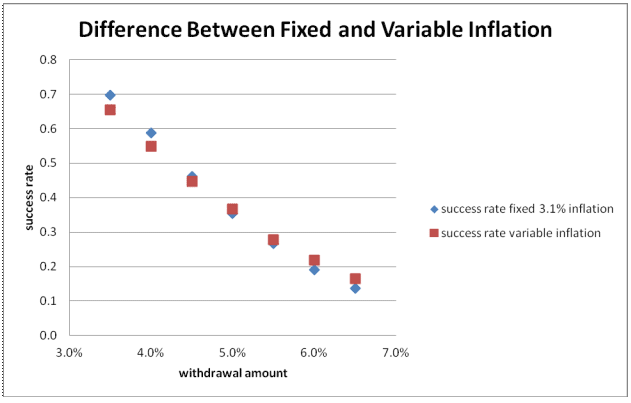
Most SWR researchers treat inflation as a fixed variable, rather than as a stochastic variable as we did. We wanted to see how our results would differ if inflation were held constant at its historical average of 3.1%. Those results are illustrated below:

This graph plots the success rate for various withdrawal percentages, with inflation as a random and a fixed variable, using equity returns of 7.6%. Treating inflation as a random variable results in lower success rates for modest withdrawal rates and the reverse for more aggressive withdrawal rates. The differences are not significant.
Adding volatility to the inflation rate increases the probability of tail events. Hence, it increases the likelihood of failure when failure would otherwise be unlikely (low withdrawal rates) and increases the likelihood of success when success would otherwise be unlikely (high withdrawal rates).
Simulations versus historical data
Other researchers, such as Bill Bengen, have used historical data in their analyses, and their results for equity/fixed-income portfolios have had higher success rates than ours, which used Monte Carlo simulations.
Historical data is a function of certain fundamental parameters – such as the historical riskless rate-of-return and the equity risk premium – that may be unlikely to apply in the future. With simulation it's easy to adjust for that, but with historical data it is more difficult. There is also the problem of using rolling periods from a finite data series, which emphasizes some historical periods more than others. One can avoid that by using a continuous loop, juxtaposing the last period of data with the first period, but that introduces other biases. In general, one should have a theory in mind when simulating the future instead of using a mindless replication of past data.
Vanguard’s John Bogle supports this position. “My concern is that too many of us make the implicit assumption that stock market history repeats itself when we know, deep down, that the only valid prism through which to view the market’s future is the one that takes into account not history, but the sources of stock returns,” he said.
It may also be that the SWR results for US investors using historical data have been inflated by fortuitous (upwardly biased) capital market returns since 1926. Indeed, Wade Pfau has found, for example, that a 4% withdrawal rate would have succeeded over a 30-year period in only four of 17 developed markets: Canada, Sweden, Denmark and the US.
Practical implications for retirees
These results are highly sensitive to the TIPS yield at the time of investment. Since mid-July, yields on 30-year TIPS have decreased to 0.97%, which will adversely affect our results. Those considering this strategy should evaluate their desired withdrawal rates in the context of 30-year TIPS rates at the time of investment.
As with all SWR research, these results are pre-tax. TIPS are subject to a “phantom tax,” based on their accreted principal value. Although this tax does not adversely affect the after-tax yield of TIPS relative to other securities, investors must incorporate these tax payments into their cash flow projections unless the TIPS are held in tax-sheltered accounts.
It is possible to lock in a withdrawal rate with a laddered-maturity TIPS portfolio. The locked-in rate, however, will generally be lower than what can be achieved with a single 30-year TIPS bond. Michael Edesess examined this strategy in a previous article.
A key difference between a laddered portfolio and a single 30-year TIPS is in the fees that an investor would be expected to pay. A laddered portfolio, whether constructed directly by an advisor or purchased through a mutual fund, will carry fees – perhaps as high as 50 basis points per year. A single 30-year bond, however, can be purchased directly by an investor and should not incur any fees (other than perhaps a few basis points for recordkeeping and monitoring).
Many investors will not have sufficient funds to retire with a 4% or lower withdrawal rate and will require a portfolio than is more aggressive and riskier than an all-TIPS portfolio. But for those with sufficient funds, the all-TIPS portfolio is eminently preferable, except in the case where one wants to leave a bequest for heirs.
Leaving a bequest, however, should be a secondary goal in retirement. As Boston University professor Zvi Bodie told me several years ago, the primary goal in retirement is to ensure that one is not a financial burden to one’s children. It is nonsensical to invest in an overly aggressive manner and incur additional risk that one’s portfolio will be depleted in one’s lifetime.
Retirees have enough to worry about. Adding the risks of equity returns, bond market returns and unforeseen inflation to their retirement strategies places an unnecessary burden on their lives. A simple and safe strategy, using 30-year TIPS, means far fewer sleepless nights.
Read more articles by Robert Huebscher