Several years ago, a group of IBM scientists watched the television quiz show Jeopardy at a local bar and decided that they could develop the technology to beat a human contestant. They succeeded, and the system they built, Watson, is situated at the leading edge of a wave of breakthroughs in artificial intelligence that will lower health care costs and accelerate economic growth.
Watson achieved fame by defeating Ken Jennings in a highly publicized man-versus-machine showdown. Its next challenge is to jump start our stagnant intellectual progress, according to the economist Tyler Cowen.

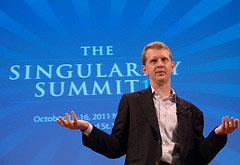
Ken Jennings: Courtesy: Singularity Summit
Jennings and Cowen were speakers at the Singularity Summit on October 16 in New York. The conference was organized by Ray Kurzweil, an inventor of optical scanning technology and “futurist,” who foresees the coming of a singularity – the moment when artificial intelligence will surpass human intelligence – in the not-too-distant future.
I’ll discuss IBM’s plans for commercializing the technology it developed for Watson, but first let’s look at Cowen’s view of our economic future.
Stagnation and its causes
Cowen, who teaches at the University of Maryland and writes a regular column on economics for the New York Times, said that the technological progress has reached “plateaus” in a number of areas, particularly over the last 40 years. The last truly great intellectual breakthrough, over a century ago, was the use of cheap fossil fuels in machines, which was the basis for developing automobiles, he said.
But the next such breakthrough – a flying car, perhaps? – is a long way off, according to Cowen.
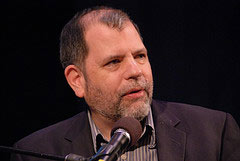
Tyler Cowen: Courtesy: Singularity Summit
His recent book, Stagnation, identifies a number of other sectors that are mature and un-developing, such as health care, education, and agriculture. We’ve gotten very good at producing good food at inexpensive prices, for example, and Cowen said there isn’t much opportunity for major breakthroughs on that front.
We badly need improvements in healthcare and education, however. The challenge, Cowen said, is that those disciplines require working with people and not with “stuff.” “Working with people is a lot more difficult than working with stuff,” he said. “Stuff is malleable. Unlike people, you can tell it what to do, move it around, and you don’t need its permission.”
A cause of stagnation is that sciences, across many disciplines, have become too complex and over-specialized for a single mind to grasp. That’s not necessarily bad, Cowen said, but it poses a challenge for would-be innovators. As a result, artificial intelligence, which has the power to bridge gaps across many fields of study, could be a catalyst for future breakthroughs.
Energy – coupled with regulation – is another obstacle standing in the way of progress, Cowen said. Tomorrow’s energy infrastructure cannot be built with today’s regulations, he said, and today’s energy sources are too limiting. The two biggest episodes of recent stagnation, according to Cowen, followed oil shocks in 1973 and in 1988-1989. Those episodes caused us to invest resources in a less productive sector – the continued reliance on fossil fuels. Failed efforts to better develop nuclear energy are a manifestation of stagnation, he said.
Our educational system is also at fault, Cowen argued. Our culture is too egalitarian, he said, and not “nasty enough.” Great innovative efforts, such as those that once took place at Apple computer, have not come from cultures where everyone was “all nice and respecting of each other.” Authoritarian cultures, such as in 19th century Germany, gave way to a “phenomenal innovation powerhouse,” he said.
High school graduation rates peaked in the late 1960s, signifying that something is “badly wrong with our high schools,” Cowen said. Although unemployment is very high, Cowen said a lot of firms would love to hire more workers; they just can’t find ones with the right training.
Demographics represent another threat to innovation. Innovators tend to be young, Cowen said, and that does not favor the US, which he said will have an age distribution in 2030 similar to Florida’s today. The U.S. is currently losing ground to China and India, which have much younger demographic profiles, although Cowen said not that many new ideas are coming from those countries.
Artificial intelligence and medicine
The most likely area for breakthroughs is artificial intelligence, where Cowen said on-the-ground successes are happening now – Watson being a clear posterchild. Computer chess programs outplay humans, and have done so for quite a while, Cowen said. A more commonplace application is Google’s ability to suggest search terms based on the most popular queries it has processed. Services like Netflix and Match.com use artificial intelligence to match user preferences to a diverse data set of possibilities.
“It may not be that you will marry a robot, but you can tell a pretty convincing story about artificial intelligence that doesn't require a major new breakthrough, but simply further improvement of what is already working and influencing our lives.”
Progress in medicine has slowed, Cowen said, and that creates an opportunity for artificial intelligence. The big advances, like clean water, vaccines and antibiotics, happened more than 50 years ago, he said. “That was the low-hanging fruit, and now we are onto some tougher problems,” he said, like cancer. Cowen said we are spending a lot of money on a “messy” health care system, without getting results.
Automating services like health care benefit a lot of people, Cowen said. Job creation will result. “Smart machines will create a lot of new jobs,” he said, and those will range from unskilled to highly skilled professions. Engineers will create the technology, but others will need to train the systems to perfect their answers.
IBM aims to be among the first to apply artificial intelligence to health care. After the success of Watson, it assigned Dan Cerutti the task of determining how to commercialize the technology. Cerutti, who spoke at the conference, said that there were four key innovations that Watson achieved: its ability to understand human language, which it often ambiguous; its permanent memory; its ability to learn from its mistakes and successes; and, perhaps most importantly, the fact that it could assign confidence levels (the probability of correctness) to its answers.
Given those characteristics and the nearly $3 million it cost to develop Watson, Cerutti said that future commercialization of Watson would need to be to help solve a high-value problem. It would have to be applied to situations where the solutions could be generalized and applied across a large number of cases. Those problems would also have to be ones that “mattered” to society at large.
He and his team considered many such problems, ranging from customer support to education to finance (e.g., “Watson, what is the correct price for this stock?”). They looked for problems where there is a big gap between the information that a person uses to make decisions and what is available.
They decided to apply Watson to help in medical diagnosis, transforming it into a service for care-givers (not just doctors) to incorporate patient inquiry, workup, diagnoses and treatment recommendations. Their goal is to offer evidence-based treatment plans that would produce better outcomes and lower waste.
Improvements are needed. IBM’s engineers enable Watson to engage in a dialog with the user, to ask questions and to understand a patient’s electronic medical records. Pilot programs are planned for next year, targeting specific medical disciplines, Cerutti said.
Jennings, who joked he was the first person to list his occupation as “quiz show contestant” on his tax return, applauded IBM’s direction. He said he will not be the last person to lose his job to a computer, and that Watson will be very good at applications that require processing large amounts of text and filtering out noise.
Cowen, however, remains skeptical as to how quickly breakthroughs will emerge. “When read about predictions for the future in the 19th or early 20th century,” he said, “it is remarkable how much they underestimated the progress that was made. But when you read what people wrote, say, in the early 1960s, it is remarkable how much they overestimated the progress that was made.”
Read more articles by Robert Huebscher