Following the financial crisis of 2008, PIMCO articulated its “new normal” forecast of slow growth and mediocre capital market returns. Appending the even drearier modifier “minus” to that outlook, Bill Gross said that expectations now appear worse than even he previously feared. Gross was pessimistic in both the near and long terms, and he startled the audience with his premonition that “capitalism is at risk.”
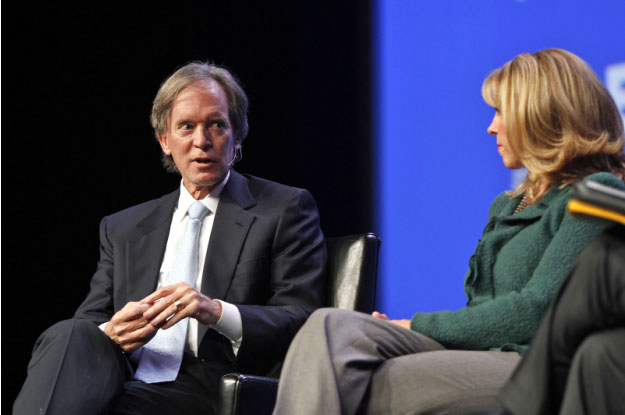
Gross, PIMCO’s founder and co-chief investment officer spoke last week at the opening session of Schwab’s IMPACT conference in San Francisco. He shared the stage with Liz Ann Sonders, the chief investment strategist for Schwab, who was much more optimistic about investor outcomes.

Bill Gross and Liz Ann Sonders
“We are in a 2%-minus type of real growth world,” Gross said, “in which structural headwinds as opposed to cyclical headwinds become dominant.”
Gross cited demographics – an aging population in the US and other important countries – as a fundamental reality that will act to dampen growth over a long period of time, spanning many of the business cycles economies have traditionally relied upon to provide a respite from more transitory economic hardship. Slower-than-expected growth in China, in emerging markets and in Europe are also drive Gross’ forecast, which he said is now consistent with that of the Fed.
The core characteristics of the new normal included a delevering global economy, policymakers continuing to re-regulate, and both the financial and non-financial sectors of the U.S. economy facing increasing political and economic pressure to de-globalize. According to PIMCO, those factors would combine to produce “painfully slow” economic growth.
Gross admitted that he did foresee how rapidly certain developments would unfold, such as Europe’s sovereign debt crisis and the debt-ceiling impasse in the US, and those events have slowed growth even further – hence, the new normal “minus.”
“We expected the new normal and we got something less,” Gross said.
I’ll look at Gross’ and Sonders’ views on the economy and the markets, and conclude with Gross’ dourer long-term outlook.
Advisors should be very worried
Gross said advisors should be “very worried” about the debt crises in Europe. Greece will default, he said, but he did not say when that would happen. The larger issue he sees is the stability of the banking system, which – if left unaddressed – will weaken or prevent economic growth.
Greece would be better off dropping out of the EU, according to Gross, and re-entering after it addressed its fiscal problems. Without such a move, he said Greece faces up to 15 years of “very difficult circumstances.”
As for solutions to the debt problems in the US and other developed economies, Gross offered four alternatives. A country can grow its way out of debt, which in the US would require 4% real GDP expansion “for a number of years,” he said. It can default, an option which Gross summarily dismissed. Or the US can undergo a period of “hidden” inflation, where we “pretend that inflation is going to be 1% or 2% when it is really 3% to 4%.”
Gross, however, views a fourth option as most likely – one he called “financial repression.” The US can maintain its policy of very low interest rates. Savers would be penalized, and the winner would be the US government, which can borrow at very low cost. Savers, he said, would “subsidize the debt of the US for a long period of time.” The US undertook a similar policy between 1945 and 1979, he said, setting an important precedent.
Financial repression can continue for an extended period of time, Gross said, as long as the central bank maintains its commitment to low interest rates. Investors, he said, will become more concerned with safety and return of their capital, and they will not perceive the negative real interest rates.
Financial repression would lead to a devaluation of the dollar, which would be inflationary, so there is considerable overlap between Gross’ third and fourth options. Gross said the success of financial repression depends on the ability of the US to devalue its currency relative to other countries, many of whom are pursuing similar policies.
Gross defended the position of the dollar as the world’s reserve currency, calling into question whether financial repression will succeed. “At least for now,” he said, “I don’t see a potential replacement.”
Dangerous cycles
Global economies have been trapped in a “vicious” cycle, Gross said. High levels of debt relative to GDP have caused central banks to ease their monetary policies, which has triggered commodity price inflation. That has dampened consumer spending in the US and led to inflation in emerging economies, forcing their central banks to adopt tighter monetary policies, which, in turn, have stifled growth in the developed world.
In the near term, Gross said, there are indications that cycle may be breaking, as there has been a “reprieve” with respect to commodity prices.
Sonders agreed that the cycle of debt and monetary easing that Gross depicted is occurring, and she said that inflation in China, for example, was causing a real estate bubble that will impair that country’s growth.
She was much more optimistic for the long term, however. She said China’s inflation will lead to wage increases that will make its manufacturing sector less competitive with that of the US. “We may be at the beginning of another resurgence in US manufacturing,” she said.
Sonders cited a recent Accenture study that found 60% of US companies with operations in China are considering bringing them back to the US.
Investment implications
Gross and Sonders translated their economic views into forecasts for various asset classes.
With 10-year yields of approximately 2% and 30-year yields of approximately 3%, Gross said Treasury bonds are “definitely overvalued relative to historical terms.” He said he doesn’t expect yields to rise or fall much in the near term.
He said today’s conditions – 3% inflation and 1% to 2% real growth combining to create 5% nominal GDP growth – would typically call for 10-year Treasury rates of roughly 4%. The reason, he said, is that the Fed and the Chinese have become the principal buyers of Treasury bonds. Decreased supply has driven yields down, and Gross said that dynamic sometimes overwhelms, regardless of whether the market is having a “risk-on” or “risk-off” day.
Gross advised having a portion of one’s portfolio in currencies “where growth is the dominant characteristic.” Brazil, he said, has very high real interest rates and attractive growth prospects, as do some other Asian countries.
He also recommended that investors seek stable sources of cash flow that earn positive (after-inflation) rates of interest, such as electric utilities and other equities that currently offer dividends in excess of 4%. “Any stock is an inflation-protected security,” he said.
REITs, Gross said, carry too much risk because of their leverage. He said they basically amount to “modern-day banks,” levered five-to-one, which is about half the leverage of commercial banks. Given that REITs do not incur the overhead costs that banks do, this might seem attractive. But the risk, according to Gross, is that their source of funding, which is primarily the repo market, will be threatened, as it was in 2008.
Gross said he would not invest in Europe -- European banks in particular – given the interconnected nature of sovereign debt and financial institutions and the potential for cascading risk. Growth will be the ultimate solution to Europe’s crisis, he said, and that will require an infusion of private capital. He doesn’t expect that to happen in the near term; China, he said, won’t get significantly involved unless it can see growth prospects.
Sonders expects better returns from equities. She noted that bonds have outperformed stocks longer than for any previous continuous period and she there should be a “reversion to the mean.” “I'm not so sure now is the time to be giving up on equities in favor of Treasuries,” she said.
“We have the potential to be pleasantly surprised on the equity side,” Sonders said, “but it is not going to come in any kind of smooth, steady line.” Investors should expect shorter business and market cycles, accompanied by a “semi-perpetual” increase in market volatility, she said.
Sonders said US equities could achieve low double-digit returns, despite growth of only 2%, provided that there is relatively low inflation to offset the sluggish growth.
Corporations have increased their share of GDP from approximately 8% to 13% over the last several years, she said, while labor costs have decreased from 66% to 61% of GDP. That has elevated corporate profits and buoyed market prices, but Sonders said those trends may be ending. Rising pricing and wage pressures will inhibit consumer spending, which Sonders said will prevent overall growth.
Explaining the poor performance of the Total Return fund
In February, Gross, who manages PIMCO’s Total Return fund, bet that interest rates would increase and took a short position in Treasury bonds. He was wrong, and the resulting performance of his fund was among the worst among its peers.
Gross explained that he did not foresee several adverse events, such as the debt-ceiling crisis and the deterioration in Europe. That caused a flight to safety, pushing up prices on Treasury bonds. “It happened so quickly,” he said, “I suppose it was quite difficult to adjust despite the fact that Treasuries were being offered almost every other week by old Uncle Sam.”
A problem with Gross’ explanation is that the two events he cited – the debt-ceiling impasse and the sovereign debt crises – did not escalate until the summer. But 10-year rates declined steadily beginning in February, and Gross did not explain his actions prior to August.
Gross pessimism
Over the short term, Gross said political impediments to growth will be daunting. “Both parties are clueless,” he said. Jobs are the near-term problem, he said, but the Obama administration has been “very ginger” in its policy recommendations. Republican suggestions to prioritize balancing the budget have similarly “avoided the critical question of how to create jobs,” he said.
Gross sounded his most pessimistic note when asked – hypothetically – how he would advise the Fed on its course of monetary policy. He said he would caution them about the destructive effects of commodity price inflation and negative real interest rates. But his sternest warning was with regard to financial repression and the disincentive it creates to save. Robust saving, he said, is “inherently important for the future of capitalism itself.”
Capitalism, Gross said, is indeed at risk. It depends on growing consumption, which he said has been fueled largely by leverage. Now capitalism is threatened by demographics, he said. It’s not just an aging but the potential for a shrinking population that poses risks for the global economy. Gross said he fears that the world’s population may decline at some point and “the common-sensical conclusion is that consumption moves in the same direction.”
“To the extent that the globe demographically slows down and eventually starts to move in the other direction – that is 30, 40, 50 years away,” he said. “Then capitalism as we know it may be at risk.”
Read more articles by Robert Huebscher