Advisors are optimistic about the returns Treasury bonds will provide over the next decade, but they are less sanguine about the projected performance of US equities. Their inflation expectations are consistent with the historical data. These findings and many others arise from our study, Investment Trends in the Financial Advisory Profession: Key Implications for the Investment Management Industry, a research report now available from Advisor Perspectives.
I’ll discuss some of the key findings from our study, but first let’s review the background behind our efforts.
The study’s data are drawn from a survey of our readers that we conducted in September. We received 1,090 responses to our survey, of which 673 were completed and 417 were partially completed. We were pleased to donate $3,600 to the Red Cross Disaster Relief fund – $5 per completed response, plus a little extra on our behalf.
The goal of our survey – and the focus of our research report – was to identify the key trends among financial advisors in terms of their investment decision-making. Specifically, we answered four broad questions:
- To what asset classes and sub-classes are advisors likely to increase or decrease their allocations over the near term?
- To which investment vehicles are advisors likely to increase or decrease their allocations over the near term?
- What criteria are advisors using to make the above two decisions?
- What are the implications for asset management firms?
We segmented our analysis along several dimensions. For example, we examined responses broken down by firm structure (independent versus dually registered advisors), tenure (the number of years the individual has been an advisor), size of firm (AUM), and type of clients served (mass affluent, HNW, UHNW, etc.).
The target audience for this report is mutual fund companies, ETF sponsors, hedge funds, funds of funds and other manufacturers of investment products sold in the advisory channel. Specifically, directors of marketing, directors of research, directors of product development, sales managers, individual salespeople and wholesalers may find its insights useful.
If you would like to learn more about this report, please contact us here.
Capital market and inflation expectations
Given the uncertainty arising from the European sovereign debt crises and the weakness of the US economic recovery, we asked readers to forecast real (after-inflation) returns for US equities over the next decade. Those data are below:
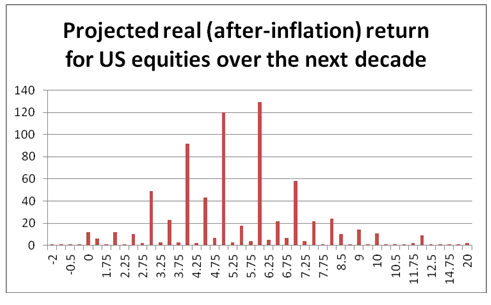
The responses clustered around 6%, which is slightly below the historical average. But those responses are several percent better than what PIMCO has forecast through its “new normal” model. Most advisors have not bought into this paradigm of slow growth and muted returns.
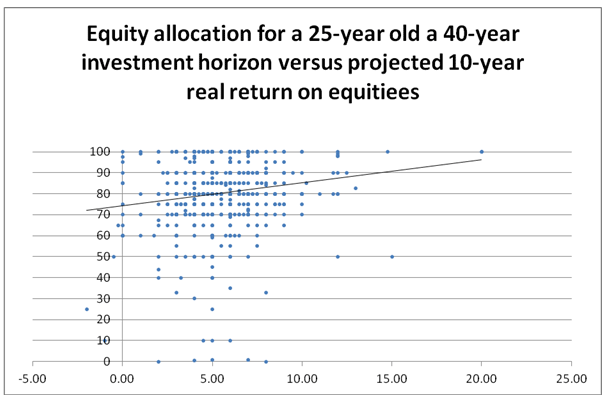
We asked what advisors’ equity allocations would be for a 25-year old with a 40-year investment horizon, and we compared those responses to advisors’ equity return forecasts. In the graph below, each dot represents an advisor’s equity allocation (on the vertical scale) and their equity return forecast (on the horizontal axis).