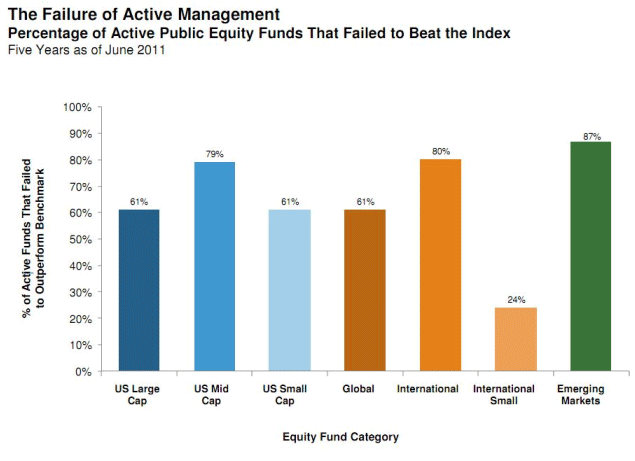
Few question that skillful mutual fund managers exist, but virtually all attempts to identify them ex ante have failed. Last week, Morningstar took up the challenge with its Analyst Ratings, which aim to identify funds with the “long-term potential for superior risk-adjusted performance.” Given the futility of such efforts over the last several decades, advisors should approach this new effort with skepticism.
The measure of whether Morningstar will succeed is quite simple, since a relatively straightforward calculation will provide risk-adjusted performance. But that test can only be applied after a complete market cycle. We need to know how well a fund and its manager performs in both up and down markets, so it will be at least a few years before we have any meaningful data to examine.
We already know that a naïve strategy of selecting low-cost funds will improve investor outcomes (and this week we learned that following the investment decisions of members of Congress might offer further benefits). We need to see whether the Analyst Ratings will do better.
A blog noted that Morningstar chose to rate some of the “bigger and best” funds first, and as a result its ratings are highly skewed:
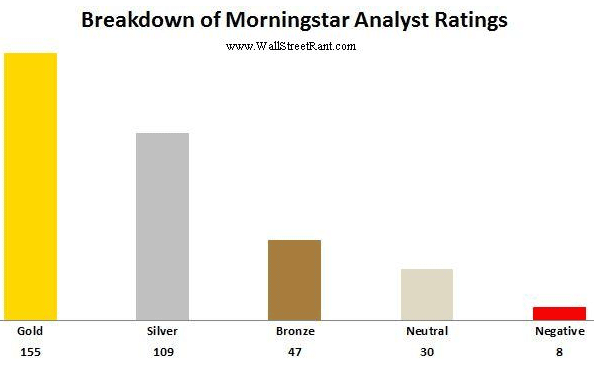
Let’s hope this is not the distribution at which Morningstar ultimately arrives for the full fund universe, since studies (such as S&P’s below) have shown that less than half of actively managed funds outperform the market, as dictated by Sharpe’s law of active management.