If class warfare is to be the dominant theme in next year’s presidential campaign, it will revive the premise of Ernest Hemingway’s 1937 novel, To Have and Have Not, which he wrote in the midst of the second downturn of the Great Depression. That was also the title Jeffrey Gundlach gave his conference call with investors last week, during which he warned that wealth inequality will threaten European and domestic economies.
In Hemingway’s novel, the protagonist, Harry Morgan, is forced into criminal activity in order to care for his family. The wealth polarization of the 1920s and 1930s – which Gundlach said the discourse of the Occupy movement recalls – figures prominently in the story.
Gundlach is the founder and chief investment officer of Doubleline Capital, where he manages its flagship Total Return Fund. The slides from his presentation are available here.
“When you have wealth polarization, not only do you get a big share of wealth going to the top one percent, but you get a lot more people showing up at the bottom,” Gundlach said. “Clearly, that is problematic; it is difficult for the budget, and it is difficult for a happy society.”
Last week also saw Morningstar pass over Gundlach as a candidate for its fixed-income manager of the year award, so we’ll look at whether that decision made sense. I’ll also review a few of Gundlach’s more provocative forecasts from last week’s call, but first let’s look at what Gundlach said were the problems posed by wealth inequality.
The haves and have-nots
Wealth inequality can be traced to growing fiscal deficits, Gundlach said. Federal debt began to escalate around 1980, he said, and since that time the top fifth of the population got almost all of the wage gains.
“One could make a very simplistic but somewhat convincing argument that this debt-based scheme looks like the country took on a bunch of money and gave it to the top 20% of the population,” he said.
Although he acknowledged that the underlying causes of wealth inequality are much more nuanced, he said that message may resonate with a significant fraction of the population.
Meanwhile, he said, the bottom fifth of the population slightly lost income over that time period.
Societal awareness of phenomena lags actual changes by a number of years, he said. The peak of income inequality was in 2007, according to Gundlach, and wealth has actually been more evenly distributed since then.
But it is a dominant theme today, affecting governments across the globe.
Gundlach said that 2011 will be remembered for the fight over the debt ceiling and the growing awareness of the need to deal with the budget deficit. He warned, however, that confronting the deficit would cause the US economy to “go sharply into the negative, just like it has in the austerity-program-ridden sections of peripheral Europe.”
Income inequality is not unique to the US, he said. Most of the countries in the world are experiencing more polarized wealth, he said, but nowhere is that tension as extreme as it is in Europe.
In Europe, the “haves,” like Germany and France, are distinguished from the “have-nots” (which include virtually every other country) by the strength of their public sectors, he said.
Unfavorable demographics are exacerbating wealth inequality in Europe. Gundlach said that in Italy there are three workers per retiree and in 20 years there will be two and in 30 years there will be 1.5 per retiree. “If you have stress at three workers per retiree, how much worse is it going to be at one-and-a-half workers per retiree? This is a really big problem,” he said.
Addressing Europe’s problems
Gundlach said that Europe’s sovereign debt problems will be resolved in the next six months.
He noted that US money market funds have been much more prudent than they were prior to the financial crisis, and they have effectively eliminated their exposure to European banks. But that is really a sideshow, and the main event will be the moves taken by the European Central Bank (ECB).
The ECB must buy the bank holdings of the debt of shaky countries, Gundlach said. For example, it has already become the only buyer of Italian bonds. Banks should be recapitalized or face bankruptcy, he said. The most likely outcome will be that the ECB will adopt rule changes that will allow it to print money and recapitalize Europe’s banks, he said.
But an ECB bailout is not guaranteed to work. Gundlach warned of a possible downward spiral. Banks are “joined at the hip” with the sovereign debt, he said, which means that a weakening of sovereign debt prices would weaken the banks, and that would create the need for additional sovereign debt issuance to prop up the banks.
“Until Europe has a major restructuring,” he said, “one should not invest in it.”
If there is a “euro sovereign debt implosion,” Gundlach said the asset classes to hold would be US Treasuries, cash (in dollars), and long-term, very-high-quality municipal bonds. He said gold would not necessarily perform well in this scenario, though he did not say why.
Gundlach said Doubleline is avoiding all non-dollar exposure. “If Europe has a problem, which is likely to happen,” he said, “then you are going to have currency losses in non-dollar assets. This is why we think the conservative investor is supposed to be in dollars.”
Index funds, TIPS and MF Global
Gundlach addressed three other subjects that will be of interest to advisors, the first being bond index funds. This led into a discussion of TIPS and the lessons of the MF Global scandal.
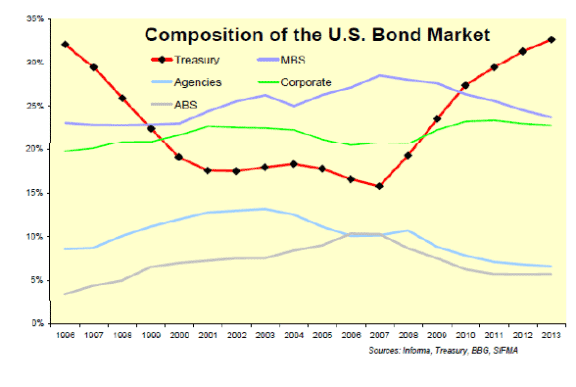
Investing in a bond index, such as the Barclays’ Aggregate, is “crazy,” Gundlach said, because their yields are too low. Moreover, he said bond indices are “arbitrarily constructed.” He provided the exhibit below.

Treasury bonds are now approximately 35% of the index, and Gundlach said that does not include US agency bonds. Index investors have been increasing their holdings of Treasuries, perhaps unknowingly, he said.
Financial theory supports Gundlach’s position. While there are compelling arguments for holding a capitalization-weighted equity index, no corresponding justification exists for a bond index weighted by debt outstanding. Weighting an index in this manner increases investors’ exposure to the most indebted entities.
The same investors who are chatting at cocktail parties about their distaste for Treasury bonds that yield 1%, he said, may be the ones increasing their exposure through index investments.
TIPS are unattractive at today’s yields, he said. Investors should wait until interest rates start to rise and their prices are discounted from today’s level.
Because of their long duration, TIPS are among the poorest performers when there is an overall decrease in bond prices. He said that, in the bear market from early November of last year though early February of this year, TIPS were the worst performing bonds.
The MF Global bankruptcy and the failings of its CEO, Jon Corzine, should be a clear warning to investors to avoid all funds with counterparty exposure. Investors whose funds were held at MF Global are facing the possibility of a total loss.
“This system is riddled, fraught with peril, as regards counterparty contracts, and funky things going on at defaulting firms,” he said. “Get out of counterparty risk and into portfolios where you don't have to worry about it. I don't care whether you think the probability of a systemic spread of the MF global problem is a high or quite low. Even if it is a quite low probability, why are you doing it?”
Manager of the year?
Let’s now turn to Morningstar’s nominations for fixed-income manager of the year. Despite Gundlach’s stellar returns, Morningstar said he did not merit a nomination because of what it called a “much more aggressive risk profile than that of most rivals,” which they believe “could make the fund perform quite differently than most investors would expect from a more conventional core bond offering.”
Regardless of who receives these nominations, we should acknowledge that this award makes no sense and does not serve to improve the outcomes for investors.
Evaluating the skillfulness of active managers, which is the task that Morningstar has chosen to undertake with this award, cannot be done over the course of a single year. It requires an evaluation over the course of a full market cycle – ideally over multiple market cycles. For bond managers, that requires periods of rising and falling interest rates, which rarely occur in a single year.
Determining the manager of the year is akin rewarding a baseball team after each inning of play. Nothing matters until all nine innings are played, when the game is decided.
In fairness, Morningstar has said that performance over the prior-year is only one criterion they consider for this award; they also look at whether managers “do what's right for shareholders and have delivered superior long-term returns with a sound strategy.”
None of the managers nominated for the 2011 award, however, were among those nominated in 2010, as shown in the table in the appendix. Going back five years, out of a total of 45 nominations, only six individuals received more than one. There have been no repeat winners over the last five years.
That leaves two possibilities: Either there are virtually no managers whose skill is consistent over time, or the criteria are weighted much more heavily to the prior 12 months than Morningstar is willing to admit. Either way, the takeaway should be that this award is ill-conceived.
Investors will be best served by managers who are incented to focus on long-term results. It is incredibly difficult for active managers to demonstrate skill over the long term. It is virtually impossible for them to outperform over short periods of time.
With its recent introduction of Analyst Ratings, Morningstar took the correct approach by stating that it would take at least three to five years to determine whether those ratings would be effective in predicting performance. But by rewarding managers for one-year performance, as Morningstar apparently does with its manager of the year, it incents managers to join a short-term performance race that will be harmful to investors.
If one were to engage in the meaningless and destructive task of selecting a fixed-income manager of the year, a rigorous approach would be necessary. It would begin by filtering the element of skill from the noise of portfolio returns. Performance by bond managers is determined by many factors: interest rate movements, sector allocations, credit decisions, and individual security selection. It must also reflect the risk taken by the manager, as measured by the fund’s duration, exposure to counterparties and other characteristics.
Managers with a broad mandate to allocate funds in multiple markets (such as Gundlach) should be treated differently from those who are constrained to invest in a single class of bonds. For the latter, it is likely that any “outperformance” will be due solely to the returns in their designated asset category.
But Morningstar’s 2011 nominees included GNMA managers from PIMCO and Fidelity. Those individuals may be talented, but they should not be rewarded because 2011 was a good year to be invested in GNMAs, especially when, by Morningstar’s own admission, one of them did not do “anything much more complicated than shifting among different coupons in the Ginnie Mae market or adjusting his modest exposure to non-Ginnie securities, such as Fannie Mae, Freddie Mac, or non-agency mortgages.”
I don’t have sufficient knowledge of the bond market to say whether Gundlach was deserving of a nomination. A recent blog posting made a compelling case that he was, and raised the issue of whether Morningstar misrepresented the riskiness of his fund and was unfairly biased against him. I’ll leave it to our readers to determine that, but my advice is to pay no attention to manager of the year awards.
Appendix – Prior nominees for fixed-income manager of the year (* denotes winners)
2011 (6 nominees)
John Carlson (Fidelity)
Bill Irving (Fidelity)
Franco Castagliuolo (Fidelity)
Scott Mather (PIMCO)
Jamie Pagliocco (Fidelity)
Scott Simon (PIMCO)
2010 (8 nominees)
Michael Hasenstab (Templeton) *
Ray Kennedy (Hotchkis & Wiley)
Mark Hudoff (Hotchkis & Wiley)
Mark Kiesel (PIMCO)
Curtis Mewbourne (PIMCO)
Tad Rivelle (Met West)
Steve Kane (Met West)
Laird Landmann (Met West)
2009 (13 nominees)
Phil Condon (DWS)
Rebecca Flinn (DWS)
Jamie Farnham (Met West)
Steve Kane (Met West)
Laird Landmann (Met West)
Gino Nucci (Met West)
Dan Fuss (Loomis Sayles)*
Kathleen Gaffney (Loomis Sayles) *
Matthew Eagan (Loomis Sayles) *
Elaine Stokes (Loomis Sayles)
Jeffrey Gundlach (TCW)
Philip Barach (TCW)
Mark Notkin (Fidelity)
2008 (8 nominees)
Bob Rodriguez (FPA) *
Tom Atteberry (FPA) *
Bill Gross (PIMCO)
Jeffrey Gundlach (TCW)
Philip Barach (TCW)
Christine Thompson (Fidelity)
Mark Sommer (Fidelity)
Jamie Pagliocco (Fidelity)
2007 (10 nominees)
Joe Deane (Legg Mason)
David Fare (Legg Mason)
Dan Fuss (Loomis Sayles)
Bill Gross (PIMCO) *
Bob Rodriguez (FPA)
Tom Atteberry (FPA)
Team (Met West)
Jeffrey Gundlach (TCW)
Doug Swanson (JP Morgan)
Arthur Steinmetz (Oppenheimer)
Read more articles by Robert Huebscher