Advisor Perspectives welcomes guest contributions. The views presented here do not necessarily represent those of Advisor Perspectives.
Buy-and-hold is not an effective strategy for risk-conscious investors. Any portfolio’s asset mix will drift from its strategic target as asset prices move differentially in response to changing economic and market forces. Over time, the higher return assets will comprise a larger proportion of the portfolio and distort its return and risk dimensions from those originally constructed.
Sound portfolio management is founded on “buy-and-rebalance.” Rebalancing involves selling the asset classes that have done relatively well to buy those assets that have lagged in order to restore the portfolio’s target mix. Rebalancing is vital in risk management since it ensures that a portfolio’s risk dimensions stay within an investor’s defined tolerance limits. This is illustrated in the following graph which compares the return and risk of a portfolio1 comprised of 40% US bonds and 60% US stocks which was rebalanced annually (in red) to those of the same portfolio that was never rebalanced (in orange).
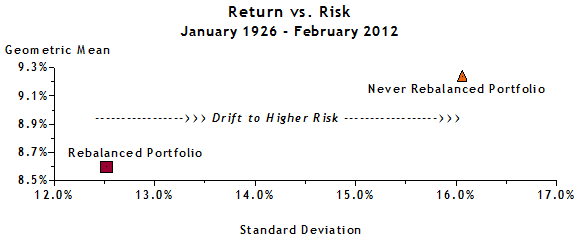
The rebalanced portfolio experienced much lower risk while the never rebalanced portfolio drifted into a much riskier asset weighting dominated by stocks. Its return was lower but that is because it avoided the escalating risk of the never rebalanced portfolio. Critically, the rebalanced portfolio had better risk-adjusted performance2.
Rebalancing has a second vital role in a portfolio. Rebalancing is a source of diversification return3 that arises from the contrarian act of selling assets that have appreciated on a relative basis and buying the lagging assets in order to restore the weights of the target asset mix of a particular investment strategy.
A return premium is created by the disciplined act of regularly “selling high and buying low” while maintaining the risk profile of the portfolio. It can be calculated by comparing the return of a rebalanced portfolio to the weighted average geometric return of the assets which comprise the portfolio4. An example of the rebalancing premium is illustrated in the following table which sets out the returns of the individual assets in the 40% bond/60% stock portfolio, the weighted average return of the two assets, the return of the rebalanced portfolio and the rebalancing premium.
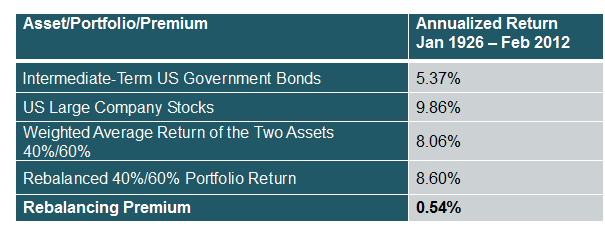
The rebalanced portfolio had an annualized return of 8.60% compared to the weighted average return of 8.06% for the two assets that comprise the portfolio. Rebalancing resulted in an annualized return premium of 0.54%.
1. Bond and stock returns are from Ibbotson’s intermediate-term government bond and large company stock series. Rebalancing is undertaken on an annual basis.
2.Although not shown, the rebalanced portfolio had a higher Sharpe Ratio, Sortino Ratio and M-Squared Ratio.
3. Booth, D.G., Fama, E.F., DiversificationReturns and Asset Contributions, Financial Analysts Journal, Vol. 48, No.3, p. 26–32, May/June 1992. Booth and Fama define the incremental return from a rebalanced portfolio compared to the weighted average asset compound return as the “diversification return”.
4.Willenbrock, Scott, Diversification Return, Portfolio Rebalancing, and the Commodity Return Puzzle, Financial Analysts Journal, Vol. 67, No. 4, pp. 42-49, July/August 2011. Willenbrock states that “the diversification return is the difference between the geometric average returns of both a rebalanced portfolio of volatile assets and a balanced portfolio of hypothetical assets with the same weights and geometric average returns as the true assets but zero volatility.” Practically, the latter term is the weighted average geometric return of the assets comprising the portfolio.