Advisor Perspectives welcomes guest contributions. The views presented here do not necessarily represent those of Advisor Perspectives.
Despite a compelling body of research arguing that most retirees would benefit by delaying the onset of Social Security payments, the majority who are eligible still elect to begin receiving them as early as possible. But delaying Social Security benefits is one of the best triple-hedges available to any retiree – simultaneously protecting against poor returns, high inflation, and longevity.
In no small part, the rush to start benefits is attributable to a "take the money and run" mentality among retirees, who don't see the value of delaying as worth the risk of forgoing benefits. And there is a material risk that the retiree will not live to the so-called "breakeven point" when the delay in benefits becomes a net financial positive.
What most retirees fail to recognize, however, is that, while there is a risk to delaying benefits and never fully recovering them, the upside for those who live past the breakeven point isn't just that the money is made back; it's that the retiree can make exponentially more. In fact, these asymmetric results – where the retiree only risks a little by delaying, but stands to gain far more in the long run – are further magnified in situations where the client lives dramatically past life expectancy, experiences high inflation, and/or gets unfavorable portfolio returns – which are, in fact, three of the greatest risks to almost every retiree.
The inspiration for this article is the recent Journal of Financial Planning article entitled "How the Social Security Claiming Decision Affects Portfolio Longevity" by William Meyer and William Reichenstein. Meyer and Reichenstein show how delaying Social Security benefits can increase the overall longevity of a retirement strategy that includes Social Security income and a deaccumulation portfolio.
The impact of delaying
The primary reason that delaying Social Security can increase the longevity of a portfolio so beneficially is the asymmetric nature of the delay decision.
For example, consider a scenario in which a 66-year-old – currently at full retirement age – with a PIA of $1,000/month chooses to delay benefits by one year, earning a delayed retirement credit of 8%. As a result of the delay, the client will receive a monthly payment of $1,080/month beginning one year from now, at a "cost" of not receiving $1,000/month for the next 12 months. Thus, the client essentially starts out $12,000 in the hole, of which she then gains back $80 each month.
In reality, though, the client recovers the cost of foregone payments slightly more rapidly over time, because the client doesn't merely receive an extra $80/month. The client actually receives $1,080/month, increased by annual cost-of-living adjustments, in lieu of receiving $1,000/month payments now, also increasing by annual COLAs. At the margin, this means the pace of $80/month at which the client is recovering his $12,000 is actually itself is increasing by COLAs each year.
How delaying compounds over time
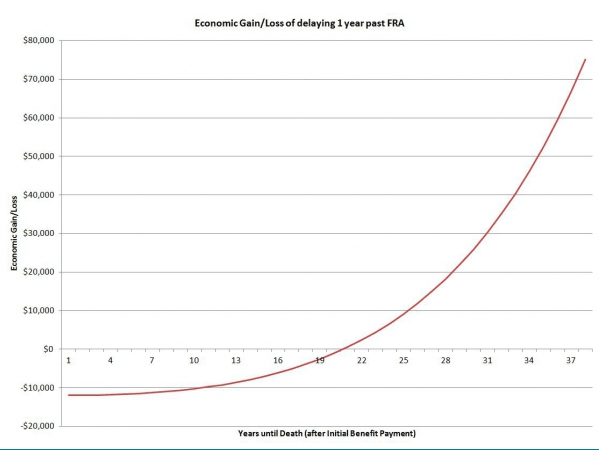
Assuming a moderate 8% growth rate on the available funds (e.g., the $1,000/month collected for the first year, compared to the extra $80/month for the client who delays for a year) and a 3% annual COLA, the chart below reveals that it takes just over 20 years for the client to come out ahead due to the decision to delay.

However, note what happens in the final years of the chart. While it takes approximately 20 years for the client to initially dig out of the $12,000 hole created by delaying initially, it takes only six more years thereafter for the client to go from even to up $12,000. And it takes only another four years after that to make another $12,000, and then just over two more years to add yet another $12,000. In other words, as the client lives longer, the client doesn't just come out ahead; the client comes out exponentially ahead. Dying 20 years before the breakeven period costs the client $12,000; living just 14 years past the breakeven period brings the client ahead by nearly quadruple that amount, to just shy of $48,000.
Sensitivity to assumptions
The value of delaying Social Security benefits is sensitive, both to the level of inflation (which impacts the COLAs) and the growth rate on the investments. Even if the client's plan is to spend the early Social Security benefits, that means other investment funds won't have to be spent down, so the growth rate is relevant regardless of whether the actual Social Security funds will be saved or spent.
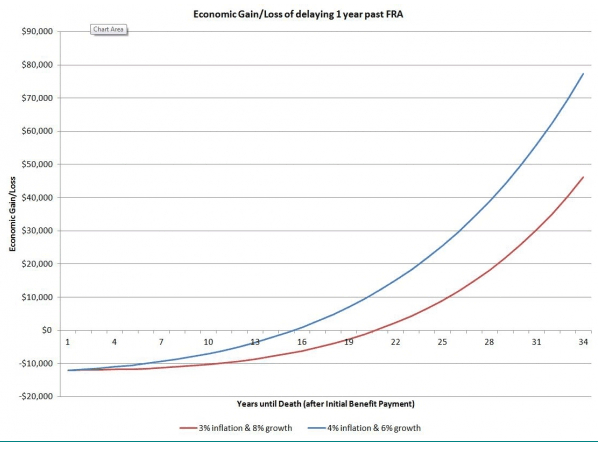
As it turns out, the lower the growth rate, the shorter the breakeven period and the greater the value of delaying Social Security benefits (because that initial year's worth of benefits won't have as much time to grow). In addition, the higher the inflation rate, the shorter the breakeven period and the greater the value of delaying, because the higher payments catch up and compound faster.
The graph below shows the original benefit delay (at 3% inflation and 8% growth), and an alternative scenario with 4% inflation and only 6% growth. In the latter case, it takes only 15 years to breakeven, instead of 20; in fact, by year 21, the client is already up over $12,000 in the higher-inflation-lower-growth scenario, and ultimately turns $12,000 at risk into almost $80,000 by the end of the 34-year time horizon. With just a 2% decrease in the growth rate and a 1% increase in the inflation rate, the economic value in the long run nearly doubled.
The true value of delaying Social Security
Living 34 years past the starting point to harvest the full value illustrated in these charts is no trivial task. An individual who is age 66 at full retirement age (thereby earning an 8% delayed retirement credit for waiting one year) must reach age 100 to get the full value shown here.
But on the other hand, that's the whole point to the value of delaying Social Security retirement benefits. The upside for outliving the breakeven isn't just to recover the amount at risk or to make it back again; it's to make exponentially more than the original amount at risk, if the client is fortunate enough to live a long time. Yet for a client who's seeking to hedge against the risk of outliving his/her money and increase the longevity of the portfolio, that's precisely the most desirable outcome; like any other lifetime-annuitized payment, it creates the most value when the client lives the longest, which is exactly when the client needs that upside value the most.
In addition, delaying Social Security not only hedges longevity, it also hedges two other adverse scenarios that are otherwise harmful to the retiree: unexpectedly high inflation and unexpectedly low returns. As noted in the charts above, either scenario increases the value of delaying Social Security, decreases the breakeven period and increases the upside for materially outliving life expectancy.
The true value of delaying Social Security is a triple-benefit of hedging longevity, poor returns and high inflation, because of the asymmetrical way that delayed higher benefits compound in the later years. It won't necessarily win for every client, but as any good hedge should, it wins the most in the times the client will need it the most.
I’m eager to hear how you approach this issue with your clients. To participate in this discussion, go here.
Michael E. Kitces is the publisher of the e-newsletter The Kitces Report at www.kitces.com and author of the blog, The Nerd’s Eye View, where this was originally published.
Read more articles by Michael Kitces