If you hailed a cab in New York at the turn of the last century – say, around 1900 – it’s likely that it would have been an electric car, built by the Electric Wagon Company of Philadelphia. The technology behind those taxis, which became the first electrified fleet in 1897, is likely to power the next generation of cars – sometime in this century.
Several electric vehicles (EVs) are already on the market, including the Nissan Leaf. They’ve only just been introduced, but those cars have already garnered twice the market share that hybrid vehicles had at this stage of their introduction.
One company making this happen is Better Place, a venture founded by Shai Agassi, an entrepreneur who was previously a top executive at SAP. Agassi has raised a staggering $750 million in capital, and his mission is to provide and service the key element in EVs – the battery.
Michael Granoff, the head of oil independence policies at Better Place, spoke at a Boston Security Analysts Society lunch on April 24 and discussed what he claims will be the future for automobiles.
Better batteries
Two facts explain why it has taken over 100 years for EVs to reappear on the roads, Granoff said, and they both have to do with the battery. EV batteries are too expensive, costing about $12,000 – roughly half the cost of a typical EV – and they provide a range of only 100 miles.
Better Place intends to solve those problems. It will provide the infrastructure to support the batteries – charging and replacing them. Better Place will build and operate battery-changing stations, similar to a car wash. As you drive through, your battery, stored underneath the car, will be replaced with a freshly charged one, without your ever leaving your vehicle – all in less time than it takes to fill your car with gas.
Better Place is currently deploying these stations in two countries, Denmark and Israel. By strategically locating them throughout the country, the firm has made it so you can drive more than 100 miles, replacing your battery along the way. Computers inside the cars will plan your route and determine the optimal times and places to stop for a new battery.
But accommodating distances greater than 100 miles is only one hurdle to adoption of EVs. Ron Minsk, a senior fellow at Securing America’s Energy Future, a think tank dedicated to achieving oil independence, provided the following data on where cars spend the most time:
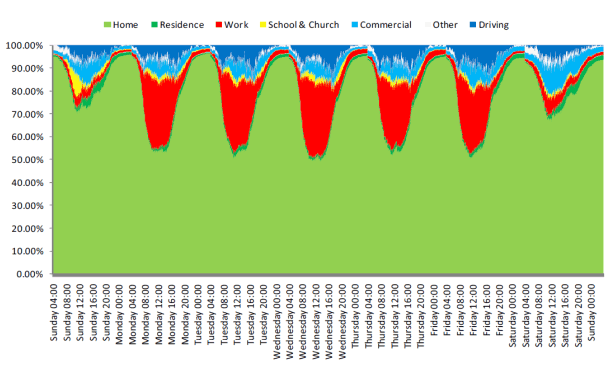
The area shaded in green represents homes and the red area represents work. Together, cars spend over 90% of their time at those locations, so providing a way to recharge there – which is part of what Better Place intends to offer – eliminates the fear of your battery running out. The company also plans to offer charging stations at locations, like malls and sports arenas, to which people often drive.