Advisor Perspectives welcomes guest contributions. The views presented here do not necessarily represent those of Advisor Perspectives.

This essay is excerpted from a recent version of The Credit Strategist (formerly the HCM Market Letter). To obtain the complete issue, you must subscribe directly to this publication; Please go here. The Credit Strategist is on Twitter - @credstrategist
“This is what the guys at Bear Stearns and Lehman Brothers forgot. They forgot that they are a part of a continuum of history, and it’s not about the **** buck that you make today at whoever’s **** expense. If there’s not a sense of continuity, a sense of some sort of communal obligation and responsibility, a sense of a future involved in what you’re doing, and a sense of being beholden to the past, you end up being one shallow, greedy mother****, just trying to get all you can get.”
Bruce Springsteen1
I recently had the honor of being asked to make a presentation at the Casey Research Summit in Weston, Florida. While Bruce Springsteen was not in attendance, many stars of the investment world were there– Doug Casey and David Galland, Lacy Hunt, John Mauldin, Gordon Chang, Harry Dent, James Rickards, Porter Stansberry, Rick Rule, Greg Weldon, John Williams, and last but certainly not least, David Stockman. I must admit that, at times, I wondered why they hadn’t handed out sedatives at the door since the general tenor of the conference was decidedly downbeat, but from an intellectual standpoint the sparks were flying.
The European economic catastrophe
One aspiring rock star who was not in attendance was Francois Hollande. He was busy campaigning for the presidency of France, an office he will likely attain. For a once great nation, M. Hollande’s ascension to the presidency will be a striking setback and an indication that the French people have lost their minds. The new president is a man of little accomplishment and, as far as we can tell, limited judgment since the proposals eructating from his lips demonstrate a shocking ignorance of history, economics and common sense.2 As someone who has spent much of his life admiring French culture and thought while abhorring French politics, this is another painful moment. How in the world can the French vote into office a socialist at this point in history? How can they fall into the trap of believing that socialism is the answer simply because the current model of crony capitalism in the West has failed? This, I suppose, is how the land of Flaubert and Proust has lapsed in the world of Houllebecq. Europe, whose economic condition is nothing less than terminal, is about to receive what physicians refer to as a “zetz” of morphine in the form of M. Hollande. A “zetz” is the final dose that doctors give to dying patients to hasten their passage to the afterlife. In Europe’s case, however, the medicine is not going to be painless, and its administration is not based on mercy but on resentment and stupidity. If the French are prepared to vote for Hollande and his patently idiotic agenda, one can only sit back and watch them get what they deserve and suffer the consequences. We can continue to enjoy their food and wine and watch the carnage from the sidelines. Even better, it will be easier to get a table at Chateau Boyer this summer!
As I told the audience at the Casey Research Conference, the European Union is a study in the misapplication of the lessons of history. After World War II, Europeans swore that they would never subject themselves to German hegemony again. More than fifty years later, they finally announced the formation of the EU with the goal of limiting German power. How did that work out for them? They ended up with a half-baked confederation that lacks political unity dominated by Germany to the extent that it is basically held hostage by Germany’s checkbook. Instead of lording over its neighbors by military means, Germany now does so by economic means. George Santayana famously warned that those who do not heed the lessons of history are doomed to repeat them. In the case of the Europeans, those who learned the wrong lessons of history are doomed to repeat them. The EU was flawed from inception and Europe and the rest of the world are now living with the consequences of this failed experiment.
The speakers at the Casey Research Summit were without exception negative on the outlook for Europe (including, obviously, your author). It is always prudent to ask whether any consensus is too obvious, but in this case you can dismiss the question. There is virtually no chance that Europe will experience a good outcome. Europe has accumulated a mountain of debt so large in both absolute and relative terms that it is impossible for it to manage its way out of it without significant damage. There may be a lot of worry about the debt situation of the United States, but global investors are still willing to finance our debts at ridiculously low rates. Europe enjoys no such exorbitant privilege, as former French President Valery Giscard-d’Estaing described it years ago. Lacy Hunt warmed up the Casey crowd with the fact that the United States currently has $55 trillion of total public and private debt and $15 trillion of GDP, a 3.67x debt-to-GDP ratio. That is a walk-in-the-park compared to the Eurozone, which bears a 4.85x debt-to-GDP ratio with $68 trillion of total public and private debt against $14 trillion of aggregate GDP. Moreover, Europe does not have nearly the flexibility that the United States potentially still possesses to reverse this condition of gross over-indebtedness. For the United States, a combination of tax reform, entitlement reform and budget discipline could shrink the debt-to-GDP ratio to a more manageable level. Theoretically one might be able to say the same thing with regard to Europe but would run smack dab into a brick wall of political and ideological division, inflexible labor regimes, grossly different cultural and economic models, a much higher debt load, and a much weaker productive engine to service it. To put it more simply, the U.S. may be behind the curve, but Europe is not even on the curve.
Spain
The economic data pouring out of Europe is simply alarming. Spain, the next domino to fall, is far larger than Greece or Ireland or Iceland and is rapidly sinking into what can only be called a depression. Spanish unemployment reached 24.44% in the first quarter, up from 22.85% in the fourth quarter of 2011. Youth unemployment is roughly 50%, which means that Spain is losing an entire generation to disillusion with political and business leadership. The next step is certain to be civil disobedience, higher crime rates, and social instability – none of which bode well for economic recovery. There is no way that Spain can (or should) conform with the Maastricht Treaty’s budget rules that “require” countries to limit their budget deficits to no more than 3% of GDP. While a respectable school of thought argues that the only way to cure a debt crisis is for a country to begin living within its means, it is perfectly reasonable to add that such a program can be phased in over several years through a combination of budget discipline and pro-growth spending designed to create the income necessary to service debt. Simple austerity without pro-growth policies is a sure recipe for disaster, and thus far European policy lacks the necessary growth component that would offer those disillusioned with austerity some hope that their sacrifice will eventually be rewarded. Hope may not be a policy, but hopelessness guarantees failure.
LTRO
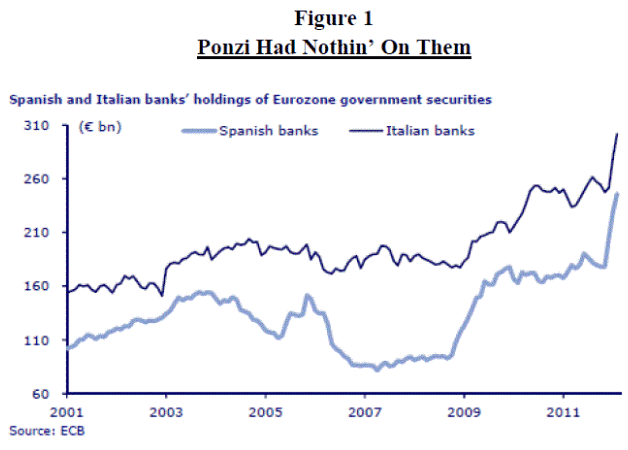
The champagne bottles that were broken out to celebrate the LTRO now merely lie broken as it becomes clear that trying to solve a debt crisis with more debt accomplished nothing and fooled nobody. The hope was that the LTRO would buy the banks and sovereigns at least a year; the reality is that it barely bought them a month. Spanish and Italian bond yields are well on their way back to 6 percent, the level considered unsustainable by most responsible observers. But honestly, who knows what level is sustainable in a world where the European Central Bank (ECB) creates fiat money out of the air, lends it to banks, and then watches those banks turn around and buy bonds issued by those banks’ sovereigns? One might think that what I just described was a satire if the potential consequences weren’t quite so serious. Then again, who else is going to buy this highly risk paper? Answer: Nobody who doesn’t have to. Since December, Spanish banks have purchased more than 100 percent of Spanish sovereign bond issuance according to Bridgewater Associates. And Spanish banks now own about €300 billion of Spanish sovereign debt while Italian banks own about €250 billion of Italy’s sovereign debt.3 Who knew that Charles Ponzi was writing a business plan for his patrimony?
1. In conversation with Jon Stewart, January 30, 2012 (Rolling Stone, March 29, 2012, “Bruce Springsteen’s State of the Union,” p. 45.
2. Having written that, I read it over and realize that virtually the same thing could be written about Barack Obama three years into his first (and hopefully final) term.
3. That is child’s play compared to the Ponzi-schemers in Japan, whose economic diagnosis would also have to be considered terminal if the country were not already economically dead. Japanese banks own $7.6 trillion of all outstanding Japanese Government Bonds (JGBs), or 66 percent of all outstanding JGBs. This data point renders the very concept of an independent central bank in Japan a joke (if that concept every applied in Japan’s managed economy).
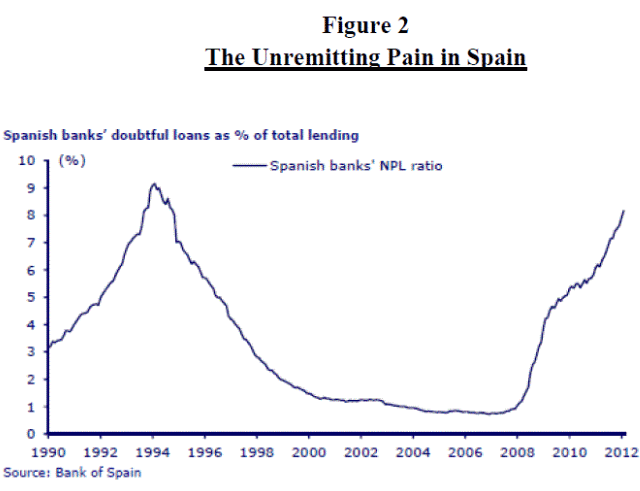
The LTRO will go down in economic history, not as one of the great feats of central banking that saved the system from collapse, but as one of the most harebrained schemes in the annals of central bank manipulation of the financial markets. TCS wrote when the plan was announced that it would do little more than load European bank balance sheets with more debt that they could never repay. We also opined that this plan would fool nobody (except, perhaps, some **** in the markets looking for a short-term profit based on the **** belief that this plan would cure European banks’ liquidity and solvency problems.) Obviously nothing of the kind was ever possible and the market has now figured that out. The interbank market is once again closed to Spanish banks. For our lay readers, that means that other banks in Europe and elsewhere are unwilling to lend money to them because they do not consider Spanish banks creditworthy counterparties. As a result, Spanish banks are left to rely on their own central bank and the ECB for funding (or on their depositors, many of whom are getting out of Dodge – or Madrid, or Barcelona, or Toledo – as quickly as possible with their pockets stuffed with cash). Private deposits at Spanish banks fell by 5.1 percent from a peak of €1.74 trillion in June 2011 to €1.65 trillion at the end of February 2012, but word is that this outflow has accelerated over the past two months. Among other things, Figure 2 shows this deposit outflow exacerbating Spanish banks’ bad loan problems. Spain is caught in a death spiral in which capital is scarcer and scarcer for businesses and consumers, which accounts for data showing further declines in housing prices and a descent back into recession.
Finally, a combination of a lack of capital and a lack of demand are slowly squeezing Spanish manufacturing into oblivion. Spain’s April manufacturing PMI fell another point to 43.5, the lowest level since June 2009. New orders fell by 2 points. Basically, nothing positive is happening in Spain from an economic standpoint. Nada.
Broader European economic trends
Spain’s performance is consistent with broader European weakness – the European manufacturing PMI fell a further 1.8 points to 45.9. Italy was markedly weaker as its manufacturing PMI dropped by 4 points from 47.9 in March to 43.8 in April. Spain and Italy are clearly involved in a race to the bottom, but they have a lot of competition. As TCS has been arguing for quite a while, what is bad for Germany’s trading partners is going to be bad for Germany. Germany’s manufacturing PMI (remember that Germany’s economic strength lies in manufacturing and exports) fell from 48.4 in March to 46.2 in April. France’s manufacturing PMI actually rose by 0.2 from 46.7 in March to 46.9 in April – apparently French manufacturers are rushing to get their sales done before President Hollande nationalizes their businesses! Then there is Hungary, which saw its PMI collapse by 10.8 points to 46.9 in March from 47.7 in February. Other notables were Norway, with a 5.6 point drop to 53.7 in April from 59.3 in March (one of the very few still in positive territory). Greece’s already pathetic March reading of 41.3 weakened even further to 40.7 in April and ranks as the lowest manufacturing PMI figure in the Eurozone (not surprisingly). Virtually the entire Eurozone’s PMI is below 50, suggesting that March weakness occurred off an already shrinking manufacturing base.
European unemployment also reached a new high of 10.9 percent in March since the adoption of the new currency. March unemployment rose by 169,000 after rising by 185,000 in February. With austerity plans in place, it is difficult to see how this trend will reverse anytime soon. Hell, with austerity in place, it is hard to see how anything good will happen in Europe. It is impossible to starve a man back to health.
Target2 Update
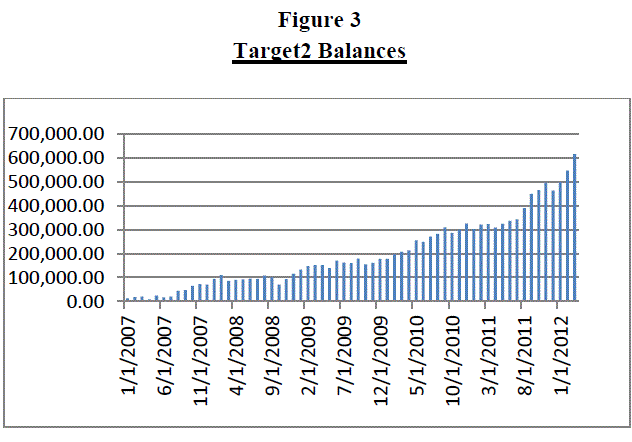
Target2 liabilities have continued their inexorable rise as the weaker nations have now borrowed more than €600 billion from the Bundesbank through this allegedly innocuous trade finance program and even France has joined in as a net borrower under this program. One can only wonder if Francois Hollande will object to the Target2 program on the grounds that it is inconsistent with his socialist platform. In the meantime, there is going to be some kind of hell to pay when the German people come to realize that they are well on their way to lending another $1 trillion to their weaker, profligate southern neighbors and even France as the latter elects a socialist who doesn’t buy into Germany’s austerity shtick. This would be comic if the consequences weren’t so serious, as the nascent rise of Greece’s neo-Nazi Chrysi Avyi party attests.
U.S. markets
While the U.S. economy is clearly struggling as it carries the albatross of tens of trillions of dollars around its neck, corporations are faring much better. That does not mean that Corporate America is not lugging around its own load of debt – something on the order of $11 trillion. But its cash balance has risen to about $9 trillion and earnings are reasonably robust. That’s what happens when companies don’t hire new full-time workers because they are worried about rising healthcare costs and higher taxes.4 There is good reason to worry about the ability of corporations to continue to flourish in an environment where GDP growth is unlikely to exceed 3 percent for the foreseeable future, but from a credit standpoint conditions remain favorable. The stock market certainly seems quite sanguine about the world as major indices have reached new four year (i.e. post-crisis) highs, ably assisted by the insufferably buoyant cheerleaders on CNBC. The lack of balance in the financial media has become galling (was it ever not galling?) and will no doubt provide Jon Stewart with fodder to mock them all over again when the markets meet their inevitable maker. For now, however, risk-taking is being rewarded, in part because relatively few investors are willing to take risk. But slowly but surely, Ben Bernanke is successfully dragging them kicking-and-screaming into the risk markets as they tire of earning nothing on their savings and come to terms with the reality that tomorrow is unlikely to be any more rewarding than today in that respect.
Readers have undoubtedly heard how disappointing 2.2 percent first quarter GDP growth was. It would have been much worse had we not been graced with the warmest winter in years, consumers not dug into their savings, and inventories not contributed 0.6 percent to growth. The job market also stinks. If the work force had not been reduced by the millions of people who have left it for one reason or another, the unemployment rate today would be 11 percent instead of the politically manufactured 8.1 percent that the so-called “CNBC Contributors” pontificate about while completely missing the point that the number is phony and misleading. If these individuals are experts, no wonder this country’s economy can’t get out of its own way.
4. As noted below, the unemployment rate would be 11 percent if the work force did not exclude millions of workers who have left it for various reasons.
David Rosenberg is not the only economist noting that this has been the most disappointing recovery of recent vintage, but he is one of the very few willing to read the economic numbers accurately and dispassionately and not be fooled by the way the government manipulates the numbers to paint a false picture. Mr. Rosenberg sees clearly that the current disappointing recovery is precisely what we should expect after a debt crisis. So is the response of a Federal Reserve led by a man who fears deflation more than death itself and who is schooled in what he believes were the missteps of his predecessors during the Great Depression of the 1930s. That is also why investors should not be surprised that bonds have been providing much better returns than stocks, as Mr. Rosenberg points out. Despite the recent strength in equities, the S&P 500 is roughly flat over the last year. The 10-year Treasury, however, has returned 15 percent over that period, while 30-year Treasuries have delivered 30 percent and 30-year zeroes 80 percent (that is not a misprint). It may be tempting to short Treasuries – the 10-year yield did briefly pop up to 2.40 percent before dropping back below 2 percent – but it has been a terrible trade and will likely remain a terrible trade until monetary and fiscal authorities figure out a different plan to deal with the United States’ grotesque and growing debt load. Do not be tempted – low rates are here to stay.
While many people say it is impossible to predict the future, that is precisely what TCS is in the business of doing. What does the future hold for the United States, and what does that future bode for financial markets?
- First, the country is going to sit through a divisive presidential election that offers two competing views of the size of government and its role in the economy. Unfortunately, the outcome will only lead to changes at the margins because the debt trajectory is inexorably large and its momentum almost impossible to reverse, particularly since both candidates and parties are owned by the same moneyed special interests.
- Second, the country is facing a so-called “fiscal cliff” on January 1, 2013 when taxes will rise and spending will be cut, resulting in a total withdrawal of economic support of about 4 percent from an economy only growing at a nominal rate of 4 or 5 percent. This almost assures a recession, something the Federal Reserve will fight tooth-and-nail with further monetary stimulus. If Obama wins and the Republicans gain strong majorities in the Senate and House of Representatives – my baseline case right now – there is a lower chance that this scenario can be avoided. Monetary policy will be forced to more heavy lifting if fiscal policy falls on its face.
- Third, the United States’ budget deficit exceeded one trillion dollars in fiscal 2012 and will do so again in fiscal 2013, fiscal 2014, and in every fiscal year through 2020 (at least). If the economy were to grow at a nominal rate of 5 percent a year between now and then, nominal GDP should reach approximately $22 trillion (assuming it is about $15 trillion in 2012). Total U.S. public debt in that year would be at least $24 trillion (assuming we add $1 trillion every year between 2013-2020 from a $16 trillion base at the end of 2012). These numbers are intentionally conservative but they are sufficiently correct to tell us that our public debt will exceed our GDP by 2020 (i.e. our public debt-to-GDP ratio will be greater than 100 percent long before then). Once that ratio reaches 90 percent, we are in big trouble according to most economists. My view is that we are already in trouble since far too much financial capital is being devoted to servicing trillions of dollars of debt instead of productive economic activities. These numbers ignore, of course, the tens of trillions of additional private debt in the economy.
Corporations should continue to do better than the economy for the foreseeable future, which means that investors will continue to find it challenging to compound their capital as the Federal Reserve and other pezzanovantes continue to rob everyone blind in the interest of preserving the wealth and power of the big banks and the coopted executives running them.
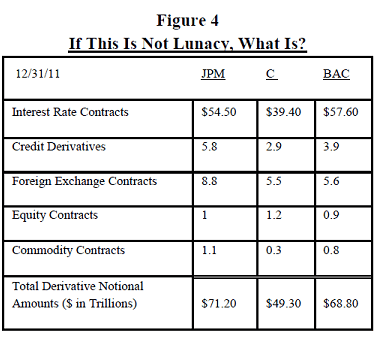
One of the slides I used in my Casey presentation (Figure 4 above) was borrowed from a terrific new book by Richard Duncan entitled The New Depression: The Breakdown of the Paper Money Economy (John Wiley, 2012). Mr. Duncan believes we are coming to the end of the road: “There is a grave danger that the credit-based economic paradigm that has shaped the global economy for more than a generation will now collapse. The inability of the private sector to bear any additional debts strongly suggests that this paradigm has reached and exceeded its capacity to generate growth through further credit expansion. If credit contracts significantly and debt deflation takes hold, this economic system will break down in a scenario resembling the 1930s, a decade that began in economic disaster and ended in geopolitical catastrophe.”5 Much of this leverage comes in the form of out-of-control derivatives. Mr. Duncan’s warning gibes with the work of the historian Niall Ferguson, who wrote in The War of the World: History’s Age of Hatred that economic volatility has led in the past to social instability.6 In a world where markets exercise an increasing influence on economies and where markets are increasingly volatile, these are warnings from serious men that we cannot afford to dismiss.
Figure 4 above shows the December 31, 2011 gross notional amounts of derivatives contracts (in trillions of dollars) on the balance sheets of three of this country’s largest financial institutions. Wall Street likes to tell us that we should ignore gross derivatives exposures and instead focus on net exposures. This is the kind of self-serving blather that led to the collapses of Bear Stearns, Lehman Brothers, Merrill Lynch, and AIG. Jim Rickards spells out the correct analysis that must be applied to derivatives exposures in a complex system like today’s global financial markets: “In complex systems analysis, shorts are not subtracted from longs – they are added together. Every dollar of notional value represents some linkage between agents in the system. Every dollar of notional value creates some interdependence. If a counterparty fails, what started out as a net position for a particular bank instantaneously becomes a gross position, not the net. When gross positions increase by 500 percent, the theoretical risk increases by 5,000 percent or more because of the exponential relationship between scale and catastrophic event size.”7 Does anybody think that Jamie Dimon, Vikram Pandit or Brian Monahan understands that today? I would bet that Pandit is the only one who might appreciate the risk. When I see institutions like JPMorgan Chase building derivatives positions of $71.2 trillion (it was about $7 trillion higher a year earlier) and then listen to Jamie Dimon whine about how bank regulation is too tough and that banks should be allowed to set their own counterparty credit ratings and the like, my reaction is that Mr. Dimon either should be fitted for an orange jumpsuit or given a place in the witness protection program. His remarks are criminally irresponsible and he is a threat to the financial health of America. Instead, we hear him celebrated as a great corporate leader. It’s not just that our priorities are screwed up – they are actually designed to destroy us.
Obamacare
One of the truisms in politics is that there is an enormous difference between campaigning and governing. George W. Bush discovered that on 9/11 and the revelation altered both his presidency and the course of history. Barack Obama ran on a platform of promise but only had a blank resume to back it up. For some reason best known to Mr. Obama himself, he then decided to jam through a badly flawed healthcare bill in the midst of a severe economic downturn. To compound the error, he and his Democratic allies in the Senate chose to cloak the legislation in the phony garb of civil rights, going so far as to enlist genuine heroes from the civil rights era (which neither Mr. Obama, Nancy Pelosi nor Harry Reid are or will ever be) to march up the steps of the Capitol in one of the most cynical displays of political manipulation in recent political history. They say that you can fool some of the people some of the time but you can’t fool all of the people all of the time, and indeed the intellectually corrupt underpinnings of Obamacare were revealed in all their ugly glory in recent Supreme Court arguments. This does not mean that the legislation will be overturned, although there is a better-than-even chance that it will. But the American people were able to see that once again – in this case with respect to the Commerce Clause of the Constitution – that the Obama administration is more than willing to trample on the rule of law when it believes that some self-righteous end justifies the means.
The most persuasive argument that I have found to overturn to mandate that requires individuals to purchase healthcare is found in the brief submitted by Paul Clement on behalf of the states that opposed the mandate.
“An individual can do very little to avoid the long arm of the federal government other than refrain from entering into commerce that Congress may regulate. If Congress not only can regulate individuals once they decide to enter into commerce, but can compel them to enter commerce in the first place, then there is nothing left of the principle that Congress’ powers ‘are defined, and limited,’ Marbury v. Madison, 5 U.S. 137, 176 (1803), as Congress could simply force within its regulatory reach all those who would remain outside it.”
In the case of the Commerce Clause, Obamacare effectively does what earlier state governments did when they tried to regulate contraception and abortion (think Griswold v Connecticut, 1965). Healthcare is different, just not in the way Obamacare’s proponents have argued. American citizens are being forced to purchase healthcare, a highly personal and physically invasive product. There is no difference from a personal liberty standpoint between healthcare and contraception and abortion. In fact, the latter are just two subsets of the former. Accordingly, how can the Obama administration, which wears its women’s rights credentials on its sleeve, turn around and argue that it can intrude into an individual’s private space by requiring him or her to purchase healthcare? How is that different from preventing a person from accessing contraception or terminating a pregnancy? At best there is a difference in degree but not in kind, and such a difference does not rise to constitutional significance. Hopefully somebody close to Mr. Romney will read this and help him articulate an argument that reveals to the American people the hypocrisy of Mr. Obama’s position. One thing is certain – Mr. Obama must have been one lousy Constitutional law professor, because not only doesn’t he understand the Constitution, but he consistently demonstrates immense disrespect for the rule of law.
The United States calls itself the land of the free, but this country has become steadily less free in recent years, particularly since 9-11. The Patriot Act has turned America into a quasi-police state where simple liberties are now treated with suspicion in the name of protecting us from one-in-a-million threats. Homeland Security has become a laughingstock as it protects the country against threats posed by the elderly, the infirm, the handicapped and the young. The only threat Granny poses to this country is with her cooking. The balance between liberty and protection from terrorist threats has grown completely out of balance as many of us warned. Governments do not understand moderation. When given power, they keep gathering it until stopped by the rule of law or violent resistance. The rule of law, however, has been steadily weakened, first by the Bush II administration and even more severely by the Obama administration. At least President Bush II was primarily interested in bending the rule of law to torture terrorists; President Obama has done the same to violate commercial contracts and play Robin Hood.
Investment recommendations
This section is available only to paid subscribers.
Michael E. Lewitt
5. James Rickards, Currency Wars: The Making of the Next Global Crisis (New York: Penguin Group (USA) Inc., 2011), p. 210.
6. Richard Duncan, The New Depression: The Breakdown of the Paper Money Economy (Singapore: John Wiley & Sons Singapore Pte. Ltd., 2012), p. ix.
7. Ferguson writes: “Economic volatility matters because it tends to exacerbate social conflict. It seems intuitively obvious that periods of economic crisis create incentives for politically dominant groups to pass the burdens of adjustment on to others. With the growth of state intervention in economic life, the opportunities for such discriminatory redistribution clearly proliferated. What could be easier in a time of general hardship than to exclude a particular group from the system of public benefits? What is perhaps less obvious is that social dislocation may also follow periods of rapid growth, since the benefits of growth are very seldom evenly distributed. Indeed, it may be precisely the minority of winners in an upswing who are targeted for retribution in a subsequent downswing.” The War of the World: History’s Age of Hatred (London: Allen Lane, 2006), pp. lxi-lxii.
Disclaimer
All opinions and investment recommendations expressed by Michael E. Lewitt in The Credit Strategist as well as on Twitter under the Twitter name @credstrategist are solely the opinions of Mr. Lewitt and do not reflect the opinions of Cumberland Advisors or its affiliates or employees, managing directors, owners or principals.
Disclosure Appendix
This publication does not provide individually tailored investment advice. It has been prepared without regard to the circumstances and objectives of those who receive it. This report contains general information only, does not take account of the specific circumstances of any recipient, and should not be relied upon as authoritative or taken in substitution for the exercise of judgment by any recipient. Each recipient should consider the appropriateness of any investment decision having regard to his or her own circumstances, the full range of information available and appropriate professional advice. The editor recommends that recipients independently evaluate particular investments and strategies, and encourages them to seek a financial adviser’s advice. Under no circumstances should this publication be construed as a solicitation to buy or sell any security or to participate in any trading or investment strategy, nor should this publication or any part of it form the basis of, or be relied on in connection with, any contract or commitment whatsoever. The value of and income from investments may vary because of changes in interest rates or foreign exchange rates, securities prices or market indexes, operational or financial conditions of companies, geopolitical or other factors. Past performance is not necessarily a guide to future performance. Estimates of future performance are based on assumptions that may not be realized. The information and opinions in this report constitute judgment as of the date of this report, have been compiled and arrived at from sources believed to be reliable and in good faith (but no representation or warranty, express or implied, is made as to their accuracy, completeness or correctness) and are subject to change without notice. The editor may have an interest in the companies or securities mentioned herein. The editor does not accept any liability whatsoever for any loss or damage arising from any use of this report or its contents. All data and information and opinions expressed herein are subject to change without notice.
The Credit Strategist
Michael E. Lewitt, Editor
The Credit Strategist is published on a monthly basis by Michael E. Lewitt. Address: 5030 Champion Blvd., G6 #161 Boca Raton, FL 33496. Telephone: (561) 239-1510. Email: [email protected]. Delivery is by electronic mail. Annual subscription rate is $395 for individuals and $995 for institutions. Visit our web site at www.thecreditstrategist.com. Copyright warning and notice: It is a violation of federal copyright law to reproduce or distribute all or part of this publication to anyone (with the exception of individuals within the same institution pursuant to the subscription agreement) by any means, including but not limited to photocopying, printing, faxing, scanning, e-mailing, and Web site posting without first seeking the permission of the editor. The Copyright Act imposes liability of up to $150,000 per issue for infringement. Information concerning possible copyright infringement will be gratefully received.
Read more articles by Michael Lewitt