Advisor Perspectives welcomes guest contributions. The views presented here do not necessarily represent those of Advisor Perspectives.

This essay is excerpted from a recent version of The Credit Strategist (formerly the HCM Market Letter). To obtain the complete issue, you must subscribe directly to this publication; Please go here. The Credit Strategist is on Twitter - @credstrategist
“[D]eflation caused by the debt reacts on the debt. Each dollar of debt still unpaid becomes a bigger dollar, and if the over-indebtedness with which we started was great enough, the liquidation of debts cannot keep up with the fall of prices which it causes. In that case, the liquidation defeats itself. While it diminishes the number of dollars owed, it may not do so as fast as it increases the value of each dollar owed. Then, the very effort of individuals to lessen their burden of debts increases it, because of the mass effect of the stampede to liquidate in swelling each dollar owed. Then we have the great paradox which, I submit, is the chief secret of most, if not all, great depressions: The more the debtors pay, the more they owe. The more the economic boat tips, the more it tends to tip. It is not tending to right itself, but is capsizing.”
Irving Fisher 1
Not to put too fine a point on it, but anybody who believes that the $360 billion portfolio being managed by J.P. Morgan’s Chief Investment Office was not an example of proprietary trading is either on the bank’s payroll or is completely unqualified to render an opinion on the subject (that is a much longer version of what we wanted to say).
It is said that “In the kingdom of the blind, the one-eyed man is king.” Today, there are no more one-eyed men – there are only kingdoms of the blind.
The world remains in the midst of the massive margin call that began in 2007. Readers of this publication should not be surprised by what is occurring since we have written about it consistently for years in this newsletter, in El Mundo, and in The Death of Capital (John Wiley: 2010 – still available at Amazon.com and still worth reading!). Economies worldwide are merely entering the next stage of the deleveraging that triggered the 2008 financial crisis, whose underlying causes were never properly addressed through effective monetary, fiscal or regulatory policy reforms.2 Recent events offer a rare illustration of the combined effects of the failure of these three policy areas to coordinate a meaningful policy response. Rising budget deficits, record low interest rates, J.P. Morgan’s proprietary trading blunder3 and the botched Facebook IPO process speak to abject policy failures in virtually every aspect of finance. It’s not even a question of not having learned our lessons; our collective policy intelligence actually appears to have diminished.
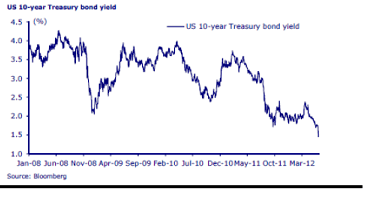
While the immediate focus is properly on Europe, whose southern economies are literally crumbling before our eyes, the malady is global. Brazil announced weak first quarter growth of 0.8%. India and China are slowing sharply. India reported its slowest GDP growth in 9 years (+5.3% year-over-year in 1Q12), while China’s May manufacturing PMI dropped more sharply than expected to 50.4 from 53.3 in April. Moreover, China has no plans to step forward with a sufficiently sizeable stimulus plan to bail the world out of its misery. China’s official economic numbers are obviously doctored in any case and are inconsistent with more reliable (and downbeat) data such as electricity usage and cement production. The U.S. 10-year Treasury bond yield hit a record low of 1.457% on June 1, but yields in the rest of the world are even lower: Swiss 10-year rates are at 0.50%, Japan’s at 0.80% (Kyle Bass was, as we noted at the time, far too early in shorting JGBs despite his masterful press management), Germany’s down to 1.13% (its 2-year rates went negative) and Denmark’s below 1%. Markets are sending a strong deflationary signal. That is what a flight to safety in the bond market is all about.
Figure 1
Deflation
Europe would have a much greater chance of solving its problems if its leaders spent 1/100th as much time doing the right thing as doing the wrong things. Instead, they continue to waste time and effort trying to prevent Greece from leaving the EU when that is so clearly both the necessary and correct course of action. It would be another matter were someone to propose a credible scenario under which Greece could remain in the EU as anything other than a ward of the union. But no such scenario is possible. Greece’s economy cannot be competitive tethered to the Euro. The appropriate cost of capital for Greek businesses is hundreds of basis points higher than the cost of capital for businesses in other European countries, even weak ones like Spain or Italy. How in the world can a Greek business hope to compete with such an albatross tied around its neck?
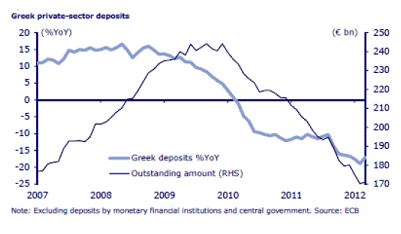
The Greeks vote on June 17 on what has become a referendum on continued EU membership. In the meantime, Greeks are moving their assets out of Greek banks and into safer institutions in Northern Europe. The alternative is to risk being told one morning that the Euros sitting in their Greek bank accounts have been exchanged into sharply devalued drachmas (likely worth 70 percent less than the Euros out of which they were spawned). This capital flight, which is eminently reasonable on an individual basis, is merely accelerating the inevitable Greek collapse.4 For all we know, by June 17th the Greeks may have already voted with their pocketbooks and rendered their decision. Make no mistake – a Greek exit will be incredibly disruptive to financial markets. But that is where we are. Are the markets prepared for such an outcome? We doubt it.
Figure 2
Greek bank run
1. Irving Fisher, The Debt-Deflation Theory of Great Depressions, Econometrica, October 1933, p. 344.
2. With respect to regulatory reform, not only are many of the proposed reforms ineffective or misguided, but very few are even being implemented. According to the law firm David Polk & Wardwell, as of May 1 the Securities and Exchange Commission had yet to draft 2/3 of the required regulations under the Dodd-Frank Wall Street Reform and Consumer Protection Act.
3. Not to put too fine a point on it, but anybody who believes that the $360 billion portfolio being managed by J.P. Morgan’s Chief Investment Office was not an example of proprietary trading is either on the bank’s payroll or is completely unqualified to render an opinion on the subject (that is a much longer version of what we wanted to say).
4. A Greek exit will give rise to all sorts of unintended or unanticipated consequences, none of them positive. Some of those consequences are already coming to light as those doing business with Greek companies begin taking steps to protect themselves. For example, the Financial Times reported on May 31 that two trade credit insurers, Euler Hermes and Coface, took the unusual (but wise) decision to stop extending covering for companies exporting to Greece (“Two trade credit insurers halt cover for exporters to Greece,” p. 16). This move reflects the fact that Greek importers will still be obligated to pay their bills in Euros but could conceivably be left holding devalued drachmas and be rendered incapable of paying their bills.
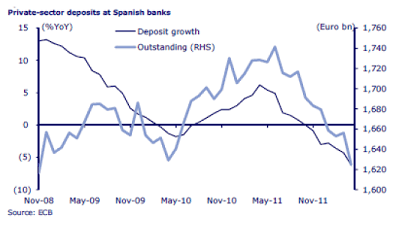
That may be the least of the world’s problems, however. Spain is too big to fail, but it is failing nonetheless. In the first quarter, an alarming €97 billion of capital fled the country, equivalent to 10% of GDP. Undoubtedly much more has departed in the last two months (we know of at least another €31 billion of bank deposits that flew the coop in April). The unemployment rate hit 24% in the first quarter, with youth unemployment eclipsing 50%. The country’s banks are hopelessly insolvent. Last week, Spain announced a €24 billion bailout of Bankia, the country’s fourth largest bank that was formed in December 2010 out of the remnants of seven regional savings banks.5 Just two weeks earlier, the bank was talking about paying its first dividend. Now it turns out it was hiding losses. The government then announced a broader plan to nationalize its banks that was promptly rejected by the EU.
Figure 3
Spanish Bank Run
Spain’s public sector is also faltering, with its largest region, Catalonia, saying that it is not going to be able to refinance its maturing debt and will require the assistance of the national government. Spain’s economy is deteriorating by the day, with April retail sales dropping by a whopping 9.8% year-over-year. Spanish yields are back above 6.5%, and Spanish CDS has widened to +580 basis points. Recapitalizing Spain will require resources that the ECB does not have. It can conjure them out of the air through further money printing, but the financial markets are likely to react very badly to such a program. Unfortunately, that scenario is looking increasingly likely by the day. It is generally believed that 7% is the breaking point after which Spain can no longer raise 10-year capital. There is nothing to indicate we won’t be there very shortly.
European leaders will undoubtedly resort to some form of massive debt monetization. The most effective would likely be government guarantees of all outstanding debts, although that would be a case of the blind guaranteeing the blind. Some are pushing for a unified deposit insurance scheme across Europe to protect bank depositors, while others propose giving the European Stability Mechanism (ESM) a banking license. A third proposal that was given new life by the election of Francois Hollande to the French presidency is Eurobonds. Eurobonds are perfectly consistent with a philosophy of socializing economic obligations, which is one reason why M. Hollande supports them. Germany is opposed to the concept because it will end up picking up the tab. None of these proposals, of course, addresses the fact that European economies are incapable of generating sufficient income to service and repay all of the debts that European countries have accumulated.
We are highly skeptical of the concept of Eurobonds, which have been proposed by many prominent individuals including George Soros. Eurobonds would only perpetuate the underlying flaws of the European Union concept. Bonds backed by the entire EU could provide access to capital that could stabilize failing economies and/or banking systems in the short-term, but the concept suffers from two fatal deficiencies. First, Eurobonds would perpetuate the failed policy of providing countries like Greece with capital at unjustifiably low interest rates; and second, they would merely be another attempt to solve a debt crisis with more debt. Debt-ridden economies like Greece and Spain need to start writing off the debts they cannot repay, not incurring additional debts at below-market interest rates that are being subsidized by Germany.
Just as we wouldn’t lend the U.S. government money for 10 years at current rates (1.457%), we run the other way from any Eurobond offering. We also wouldn’t consider lending money to Germany. Despite the flight to safety that is pushing German 10-year Bund yields to record lows (1.13%), it is difficult to see how Germany’s cost of capital will not increase as its largest trading partners crumble around it. Based on that view, we would be short German credit spreads. We would also be shorting French credit spreads on the expectation that France will either be asked to step up and help pay more for its bankrupt neighbors or see its economy weaken (actually the two could easily occur simultaneously). We are definitely not of the school of thought that would be selling protection (going long) the credit of any European sovereign, even the strongest, on the basis that the European authorities will come up with some miraculous plan to solve the crisis.
Europe has dallied too long. The reality is that Europe can’t service its collective debt burden. It would require a union consisting of several Germanys – but unfortunately Europe has only one Germany, along with one Greece, one Ireland, one Portugal, one Spain and one Italy. Try as it might, policymakers can’t make the pieces fit together. Many want to believe that Europe will “muddle through” and that the ECB will come up with another massive monetization program like the LTRO that will allow the EU to live another day. That is just a form of magical thinking. The EU as originally formulated has reached the end of the line and the sooner its leaders recognize that fact and act on it, the better off everyone will be. The same is true of the believers in the “muddle through” scenario. In fact, that scenario would be the worst possible outcome because it would delay the ultimate reckoning and make it that much more catastrophic. Everything the European authorities have done has only made matters work. It is time to let the markets work. Anything else is a delusion.
The U.S. Economy
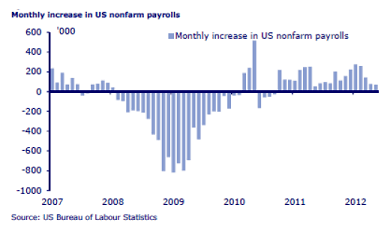
TCS has repeatedly questioned the premise that the U.S. is experiencing a self-sustaining recovery. The economic data is proving that we were correct. The May jobs report – the third disappointing release in a row - was dismal in virtually every respect.6 Not only were the 69,000 new jobs an abysmal number, but downward revisions of -11,000 in March and -38,000 in April made it impossible to put any lipstick on this pig of a report. The unemployment rate ticked up to 8.2% and is now roughly where it was when Obama took office (although if it weren’t calculated based on a shrinking labor force it would be closer to 11 percent). U-6 (which measures underemployment) jumped to 14.8% from 14.5%.
Figure 4
Joblessness
This report may well be a turning point in the presidential election because it proves that the Obama administration’s economic policies are failing. Mr. Obama will continue blaming his predecessor, the Japanese tsunami, Europe, the Republican Congress (even though he had a Democratic Congress that gave him what he wanted during his first two years in office), and anyone else he can think of right up through Election Day. But after $5 trillion of additional spending and four years of zero interest rates, the president would do better to acknowledge his own policy failures. He could blame Larry Summers – for clearly none of the so-called brilliant ideas from this so-called brilliant economic mind have worked.7 One could argue that things would have been worse without all the stimulus that was thrown at the economy, but that argument is the intellectual equivalent of shooting a corpse. The Obama administration had every opportunity to adopt meaningful pro-growth economic policies during its first two years in office when it controlled Congress. Instead it opted for expensive healthcare reform (dressed up as a phony civil rights mission) and a bunch of gimmicks that yielded nothing (Cash for Clunkers, etc.). These policies and the philosophy behind them were both flawed. Mr. Summers failed to teach the former community organizer that governments don’t create jobs. Governments can only create an environment in which the private sector can create jobs. The Obama administration, however, has forged an environment characterized by regulatory overreach and policy uncertainty. This is precisely the opposite of what is needed during a balance sheet recession, but that is what we were given.
We do not expect interest rates to rise significantly for at least another two years. For that reason, we believe it is still too early to start shorting Treasuries. If the fear trade weren’t reason enough for the rally in bonds, a decided lack of inflation would be. 10-year TIPS are now trading at a negative yield of negative 0.50 percent. The bond market may be serving as a shelter from the European storm, but the deflationary signals it is sending can’t be ignored. Inflation is dormant in the U.S. in large part because of the weak job market. Labor costs account for the lion’s share of product costs, and weak labor markets are suppressing any potential increases in wages. As David Rosenberg pointed out after the May jobs report, there are 18 million candidates competing for only 3.7 million job openings. Such a supply-demand imbalance guarantees stagnant wages for the foreseeable future. Inflation is also being dampened by the sharp drop in oil prices, which fell by 16% in May. Other commodities sold off as well during May, including Dr. Copper, which collapsed by 11% during the month. There is still significant excess capacity in the U.S. economy (despite arguments by Bridgewater Associates that this capacity is being rapidly absorbed during what it calls a “beautiful deleveraging” – it is not and there is nothing beautiful about what is happening). The output gap (the difference between real GDP and where real GDP would be if the economy were operating at full capacity) is 5.4%, which is wider than we would see if this were a normal recovery from a conventional business cycle recession. Instead, the U.S. is experiencing a balance sheet recession, which means that businesses are cautious in their expansion and hiring plans. Couple low inflation/deflation with a flight to safety and we are likely to see rates drop even further. We would not be surprised to see 10-year U.S. rates hit 1.25% by Labor Day, and 1.0% is not out of the question either.
Many strategists are now predicting the imminent arrival of QE3. Ben Bernanke’s track record certainly suggests that more stimulus is coming, either in the form of central bank purchases of debt or more maturity reshuffling. As we have argued with respect to previous quantitative easing schemes, such a move would perpetuate a long series of policy errors. If four years of zero interest rates, five trillion of deficit spending, QEI, QEII and Operation Twist have not worked, what in the world possesses anyone to believe that further quantitative easing is going to suddenly work miracles? It is time to acknowledge that such policy maneuvers do not work during a balance sheet recession other than to provide a temporary boost to equity prices (which merely serves to suck investors back into the market so they can lose the rest of their money). Monetary policy has run its course. The correct policy path is the adoption of pro-growth fiscal policy measures and the removal of regulatory and tax obstacles to growth. This is why the upcoming presidential election is so important. There is no chance that the necessary policy changes will occur if President Obama is re-elected. And that means the economy and markets will suffer badly.
The U.S. Corporate Sector Stumbles
Facebook. While overall corporate health remains robust in the U.S., the last couple of months have seen a series of corporate stumbles that have contributed to investors’ low degree of confidence in the stock market. The most obvious disaster was the Facebook IPO. TCS warned readers (and reiterated its view multiple times on Twitter) to avoid this deal. Apart from our instinctual dislike of this privacy-destruction engine, we viewed the $100 billion valuation as ludicrous and the corporate governance structure as obnoxious. With all due respect to Mark Zuckerberg’s talent, leaving the reins of a $100 billion company in his hands does not impress us as a prudent move. The very capable Sheryl Sandberg may be babysitting the boy genius, but managing a public company of the scale and velocity of Facebook requires a different set of skills than Mr. Zuckerberg has demonstrated he possesses.
5. If nothing else, the Spanish government deserves points for creativity. It proposed to recapitalize Bankia by injecting €19 billion of sovereign bonds into the bank and then swapping those bonds for cash at the ECB. This clever scheme was promptly rejected by the ECB.
6. The only glimmer of hope was an increase in the labor force, which was what contributed to the higher unemployment rate. Theoretically, more people joining the labor force indicates more confidence in the economy.
7. Mr. Summers still hasn’t learned from his errors and as recently as this weekend was arguing that the U.S. should borrow more money and spend it to revive the economy.
There were also a series of events that occurred in the weeks leading up to the IPO that confirmed our doubts but apparently failed to dissuade diehard fans of the company. The first was the “process” whereby Facebook acquired Instagram. If nothing else, Mr. Zuckerberg’s failure to consult his directors until after cutting the deal at a funny-money valuation suggested a lack of adult supervision at the company. Then there was the disclosure that the company’s 1Q12 revenues declined from 4Q12, as well as the company’s admission that it has yet to figure out how to monetize mobile revenues. General Motors’ withdrawal of its advertising didn’t help matters either. Finally, the unseemly amount of insider selling was a sure sign that something was rotten in the kingdom despite the torturous justifications put forth to rationalize their rush to the exits. One never wants to be buying what those with the most knowledge are selling.
The lead underwriter, Morgan Stanley, faced a thankless task in pricing the deal. The offering was boxed into an absurdly high valuation by the fact that shares had been changing hands in the private market at a $100 billion valuation. It is easy in retrospect to argue that the deal should have been brought at a lower valuation, but what would have been the appropriate value? $50 billion? $75 billion? Despite protestations to the contrary, the Facebook IPO bore a great deal of similarity to Internet IPOs sold at the height of the Internet Bubble in the late 1990s. Like those deals, Facebook’s valuation was derived by discounting a wide spectrum of unknown future outcomes. Of course, it was Morgan Stanley’s job to manage that process, but the firm badly miscalculated the ultimate demand for the stock and then was dealt a very bad hand by Nasdaq’s incompetence. Yet anyone tempted to feel badly for the underwriter was quickly disabused of those feelings after hearing the firm’s chairman, James Gorman, tell CNBC that investors who participated in the IPO hoping for a first day pop were either naïve or acting under false pretenses. Insulting those whom you’ve screwed is an unusual public relations strategy, to say the least.
The Facebook IPO highlights everything that is wrong with Wall Street. Research analysts employed by underwriting firms should not be permitted to whisper in the ears of favored large customers on the eve of an IPO. This type of conduct is directly contrary to the full disclosure that is the gravamen of the securities laws. Once again, the SEC functioned like a good cop – it was not around when investors really needed it. In this light, Mr. Gorman’s defense that his firm performed within the rules completely missed the point. The rules are deficient and Morgan Stanley should have required its analysts to conform their conduct to higher standards of ethical conduct. Instead of asking Mr. Gorman whether firms will now be reluctant to hire Morgan Stanley to manage their IPOs in view of the firm’s bungling of the Facebook deal, CNBC’s Maria Bartiromo should have asked whether investors will be more reluctant to participate in the next Morgan Stanley underwriting. After all, Facebook got its $16 billion of underwriting proceeds; it is the investors who are nursing huge losses on their shiny new Facebook shares.
The media also played its part in pumping up the deal beyond all reason. The zenith of media idiocy was undoubtedly CNBC’s reports about Mr. Zuckerberg’s hoodie (and are we the only ones who can’t help thinking of the contrast with the recent focus on Trayvon Martin’s hoodie?). On a more constructive note, Jim Cramer deserves a great deal of credit for warning investors against participating in the IPO. Mr. Cramer was harshly criticized for being a market cheerleader in the period leading up to the 2008 financial crisis, but he has more than redeemed himself with this call and many other caution flags he has raised since then.
As for Facebook itself, it is time for Mark Zuckerberg to grow up, and for those around him to stop coddling him. His post-IPO silence is inexcusable and only furthers the impression that his attitude toward shareholders is one of disdain. If Mr. Zuckerberg wants to exclusively focus on his customers, then he shouldn’t have gone public. He owes shareholders the respect of addressing the IPO fiasco in order to assure them that he takes his responsibility as a public company leader seriously.8 He certainly had no trouble pocketing their money. The IPO was disastrous enough, but management’s silence suggests that further disasters lie ahead for a company that is still trying to figure out what it wants to be when it grows up.
Chesapeake, Yahoo, RIMM, JC Penney. The Facebook debacle was just the worst of a series of corporate snafus in recent weeks. The drama at Chesapeake Energy (CHK) continued with Carl Icahn accumulating a large stake and demanding board representation (which he got). We continue to believe that it would be a grave error to remove Aubrey McClendon as CEO, and also believe that CHK remains more undervalued than ever. Yahoo’s CEO lost his job when it turned out he lied on his resume, although of more concern to stockholders should be the tepid response of the shares to the sale of 50% of its interest in Ali Baba. Research in Motion (RIMM) basically blew up at the end of the month after announcing a surprise loss and the hiring of financial advisors. JC Penney’s new Chairman Ron Johnson lost his Apple, Inc. halo after the company announced a terrible quarter and it became apparent that the retailer was further behind in its turnaround than the media hype and its media-savvy investors suggested.
JP Morgan. And then there was J.P. Morgan, which did more than its part to destroy stockholder value in the banking sector when it disclosed an inexcusable $2 billion (which is likely to be considerably larger) proprietary trading loss in its Chief Investment Office. TCS was aware of the spoutings of the London Whale when we raised questions last month about Mr. Dimon’s opposition to stricter financial regulation while sitting atop of $71 trillion of derivatives. When you are sitting on a pile of dynamite, it is best not to light a match. Yet that is exactly what J.P. Morgan did. The loss came from derivative positions right under Mr. Dimon’s nose. Still, people make mistakes, and we doubt Mr. Dimon will repeat this one. And despite our criticism of his anti-regulatory jawboning, Mr. Dimon remains the most qualified individual to manage J.P. Morgan. He obviously began believing the smoke that was being blown up his posterior by the media, and this setback should administer the necessary dose of humility that even the most capable among us require from time-to-time.
We are also completely unsympathetic to those who argue that this trading loss does not implicate the Volcker Rule. The losses in question originated in a trading book that is twice as large as the bank’s $183 billion of year-end shareholders’ equity. The bank was using the intellectually discredited concept of Value at Risk (VaR) to measure the portfolio’s risk of loss, which alone tells us that the individuals in charge were out of their depth. Mr. Dimon and the rest of us should be thankful that the loss will be able to be absorbed by the bank’s earnings and existing capital. But nobody should pretend for a moment that in the end J.P. Morgan, as a too-big-to-fail institution, is not back-stopped by the American taxpayer. The bank may argue that it was playing with its own money on these trades, but that is only true to the extent that it does not blow itself up. Some (why do I keep seeing Ken Langone in my mind as I write this?) will laugh and call what I am writing preposterous. I would respond by saying that it is only preposterous until it is not, and then it will be too late. Just ask the Europeans. No bank ever failed because it had too much capital. Trading should be left to those who truly have their own capital at risk. That does not include J.P. Morgan or Mr. Dimon, whose legal expenses in this matter will be fully covered by his employer.
The Private Equity Debate
Readers are well-acquainted with TCS’s jaundiced view of the private equity industry so we will not repeat ourselves here. We believe, however, that President Obama is making a serious error in attacking Mitt Romney’s private equity experience. Mr. Romney’s private equity background is clearly relevant to his qualifications to lead the nation. Unfortunately for Mr. Obama, however, Mr. Romney’s record is largely one of accomplishment, not failure. We need an individual in the White House who understands what is involved in creating jobs and expanding a business, something Mr. Obama has demonstrated he does not understand. Moreover, Mr. Obama’s argument that private equity is merely about making money is a complete red herring. Of course private equity partners are focused on producing profits for their investors and themselves. But that is precisely why Mr. Romney is well-equipped to handle economic policy. Private equity firms must figure out how to squeeze the most out of their resources, something that is antithetical to the mentality of governments. Companies owned by private equity firms must balance their budgets and figure out how to grow with the resources they have. They do not have the luxury of printing more money. Having been through the business formation and destruction process in the private sector, Mr. Romney brings a perspective to the public sector that has been totally absent from the Obama administration, which relied on economic advisors who were devoid of private sector work experience. The reign of Larry Summers, which was mercifully cut short, illustrates the adage that economies work in theory but they don’t work in practice. Professor Summers wouldn’t recognize a job if one flew across the room and hit him in the head. We need fewer economic theoreticians and more practitioners in government.9
The real policy question with respect to private equity is whether using leverage to purchase otherwise healthy companies is the type of economic activity that merits the tax incentives that private equity enjoys. These incentives include not only the carried interest tax, which is completely unjustified, but also the favorable treatment of interest and dividends. All interest and dividend payments should not be created equal, and those used for unproductive activities should not be granted the same incentives as those used for productive activities. Private equity proponents will argue that it is impossible to distinguish between productive and unproductive investments. We strongly disagree. The evidence is clear that much of the capital devoted to private equity over the past two decades had done little to promote economic growth or the expansion of the economy’s productive capacity. Now more than ever, this country requires the financial and intellectual capital of private equity firms to promote economic growth through investments in promising new industries, struggling businesses that require capital to grow, and venture capital opportunities. Distinguishing between types of activities that merit tax breaks and those that do not does not require the intellectual capacity to split the atom. It requires common sense and, once the rules are applied, a good faith effort by business leaders and their advisors to follow the rules rather than expend all of their energies trying to exploit or avoid them (admittedly an incredibly naïve thing to say).
Investment recommendations
This section is available only to paid subscribers.
Michael E. Lewitt
8. Hiding behind the so-called quiet period is no excuse either. Mr. Zuckerberg could have easily made some type of comment to address the obvious concerns of shareholders without violating securities laws (which are in any case inane).
9. We also think that Mr. Obama’s argument is so transparently political that voters are going to reject it. He would be far better served by proposing a series of pro-growth economic initiatives that among other things would remove the impediments to business and job formation that his healthcare and tax policies have imposed on the American economy.
Disclaimer
All opinions and investment recommendations expressed by Michael E. Lewitt in The Credit Strategist as well as on Twitter under the Twitter name @credstrategist are solely the opinions of Mr. Lewitt and do not reflect the opinions of Cumberland Advisors or its affiliates or employees, managing directors, owners or principals.
Disclosure Appendix
This publication does not provide individually tailored investment advice. It has been prepared without regard to the circumstances and objectives of those who receive it. This report contains general information only, does not take account of the specific circumstances of any recipient, and should not be relied upon as authoritative or taken in substitution for the exercise of judgment by any recipient. Each recipient should consider the appropriateness of any investment decision having regard to his or her own circumstances, the full range of information available and appropriate professional advice. The editor recommends that recipients independently evaluate particular investments and strategies, and encourages them to seek a financial adviser’s advice. Under no circumstances should this publication be construed as a solicitation to buy or sell any security or to participate in any trading or investment strategy, nor should this publication or any part of it form the basis of, or be relied on in connection with, any contract or commitment whatsoever. The value of and income from investments may vary because of changes in interest rates or foreign exchange rates, securities prices or market indexes, operational or financial conditions of companies, geopolitical or other factors. Past performance is not necessarily a guide to future performance. Estimates of future performance are based on assumptions that may not be realized. The information and opinions in this report constitute judgment as of the date of this report, have been compiled and arrived at from sources believed to be reliable and in good faith (but no representation or warranty, express or implied, is made as to their accuracy, completeness or correctness) and are subject to change without notice. The editor may have an interest in the companies or securities mentioned herein. The editor does not accept any liability whatsoever for any loss or damage arising from any use of this report or its contents. All data and information and opinions expressed herein are subject to change without notice.
The Credit Strategist
Michael E. Lewitt, Editor
The Credit Strategist is published on a monthly basis by Michael E. Lewitt. Address: 5030 Champion Blvd., G6 #161 Boca Raton, FL 33496. Telephone: (561) 239-1510. Email: . Delivery is by electronic mail. Annual subscription rate is $395 for individuals and $995 for institutions. Visit our web site at www.thecreditstrategist.com. Copyright warning and notice: It is a violation of federal copyright law to reproduce or distribute all or part of this publication to anyone (with the exception of individuals within the same institution pursuant to the subscription agreement) by any means, including but not limited to photocopying, printing, faxing, scanning, e-mailing, and Web site posting without first seeking the permission of the editor. The Copyright Act imposes liability of up to $150,000 per issue for infringement. Information concerning possible copyright infringement will be gratefully received.
Read more articles by Michael Lewitt