Advisor Perspectives welcomes guest contributions. The views presented here do not necessarily represent those of Advisor Perspectives.
Only a few short years ago, investors demanded a 5.0% yield to invest in AAA-rated US Treasury bonds. Those days are a distant memory. As illustrated below, the yield of Treasury bonds1, now AA-rated, plummeted to a miniscule .87% at the end of May. Market historians have to go back to World War II when rates were set by the joint agreement of the Federal Reserve and the Treasury Department to find rates so low.
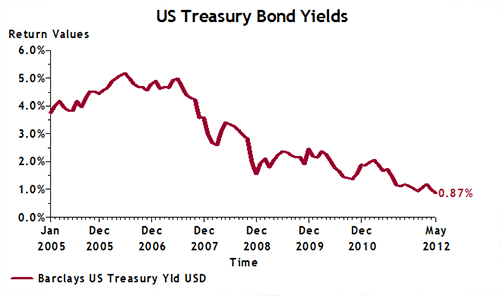
There are a number of reasons behind this precipitous fall. Worldwide there is a growing scarcity of “safe” government bonds as runaway sovereign debt reduces the number of top-rated issuers. It is easy to forget that the bonds of both Italy and Spain were once rated triple-A by Moody’s. The ultra-low interest rate policy of the Federal Reserve as well as quantitative easing has been a critical factor. Heightened demand has also played a role. Since 2007, US investors have poured nearly a trillion dollars into bond funds, a pace over four times greater than the previous four years.
Today’s extraordinarily low rates on top of a lower equity premium leave conservative retirees with the risk of heightened capital depletion as poorer portfolio returns may be inadequate to offset the combined impact of withdrawals and inflation.
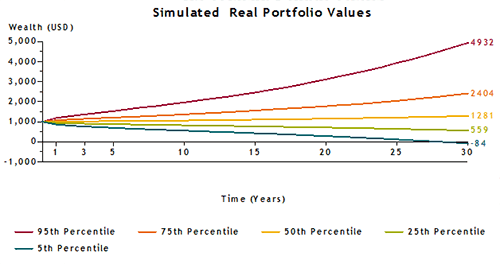
To illustrate the crucial significance of this issue, we analyzed a conservative balanced portfolio of $1,000,000 comprised of 60% US long-term government bonds and 40% US large company stocks. We assumed annual inflation-adjusted withdrawals are made equivalent to 4% of the starting portfolio value for a 30-year period – in other words, an inflation-adjusted annual income of $40,000 for three decades.
To establish a baseline, we initially analyzed this portfolio using historic returns and inflation (as detailed in Appendix I) and the 4% withdrawal rate. We ran 5000 simulations2 to calculate the expected real value of the portfolio. The following graph Illustrates the expected real value (in 000’s of $) of the portfolio over the next 30 years at different levels of probability - the 5th, 25th, 50th, 75th and 95h percentiles. All numbers are inflation-adjusted in 2012 dollars.
1. The Barclays US Treasury Bond Index reflects the public obligations of the US Treasury with a remaining maturity of one year or more.
2. Morningstar Encorr was used to provide the historic return and inflation information and to model and simulate the hypothesized portfolio. Long-term bond and large company stock returns are from the Ibbotson series.