Advisor Perspectives welcomes guest contributions. The views presented here do not necessarily represent those of Advisor Perspectives.
Today’s ultra-low interest rates have propelled investors into a frantic quest for higher income. In response, high-dividend yield stocks have become the favorite recommendation of a host of advisors. Yet, an undue focus on income alone obscures the irreducible fact that long-term investment success is based on the total return of a portfolio including both income and capital growth.
This raises two questions. First, given its income focus, how has the total return of a high-dividend yield strategy fared relative to the market overall? Second, how does its total-return performance compare to the returns of other possible stock-selection strategies?
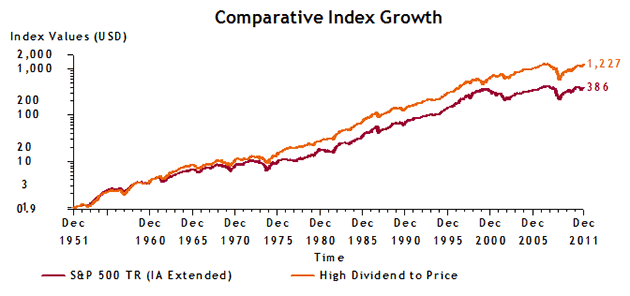
A high-dividend yield strategy is a systematic methodology to buy and hold stocks where the dividend is high in relation to the stock’s price. In effect, it is a strategy that selects value stocks since it is actually the low price of the stock relative to the dividend that primarily creates the high yield. As evidenced in the following graph, from 1952 through 2011, $1.00 invested in high-dividend yield stocks1 (in orange) grew to $1,227, more than three times the $386 in the S&P 500 (in red).

Over this period, high-dividend yield stocks returned 12.6% annually, far outpacing the 10.4% of the S&P 500. The US market is not alone in evidencing a return premium from high-dividend yield stocks. A global review2 of dividend yielding stocks in 21 countries over multiple decades found that high-dividend yield stocks outperformed low-yield stocks in 20 of the countries with an overall average premium of 4.1% a year.
However, a high-dividend yield strategy is just one variant of stock strategies that select value stocks and there is considerable evidence as well as theoretical support that value stocks outperform both growth stocks and the market over longer periods of time. (See our July 2009 commentary, Beating the Market.) In this context, the “yield” premium ascribed to high-dividend strategies is actually a “value” premium.
Other value strategies
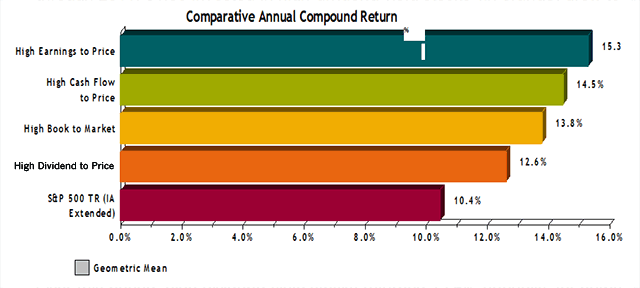
3 select stocks based on high earnings or high cash flow in relation to price, as well as high book value of equity relative to market value. As evidenced in the following chart, over the period 1952 to 2011, high-dividend yield stocks, although outpacing the overall market, returned
less than value stocks selected on the basis of earnings, cash flow or book value.
1. The high dividend yield portfolio was created using data from Professor Ken French’s website. The high-dividend portfolio is based on the top 30% of capitalization weighted dividend paying stocks rebalanced annually.
2. Credit Suisse Global Investment Returns Yearbook 2011. February 2011. Credit Suisse Research Institute.
3. All portfolios were created using data from Professor Ken French’s website based on the top 30% of capitalization weighted stocks measured on earnings to price, cash flow to price, and book to market value.
One likely explanation for the lower return of the high-dividend yield stocks versus stocks selected using other value parameters is that dividend-paying stocks tend to be of larger companies. Non-dividend paying companies, by definition, are excluded from selection and these tend to be smaller.4 Hence, a high-dividend yield strategy foregoes to a greater degree the return premium available from investing in smaller companies (See our commentary, Good Things Come in Small Packages.)
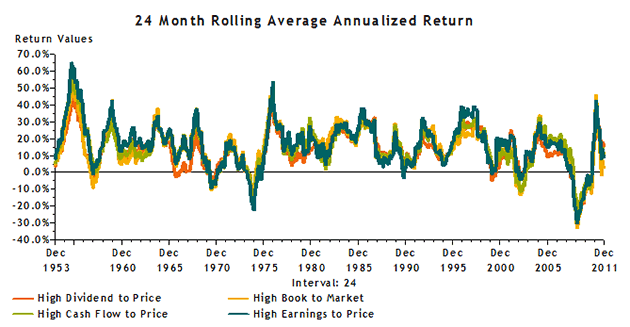
Value stocks selected on the basis of high earnings to price or, as more commonly known “low price-to-earnings,” had the strongest performance. This value strategy can buy non-dividend-paying growth companies that are out of favor or whose prospects are underestimated by the market as well as profitable companies that have temporarily suspended or reduced dividends5. Apple, Inc. at one time was a classic example of the former. However, as evidenced in Table I in the Appendix, no single value strategy outperforms consistently over shorter time frames. Hence, strategy diversification could prove beneficial, especially for impatient investors.
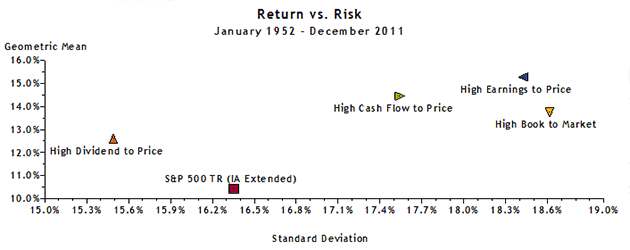
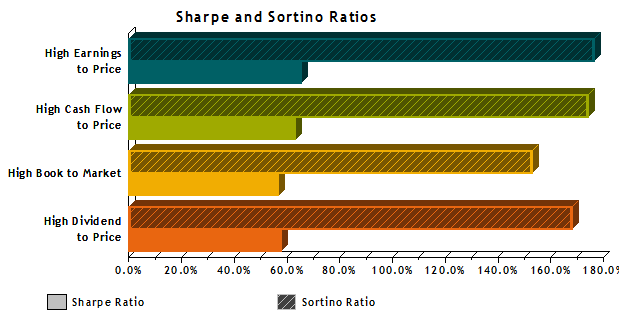
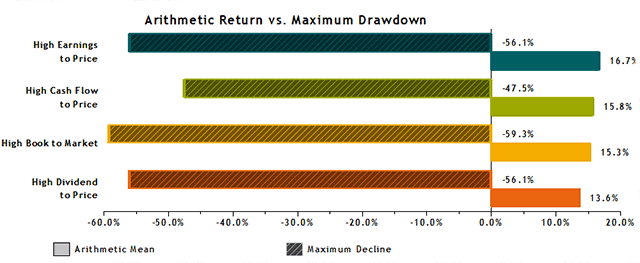
A much cited virtue of high-dividend strategies is that they are less volatile than the market. As evidenced in Table II, this is true – high-dividend stocks are less volatile. However, as illustrated in Table III, value stocks based on either earnings or cash flow had modestly higher risk-adjusted returns than the high-dividend yield strategy.
A high-dividend strategy does result in less stock turnover than a strategy based on either cash flow or earnings6 and to this extent, it can reduce capital gains taxes. However, a strategy based on high book-to-market also reduces turnover and potential capital gains taxes. Overall, with a focus on regular and significant taxable income generation, a high-dividend strategy is tax inefficient, particularly in countries with higher tax rates for dividends.
In summary, a high-dividend yield strategy possesses several virtues. It is simple, understandable and appeals to many investors’ innate desire to leave their capital untouched. It also has the potential of outperforming the market with less volatility.
However, on an absolute basis, its returns have lagged other value strategies. Viewed through a risk-adjusted prism, its reduced volatility comes at a cost of lower returns. High income earners and wealthy individuals, in particular, may be disadvantaged by a high-dividend yield strategy. By triggering immediate taxes on unneeded income, they are creating an unnecessary tax drag on wealth accumulation.
In general, investors, particularly taxable ones, would be better off creating a stream of cash flow through a systematic withdrawal program from a portfolio that seeks higher returns from other value strategies rather than relying solely on a high-dividend yield strategy.
September 30, 2012
www.tacitacapital.com
4. Fama, Eugene F. and French, Kenneth R., Disappearing Dividends: Changing Firm Characteristics or Lower Propensity to Pay? (June 2000). AFA 2001 New Orleans; CRSP Working Paper No. 509. Available at SSRN.
5. Chan, Louis K., and Josef Lakonishok, 2004, “Value and growth investing: Review and update”. Financial Analysts Journal, vol. 60, no. 1, pp. 71-86.
6. Davis, Jim L., and Inmoo Lee, "Defining Value and Growth: Implications for Returns and Turnover," Dimensional Fund Advisors White Paper, 2008.
Appendix
Table I
Source: Tacita Capital based on Ken French’s data
Table II
Source: Tacita Capital based on Ken French’s data
Table III
Source: Tacita Capital based on Ken French’s data
Source: Tacita Capital based on Ken French’s data
Tacita Capital Inc. is based in Toronto, Canada and is a private, independent family office and investment counseling firm that specializes in providing integrated wealth advisory and portfolio management services to families of affluence. We understand the challenges of affluence and apply the leading research and best practices of top financial academics and industry practitioners in assisting our clients to reach their goals.
Read more articles by Michael Nairne