Depending on your political leanings, you’re likely to align yourself with one of two views of the economy. Either you believe our debt is the greatest crisis we face and deficit reduction should be a national priority, or you advocate increased government spending – and the additional debt that comes with it – to stimulate growth.
This debate is the central conflict that, if we can settle it, will shape our economic future, and finding a middle ground seems all but impossible. But such a compromise could be the key to finding policies both sides are willing to enact that can revive our economy.
Last week I spoke with Lacy Hunt, an unequivocal member of the deficit-reduction camp. Hunt defended – as persuasively as few others can – the need to address our fiscal imbalances. But equally respected economists are advocating for the other extreme, and he shares some common ground with them.
Hunt is an internationally respected economist and the executive vice president of Hoisington Investment Management, a Texas-based fixed-income management firm.
I’ll look why this issue is so pivotal and examine the arguments put forth by both sides of the debate. I’ll also highlight those points where there is a consensus – and possible seeds of a compromise.
The bang point and its dissenters
Our ability to incur more debt has limits, and much of the debate centers on determining where that limit may fall.
In our conversation, Hunt said we’ve already surpassed the point beyond which debt constrains economic growth. He cited a number of econometric studies, the most prominent of those being two papers by Carmen Reinhart and Ken Rogoff, Debt and Growth Revisited and Growth in a Time of Debt. Using data from 44 countries over the past two centuries, those studies showed that once a country’s debt-to-GDP ratio exceeds 90%, economic growth slows by about 1% per year. The 90% threshold has been widely cited as a danger zone for the US, and Hunt agrees about that figure’s significance.
The debt-to-GDP ratio for the US is just over 100%, according to OECD data, Hunt said.
At some point, the cost of servicing a country’s debt becomes intolerable. Credit markets calcify and the “bang” point (a term Reinhart and Rogoff coined) is reached; default is the only option. The bang point goes by other names – the fiscal limit, the Keynesian endgame, and the Cochrane condition – but, whatever you call it, it’s a point of indebtedness from which a country cannot escape.
Nobody knows when a country will hit its bang point, but considerable research has examined the path leading up to it.
Since Reinhart and Rogoff published their pioneering studies, others have expanded on their results. Hunt described four studies. In September 2011, three researchers at the Bank of International Settlements published The Real Effects of Debt, which confirmed Reinhart and Rogoff’s 90% threshold and went on to identify additional limits on corporate and household debt beyond which, according to Hunt, “you get a cancerous effect.”
In April of last year, two Swedish economists published Government Size and Growth: a Survey and Interpretation of the Evidence, further confirming Reinhart and Rogoff’s results and using what Hunt described as “elegant econometrics.” Their key finding was that increasing the size of government by 10% is associated with a 0.5% to 1% lower annual growth rate.
A third study, The Impact of High and Growing Government Debt on Economic Growth: an Empirical Investigation for the Euro Area, was financed and published by the European Central bank in 2010. Hunt said its findings were “startling:” There is a non-linear impact on growth once government debt exceeds 90% to 100% of GDP, the researchers found. The study also showed how debt impedes growth – by reducing private savings and public investment, lowering productivity, and ultimately increasing long-term interest rates.
Reinhart and Rogoff published another paper, Debt Overhangs, Past and Present, which they co-authored with Vincent Reinhart, Carmen Reinhart’s husband. The trio looked at 26 advanced economies where the public debt-to-GDP ratio exceeded 90% for at least five years. In those cases, economic growth slowed for an average duration of 23 years, and GDP came in an average of 25% below what its historical trend would have suggested. Another finding – which Hunt called very significant – was that debt can increase for a long time before interest rates rise. “Weaker economic performance dominates until you are very close to the end,” Hunt said.
“There has been very substantial additional research since the original Reinhardt-Rogoff paper which is of a strongly confirming nature,” Hunt said.
But the other side of the debate contends that, in the aftermath of a financial crisis, a country has no choice but to incur additional debt.
In those situations, they say, it is necessary for the private sector to be forced into a surplus as a result of deleveraging. Consequently, the public sector must run a deficit. The government cannot balance its budget, because that would require it to run a trade surplus instead of that trade deficit, which the rest of the world would not tolerate; a depression would result.
Since 2008, the US has been in precisely the situation I just described, and it remains there today. Households and corporations have been slowly deleveraging over the last four years. If the public sector had attempted to simultaneously de-lever – by reducing spending or increasing taxes – economic conditions would have been far worse than they are today. The US had no choice but to take on public debt in the short run, in hopes of eventually reducing its overall debt once growth rebounds.
The US runs a trade deficit of approximately 4% of GDP. It is the consumer of last resort for the rest of the world; the economies of surplus countries depend on the US market to sell their goods. The US can neither increase exports nor reduce imports over the short term without inflicting economic hardship on itself and the rest of the world.
This line of reasoning is bolstered by the argument that it is appropriate to shift the indebtedness from the private to the public sector, which effectively forces current and future taxpayers to bear the burden of repayment – only fair, since they'll also enjoy the benefit of a larger economy.
Hunt’s counter – and a sliver of agreement
I asked Hunt how he can reconcile his views with those who advocate for additional government borrowing as means to economic growth.
“We have tried the path of greatly increasing indebtedness,” he said, “and the recovery is the worst since 1945. Our GDP is growing at half the normal rate.” Moreover, median household income has declined more than in prior recessions, he said.
Hunt said the US has no choice but to impose some degree of austerity. Indeed, he cited research confirming that austerity has been the most common solution when countries become too debt-laden.
Hunt cited a 2010 study by McKinsey, the global consulting firm, which examined 32 cases of excessive sovereign debt. Of those, Hunt said that eight were not relevant; because the countries in question were too small to be relevant to the US.
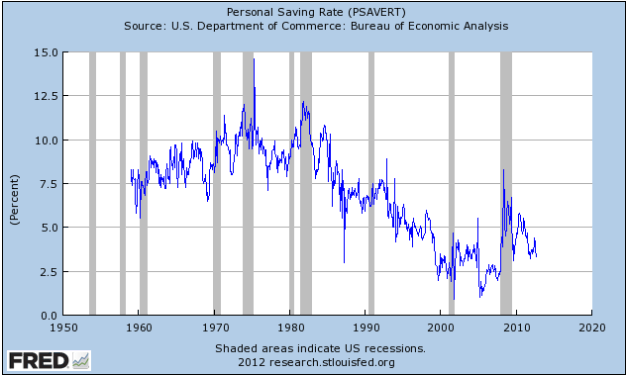
Of the remaining 24 cases, all of which were of major economies, he said the primary pathway out was austerity. Excessive debt is equivalent to living beyond one’s means, according to Hunt, which in economic terms manifests in a decreased savings rate. To correct the problem, the savings rate must increase, and Hunt said that can be achieved primarily by constraining debt so that it grows at a slower rate than the GDP – the definition of austerity in the McKinsey study.
The savings rate in the US has mostly been declining steadily since 1980; it did increase sharply during the last recession, but it remains at 3.3%, a historically low level:
The above data, if anything, understate the underlying problem. Wealthy Americans are saving at a rate far higher than the 3.3% average; the savings rate for the vast majority of the country is much lower than this average.
The savings rate must increase. Both sides of the debate agree on this point.
Surprisingly, both sides also agree how to make that happen. Hunt said that the increase in public indebtedness has been for current consumption, which is not productive. Hunt classified entitlement spending as current consumption. Economists including Fisher, Minsky and Kindleberger have argued that debt can be productive only if it generates a future income stream, according to Hunt.
“If we shifted the indebtedness so that it was in strong public investment as opposed to daily conceptive needs, then there would be some benefit,” he said. “But there is very little investment.”
Investment – not indebtedness – is the key, Hunt said.
Many who advocate for increased government spending, including Woody Brock, share that view. In his book, American Gridlock, Brock proposed an aggressive federal program aimed at funding high return-on-capital projects, such as infrastructure improvements.
The policy choices
Given that both sides agree on the imperative to invest productively, why hasn’t it happened?
The problem, at least in part, is that our political structure is too weak. “We are a compassionate nation, and so we want to respond,” Hunt said. “The net result is that the simplest path is to borrow more money and spend it, but the bulk of the money that we borrow is for daily consumption, which is of the unproductive nature, and which is not going to generate an income stream and thereby get us out of the problem that we are in.”
The difficulty also lies in the faith one puts in the econometric research Hunt cited. Hunt firmly stated that Reinhart and Rogoff’s key finding – that growth slows once debt-to-GDP exceeds 90% – applies to the US.
But many on the other side reject that view, arguing that high debt can be perfectly manageable in countries that know how to manage it. Examples such as the US following World War II and the UK prior to the Industrial Revolution serve to show, they claim, that countries have successfully grown their way out of debt without implementing austerity.
Another point of agreement is that monetary policy is unlikely to offer a solution. Long-term rates, Hunt said, are low because they reflect the forecast of modest economic growth, not because of the Fed’s zero-interest rate policy. Quantitative easing won’t work either, according to Hunt, because it is creating inflation without increasing wages.
“It takes funds away from wage earners by inducing higher prices, because the Fed can cause an increase in short-term inflation, but it has no control over the wage rates,” he said.
With fiscal measures thwarted by political dysfunction, Hunt said, the only option is a “curative process that is caused by time. We gradually need a rise in real wages, which will then stimulate an increase in saving, which will allow the debt to be paid down, and that takes time. Everybody wants to waive a magic wand, but there is no magic wand.”
Hunt fears, however, that time will eventually run out. He cited the philosopher David Hume, who, in his 1752 essay, Of Public Credit, wrote, “When a government has mortgaged all of its future revenues, the state by necessity lapses into tranquility, languor, and impotence.”
Hunt doesn’t think the US has reached that point, but he said we are on that path. Somewhere down the road lies a horrific ending – the bang point – when neither monetary nor fiscal policy will be capable of dealing with the chasm of debt we have left ourselves.
For Hunt’s camp, the only way to change course is to stop digging ourselves deeper – now.
Read more articles by Robert Huebscher