Advisor Perspectives welcomes guest contributions. The views presented here do not necessarily represent those of Advisor Perspectives.

This essay is excerpted from a recent version of The Credit Strategist (formerly the HCM Market Letter). To obtain the complete issue, you must subscribe directly to this publication; Please go here. The Credit Strategist is on Twitter - @credstrategist
“We are not enemies, but friends. We must not be enemies. Though passion may have strained it must not break our bonds of affection. The mystic chords of memory, stretching from every battlefield and patriot grave to every living heart and hearthstone all over this broad land, will yet swell the chorus of the Union, when again touched, as surely they will be, by the better angels of our nature.”
Abraham Lincoln1
Abraham Lincoln was elected President of the United States on November 6, 1860. Between his election and his inauguration, seven southern states seceded from the union. Mr. Lincoln’s predecessor, James Buchanan, declared the secessions illegal but claimed that the federal government could do nothing to prevent them. During the months prior to taking office, the president-elect maintained a strict code of silence regarding his policy toward the new Confederacy. Those privy to his thinking were sworn to silence. He drafted his inaugural speech in the back room of his brother-in-law’s store in his home town of Springfield, Illinois, and he locked the working drafts in the safe of a local newspaper office. The president-elect and his family and friends left Springfield on February 11 to travel by train to Washington, D.C. for his inauguration. Along the way he toured the North and made stops in a number of cities including Pittsburgh, Cleveland, New York and Philadelphia. In a grim foreshadowing of fate, an alleged assassination plot forced the president-elect to sneak into the capital in the middle of the night accompanied by two private detectives.
Mr. Lincoln’s inaugural address was aimed at reassuring the Southern states that slavery was not at risk from his administration. He provided that assurance while refusing to recognize the secessions. The Constitution, he argued, was a legal contract among the states. A contract can only be abrogated by all of the parties that entered it; it cannot be unilaterally broken by one party. If the South wanted to exit the union, it could only do so with the North’s assent. No such assent would be forthcoming, but the new president assured the South that the North would not initiate any conflict with it. He kept his word, but civil war ensued nonetheless in April 1861 after the Confederacy attacked Fort Sumter.
Less than two years later, on January 1, 1863, Mr. Lincoln signed the Emancipation Proclamation. Based on his authority as commander-in-chief, this executive order proclaimed that all slaves in the Confederate States were forever free. No longer would the United States countenance slavery. Had the president acted contrary to the assurances given in his inaugural address? Of course. Had he effectively usurped the sovereignty of the states? Absolutely. Did that make him any less of a leader? Of course not. It made him a great leader because he acted with moral courage to end the scourge of slavery.
1. First Inaugural Address, March 4, 1861.
The f*&# cliff
As irritating as the subject of the fiscal cliff may be, CNBC has managed to make it completely unbearable with its insufferable “Rising Above” campaign. There may be a method, however, to the business network’s madness. If all else fails, President Obama should lock the members of Congress inside the Capital about a week before Christmas, post the military at the door, hang big-screen television in each chamber, tune them to CNBC, and turn up the volume up. Faced with listening to endless repetitions of the words “rising above” or “fiscal cliff” or “kick the can down the road,” our legislators will have no trouble reaching a compromise quickly.
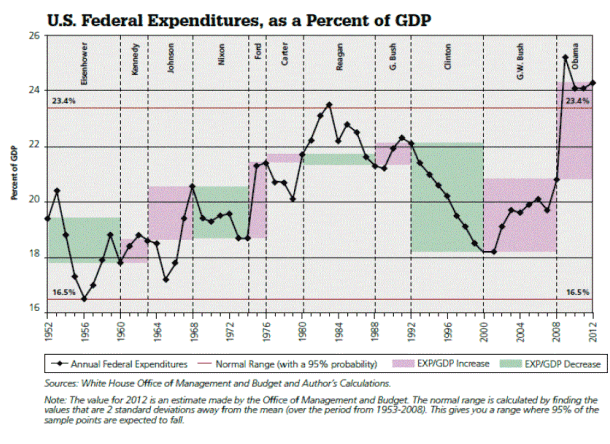
Figure 1
Uncharted Territory, or Just Off the Charts?
Figure 1, courtesy of Johns Hopkins Professor of Applied Economics Steve Hanke, illustrates just how outside of normal bounds government expenditures have grown since 2008. The most important aspect of the figure is the trajectory of change: in five years, government expenditures as a percentage of GDP increased by almost 20%. Historian Niall Ferguson suggests that it is the pace of economic change that has the greatest impact on social stability.2 The pace of change in the United States’ economy has been drastic and decidedly negative. It is imperative that this trend be reversed.
Altering the trajectory of government spending as a percentage of GDP will require a combination of reining in spending and growing GDP. Current discussions about raising tax rates are misguided in terms of their likely economic impact. Some point to the Clinton years as proof that tax rates can be raised without hampering economic growth. This argument ignores, however, the fact that monetary policy was extremely lax during the 1990s and that corporate profitability and productivity were exaggerated (that is a polite way of saying they were fudged). In fact, the so-called strength of the U.S. economy during the Clinton presidency was an illusion; the 1990s were a period of debt-financed faux-prosperity.
The entire deficit debate would be farcical were its potential consequences not so serious. The official story is that the federal deficit is about $16 trillion (more than 100% of GDP) and the 2012 deficit was about $1.2 trillion (about 7% of GDP). Those figures are troubling enough. But in reality these numbers are a complete fantasy resulting from the delusional method of accounting used by the government. These numbers exclude large portions of the government balance sheet. A complete budget picture would show that the federal government’s liabilities are actually $86.8 trillion when Social Security, Medicare and federal employees’ future retirement benefits are included. As of April 2012, the Medicare Trustees’ report calculated that the net present value of the unfunded liability of Medicare was $42.8 trillion, while the liability for Social Security was $20.5 trillion. The sheer scale of these obligations renders some of the dialogue surrounding the fiscal cliff nothing short of an embarrassment.
2. See Niall Ferguson, The War of the Worlds: History’s Age of Hatred (London: Allen Lane, 2006), p. xli.
For example, Illinois Democratic Senator Dick Durbin has been arguing that any deal should not include Social Security reform because Social Security is not running a deficit. That is like saying a boat isn’t going to sink because it has a hole in the stern but not in the bow! Our government is financing itself by having one arm (the Federal Reserve) sell bonds to another arm (the Treasury); 3 therefore, any pretense of separating Social Security into a separate silo is a sham. The social security trust fund is empty; the money is taken out each year and spent. Instead, the social security trust fund consists of promises from the Treasury to pay $20+ trillion of future obligations. Perhaps we should excuse Mr. Durbin’s comments – he is probably basing his statements on how money is accounted for in his hopelessly bankrupt home state of Illinois. How can the American people expect results out of Congress when there isn’t even honest discussion of the facts?
It is not an exaggeration to say that not only the fiscal cliff but the long-term budget crisis can be solved on the back of an envelope. Here are five ideas that would go a long way to solving the problem:
- Means test Social Security and Medicare.
- Raise the age of eligibility of Social Security and Medicare for new retirees.
- Cut non-entitlement government expenditures across the board by 2% in 2013, keep cutting them by 2% a year for three years, and then cap them.
- Reform the tax code by lowering rates to 25%/15%/5% (with a 35% rate on incomes over $1 million), end the preferential treatment of capital gains and dividends, and eliminate all tax preferences.
- Reduce corporate tax rates to 25%, institute a corporate minimum tax of 18%, and allow offshore capital to be repatriated at a 10% tax rate.
Such a plan would not only be far superior to our current system but also lead to higher tax revenues and higher rates of economic growth than the 2% or less to which the U.S. is likely consigned for years to come.
I do not expect anything more than a stopgap solution to the fiscal cliff before year end. Mr. Obama is under an illusion that his marginal victory in the popular vote granted him a mandate to raise tax rates without serious entitlement reform. It did not and despite his constant refrain that the tax issue was decided by the election, he conveniently ignores the fact that he promised not just higher taxes on the wealthy but spending cuts as well. His opening offer of $1.6 trillion of new revenue and $500 billion of cuts even, as a negotiating ploy, was a joke. If Mr. Obama doubles down on his first term agenda of raising taxes and spending (while adding to the regulatory burden of individuals and businesses), his second term is going to be one term too many. Seeing little change coming from Washington, investors are going to alter their behavior in reaction to higher taxes as they have in the past. That is why tax reform that can influence behavior in constructive ways is so desperately needed. Reality is setting in – four more years of Obama’s pro-tax, pro-regulation and anti-growth policies are bad news for the stock market and the economy. That is not the platform for which the bare majority of Americans who re-elected the President were voting.
The remaining sections are available only to paid subscribers.
Michael E. Lewitt
[email protected]
3. Moreover, the housing market is being artificially supported by replacing the shrinkage in Fannie Mae’s and Freddie Mac’s balance sheets with Federal Reserve purchases of $40 billion of mortgages a month. This policy is misguided. Rather than committing more capital to the unproductive housing sector, it would be much wiser to reform the foreclosure system by incentivizing banks to exchange debt forgiveness for equity ownership in residential properties.
Disclaimer
All opinions and investment recommendations expressed by Michael E. Lewitt in The Credit Strategist as well as on Twitter under the Twitter name @credstrategist are solely the opinions of Mr. Lewitt and do not reflect the opinions of Cumberland Advisors or its affiliates or employees, managing directors, owners or principals.
Disclosure Appendix
This publication does not provide individually tailored investment advice. It has been prepared without regard to the circumstances and objectives of those who receive it. This report contains general information only, does not take account of the specific circumstances of any recipient, and should not be relied upon as authoritative or taken in substitution for the exercise of judgment by any recipient. Each recipient should consider the appropriateness of any investment decision having regard to his or her own circumstances, the full range of information available and appropriate professional advice. The editor recommends that recipients independently evaluate particular investments and strategies, and encourages them to seek a financial adviser’s advice. Under no circumstances should this publication be construed as a solicitation to buy or sell any security or to participate in any trading or investment strategy, nor should this publication or any part of it form the basis of, or be relied on in connection with, any contract or commitment whatsoever. The value of and income from investments may vary because of changes in interest rates or foreign exchange rates, securities prices or market indexes, operational or financial conditions of companies, geopolitical or other factors. Past performance is not necessarily a guide to future performance. Estimates of future performance are based on assumptions that may not be realized. The information and opinions in this report constitute judgment as of the date of this report, have been compiled and arrived at from sources believed to be reliable and in good faith (but no representation or warranty, express or implied, is made as to their accuracy, completeness or correctness) and are subject to change without notice. The editor may have an interest in the companies or securities mentioned herein. The editor does not accept any liability whatsoever for any loss or damage arising from any use of this report or its contents. All data and information and opinions expressed herein are subject to change without notice.
The Credit Strategist
Michael E. Lewitt, Editor
The Credit Strategist is published on a monthly basis by Michael E. Lewitt. Address: 5030 Champion Blvd., G6 #161 Boca Raton, FL 33496. Telephone: (561) 239-1510. Email: . Delivery is by electronic mail. Annual subscription rate is $395 for individuals and $995 for institutions. Visit our web site at www.thecreditstrategist.com. Copyright warning and notice: It is a violation of federal copyright law to reproduce or distribute all or part of this publication to anyone (with the exception of individuals within the same institution pursuant to the subscription agreement) by any means, including but not limited to photocopying, printing, faxing, scanning, e-mailing, and Web site posting without first seeking the permission of the editor. The Copyright Act imposes liability of up to $150,000 per issue for infringement. Information concerning possible copyright infringement will be gratefully received.
Read more articles by Michael Lewitt