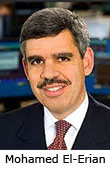
The global economy is operating at three distinct speeds, according to Mohamed El-Erian, and investors need to understand the implications of the divergent paths that key countries are following. Japan and most European countries are going backward, he said, and could continue in that direction for decades. The U.S. is “healing,” but not quickly enough to get to “escape velocity.” Certain emerging markets, meanwhile, are adapting technology and innovation and are growing rapidly.
El-Erian said investors need to answer three questions: How long will each country remain at its current speed? How long can the global economy sustain this multi-speed environment? What should policymakers do to address the situation?
“Every time you invest, you are expressing an answer to those questions,” he said, “so let’s be very explicit about it.”
Major economies, including the U.S., are heading down a road that will end in a “T” intersection; a right or left turn will signify the speed and direction of their recoveries.
El-Erian is the chief executive officer and co-chief investment officer of PIMCO. He spoke May 3 at the Strategic Investment Conference in Carlsbad, CA, which was sponsored by Altegris Investments and John Mauldin.
Let’s look at El-Erian’s answers to the three questions he posed and the implications they carry for investors.
The ECB’s decision
The multi-speed environment can persist, El-Erian said, but not forever. He started with the slowest speed economies – in Europe’s periphery.
El-Erian said Cyprus’ banking system grew to seven or eight times the size of its economy, attracting capital from Russia that was ultimately invested partly in Greek sovereign debt, until Greece’s economy collapsed.
The first lesson of Cyprus’ downfall, he said, was that the “troika” – the International Monetary Fund, the European Central Bank and the European commission – is no longer operating in a coherent fashion. That was evident when the troika disavowed Cyprus’ initial decision to tax insured depositors.
The second lesson is that the creditors are “fatigued,” El-Erian said. “This is now four years into the financial problems and they see no end to the checks they are writing,” he said.
Cyprus is an example of a country that lacks not only growth, he said, but a growth model. Its model was built on a leveraged banking system, which has now been shown to be unsustainable.
For Europe as a whole, El-Erian said the choice for its T-juncture lies primarily with the ECB. The ECB can make a further commitment to the Eurozone, and the choice in primarily political. If Europe opts for a fiscal union, it will endure “a little bit of distraction,” he said, but the EU could endure. The other choice at the T-junction, he said, is “fragmentation,” which would be very messy.
Possible U.S. Recovery
The U.S. is also heading to a T-juncture, though it lies farther in the future than Europe’s, El-Erian said, and its choices are much less severe. The U.S. is “healing,” he said. Corporations are strong, banks are mostly repaired, the housing market has stabilized and household finances are improving.
The Federal Reserve will dictate which direction the U.S. takes. It must decide when to disengage from its current monetary policies of zero interest rates, aggressive forward guidance and quantitative easing. One path, El-Erian said, would lead from assisted to self-sustaining growth, fueled partly by the energy revolution in technologies such as hydraulic fracturing, known as fracking.
The other path, however, would be one dominated by structural unemployment. El-Erian said he’s not convinced that long-term unemployment or the joblessness facing the younger generation has been adequately addressed. “If it turns out that the structural side is problematic,” he said, “the healthy balance sheets will not engage, and the energy revolution and newer technologies will be sector stories.”
Macroeconomic implications
The emerging markets face a much longer road than either Europe or the U.S. These countries face the choice between transitioning to consumer-based economies or continuing to rely on export-driven growth.
To answer the broader question of global growth prospects, El-Erian cited Tom Friedman, the New York Times columnist. Friedman has written that the world is not just interconnected; it is interdependent. In such an environment, one’s competitors become one’s friends, and those relationships shape macroeconomic growth prospects.
“We cannot afford for China, our biggest competitor, to stumble,” El-Erian said. The same is true of Europe. The U.S. relies on those economies to purchase securities and supply imported goods, and recessions there will impact U.S. growth.
But policy coordination at the global level has been “virtually nonexistent,” he said, and bank regulation is taking divergent paths. The challenge now is that major developed markets are weak, El-Erian said, and nobody is stepping in to stabilize the global economy.
Investing implications
El-Erian outlined six takeaways for investors.
-
“Ride the central bank wave:” Central banks are creating liquidity by engaging in quantitative easing, and those policies are likely to continue, El-Erian said. He did not explicitly say what he meant by “riding the wave,” but the implication was that investors should hold riskier assets, like equities.
He warned, however, that it is a “crowded wave” and that it will break at some point, either smoothly or abruptly. Investors will need to accurately anticipate central bank decisions. He said that PIMCO has been pursuing this path, but the likelihood is that riskier investments will get more costly and riskier, increasing the probability that the wave will break badly.
-
Take advantage of other waves that are less affected by central bank actions: Opportunities exist, for example, with small companies, which are insulated from Fed policy.
-
Don’t be held hostage to benchmarks that may have made sense previously, but don’t in today’s markets: “Advanced economies are not just vulnerable to interest rate risk. You are being haircut every day, including through financial repression,” he said. “The emerging world is not simply credit risk anymore. It is a much more diverse opportunity set.”
-
Recognize that “beta is simply not going to be there anymore:” Prices are approaching levels where investors are hoping the fundamentals will validate central bank actions, El-Erian said. He said there is a limit to how far investors can expect overall market movements to benefit them. “That is another way of saying alpha is going to have to do a lot more of the heavy lifting for you than beta,” he said.
-
Keep liquid : With economies approaching T-junctures, investors should remain flexible. “If it happens that we go the bad way,” he said, “you will get loss of assets very cheap.”
-
Consider cost-effective tail hedging, especially now that volatility is at an enormously low level: Risk mitigation strategies are going to evolve, El-Erian said.
“Maintain as much operational agility as possible,” he said. “Make sure you have a good dose of resilience on top of that.”
Read more articles by Robert Huebscher