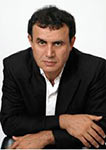
Despite a modest recovery from the nadir of the financial crisis, the global economy still faces tail risks, according to Nouriel Roubini. Roubini’s forecast is not as gloomy as the one that earned the moniker “Doctor Doom,” when he correctly predicted the housing market collapse and the ensuing global recession. But, in a talk May 1, he identified today’s biggest danger points in Europe, the U.S., China and geopolitics which he said threaten to destabilize the global economy.
Roubini, an economist, teaches at the N.Y.U. School of Business. He is also the cofounder and chairman of Roubini Global Economics, an independent, global macroeconomic strategy research firm based in New York. He spoke at the Strategic Investment Conference in Carlsbad, CA, which was sponsored by Altegris Investments and John Mauldin.
“The global economy has some signs of revival, especially in emerging markets,” he said. “Things are more fragile in advanced economies. Tail risks in the global economy have not gone away. Policymakers in advanced economies are running out of policy bullets on the market side, on the fiscal side, and in terms of backstopping a defense for the financial system.”
Bold action by the European Central Bank averted a crisis in Europe, and concerns about the U.S. were allayed when we steered clear of the fiscal cliff. For the time being, China seems to have avoided a hard landing, and tensions in the Middle East have not escalated to a full-scale war. The reductions in those risks, according to Roubini, explain the rally in global equities over the last nine months. But the question investors must ask – and which Roubini attempted to answer – is whether those risks have gone away or been forestalled.
I’ll look at the four reasons why Roubini said investors should be worried, then turn to his assessment of the likely path to recovery.
Europe’s tension between bailouts and austerity
Talk of a triple-dip recession in Europe is moot, according to Roubini, because most of the continent is still mired in a double-dip recession that is spreading from the periphery to the core, including France and Germany. Growth is slow, he said, due to aging demographics and, more importantly, because productivity is low and the implementation of reforms has been very slow.
The euro is too strong to allow the periphery to recover, he said. Labor costs have risen by 40% there over the last decade. With austerity programs and banks suffering from credit constraints, there is insufficient liquidity for businesses to expand.
Any attempt to achieve growth through a painful process of austerity, he said, will be undone by the strength of the euro, which has risen from $1.20 last summer to over $1.35 now.
Indeed, Roubini said some countries are in a depression, not just a recession. Spain and Greece, he said, have unemployment rates over 25%. Among youth (aged 15-24), unemployment is over 50%.
The fundamental problems within Europe — low potential growth, rising debt-to-GDP ratios and structural loss of competitiveness — have not been resolved, according to Roubini.
The European periphery is suffering from “austerity fatigue,” Roubini said. In Greece, Spain, Portugal and Ireland, people are threatening to emigrate if policies are not implemented to stimulate growth. Germans, he said, are suffering from “bailout fatigue.” They are reluctant to support efforts like rescuing the banks in Cyprus.
The clash between bailout fatigue in the core and austerity fatigue in the periphery will be a significant source of tension, Roubini said. He identified seven countries that are in trouble: Greece, Ireland, Portugal, Italy, Spain, Cyprus and Slovenia. Any of them, he said, could face a restructuring similar to what Greece has already endured.
“If in the next three to five years the problems become so severe that Italy and Spain have to restructure their debts or exit [the EU], that will be the end of the Eurozone,” he said. “The tail risk in the worldwide economy coming from the Eurozone has not gone away.”
The fiscal drag facing the U.S. economy
The U.S. economy has some positive aspects, Roubini said: the housing recovery, some re-shoring of manufacturing, rising labor costs in China and modest gains in employment.
But those do not offset the “massive fiscal drag” that is confronting our economy, he said.
Recent tax increases and the sequester will cost 2% in GDP growth, he said, which is “too much for an economy that is barely growing at 1.5%.”
Over the medium term, he said the biggest challenge would be the exit from quantitative easing. Roubini is worried that the U.S. will see a repeat of what happened in the last business cycle, when Fed Funds rates were increased by 25 basis points every six weeks over a period of two between 2004 and 2006. That policy, he said, was implemented in a period of weak growth and high unemployment. It led to bubbles in housing and the equity markets, and ultimately caused the financial crisis in 2008.
With the economy even weaker now, Roubini said the Fed will not begin its exit for at least two years. This added period of easy money, he said, will lead to excessive risk-taking and leverage throughout the financial system. “We are going to have a huge credit bubble and asset bubble,” he said, “and that is going to end up into a bust.”
Roubini dismissed claims that so-called “macro-prudential” policy tools would be able to mitigate the threat of financial instability. Those tools, which include capital ratios for banks, credit controls and other restrictions on investment activities, are not strong enough to counteract bubble formation, he said.
Emerging markets and the Chinese hard landing
Although growth in the emerging markets – particularly those in Asia – is 5% or higher, Roubini said underlying weaknesses remain.
Growth in Brazil, Russia, China and India (the BRICs) has slowed from levels of between 8% and 10% a few years ago. Roubini said that is partly due to the general weakness in developed markets. But a greater impediment for those countries has been a decrease in investment that would have boosted private sector consumption and productivity, he said.
Growth in China is “uncoordinated, unstable and unsustainable,” he said, due to the country’s initial reliance on net exports and, more recently, due to its reliance on high savings and fixed investment. Roubini forecast growth of 6% to 7% next year, which he said would be “close to a hard landing” and would have a huge negative effect on emerging Asia, commodity prices and developed economies.
Roubini said the BRICs have been “over-hyped” relative to other emerging markets. Instead, investors looking for economic growth in Asia should consider Hong Kong, Singapore, the Philippine, Malaysia or Indonesia. In Latin America, he said Chile and Colombia offer better prospects than Brazil. Even Mexico, which he said faces a debate over which reforms to implement, “could be a positive story.” In Africa, Roubini was optimistic about Botswana, Mozambique, South Africa, Kenya, Rwanda and Uganda.
“If we look at the emerging markets, I would say for too long for the last decade we looked at the big ones,” he said. The BRICs may do better, he said, but there is a trend in the wrong direction.
Geopolitics and oil prices
Negotiations with Iran and sanctions are not working, Roubini said. Iran is trying to buy time to “steal” more uranium to reach a “breakout capability,” he said. It may be only a few months from having enough uranium to build a bomb.
Israel is becoming restless, according to Roubini, and he questioned whether Obama is sincere in his stated policy of preventing Iran from acquiring nuclear weapons. “He may be bluffing,” Roubini said, because the U.S. was unable prevent Pakistan or North Korea from building nuclear weapons.
The U.S. and Israel may jointly or separately attack Iran to destroy or delay the implementation of its nuclear program, according to Roubini.
“If there was a war, oil prices could double from $100 a barrel to a $200 barrel in a matter of months, and that is going to lead to another global recession,” he said. “Given the fragility of the global economy, and the debt in the private and public sectors in advanced economies, we will have another global financial crisis.”
Any of the four risks could derail the global economy
“If you look at the latest economic data, things don't look very good,” Roubini said. PMI data from China indicated a slowdown in the first quarter, as has similar data for the U.S. economy, he said, even before the sequester became effective. The German economy is weakening, and the U.K. is “stuck between a recession and slow economic growth,” he said.
Prices in the financial markets have defied the fragility of the real economy, according to Roubini, because they have been propped up by central bank actions. “A lot of the disconnect is explained by what is happening in terms of the monetary policies and reducing the tail risk,” he said, “and essentially risking inflation.”
“We are living in the world where economic growth – because of deleveraging – is weak in advanced economies and fiscal austerity is going to make it even worse,” Roubini said. “The saving grace for these economies has been aggressive monetary easing.”
The pursuit of quantitative easing amounts to currency wars, he said, and will eventually lead to protectionism.
Roubini said that each of the four tail risks could put the global economy into a recession. “Each one of these tail risks for the time being has been contained but has not been eliminated,” he said.
“It's still a world where there is a huge amount of volatility, macro risk, financial risk, fiscal risk, taxation risk and increasingly geopolitical risk.”
Read more articles by Robert Huebscher