Advisor Perspectives welcomes guest contributions. The views presented here do not necessarily represent those of Advisor Perspectives.
In the wake of the Affordable Care Act and its accompanying deluge of regulation, advisors are helping baby boomers prepare for retirement in more ways than ever before. But our industry continues to overlook a significant threat to clients’ continued comfortable lifestyles: out‐of‐pocket healthcare costs.
There is a distinct likelihood that many clients are completely unaware of these costs.
While nobody knows exactly what health-care costs will be in the future, these costs will undoubtedly escalate during retirement. The discussion surrounding retirement planning has mostly been about allocating assets, not about outliving one’s income, transferring wealth or paying future estate taxes. But the health-care costs outlined below are a very real threat.
Even if our projections are off substantially, this threat still needs to be addressed.
“But I’ll be fine. I have Social Security.”
For the roughly 78 million baby boomers heading to retirement (at the pace of roughly 10,000 each day), Social Security has never been a more integral part of financial planning. Social Security is one of the more important factors to consider when addressing health-care costs in retirement. Calculating benefit amounts and deciding the best time to file claims are quickly becoming hot‐button issues in the financial industry.
Depending on a person’s individual circumstances, it may be as simple as choosing one of two options:
- Take Social Security as soon as you qualify for and need it.
- Delay it as long as possible, because your health just may depend on it.
Can it really be this straightforward? The short answer is: It depends. Have you factored in how future health-care costs will affect your clients’ Social Security income (SSI) benefits?
An overview of the situation
For many middle‐income married couples, Social Security Income will comprise approximately 20% to 50% of their retirement income. But one of the most ignored expenses that will be deducted directly from this income is the cost of Medicare premiums. These premiums can easily wipe out any cost-of-living adjustments that retirees will need, and they could even wipe out a person’s total Social Security benefits. A significant number of retirees could never receive any Social Security income and also be taxed on the very same income they never see.
Simple financial planning techniques, along with several appropriate financial products available today, could help tens of millions of clients control skyrocketing health-care costs in retirement while providing income to maintain their financial freedom.
By understanding the relationship between Social Security and Medicare, advisors can make the transition into retirement a much easier one for their clients.
In no way are we attempting to educate the financial industry on the inner workings of either Social Security or Medicare. We assume the reader has a base level of knowledge of how Social Security and Medicare function. Instead, we are focusing on the sometimes-subtle interactions between the two programs.
How do Social Security and Medicare interact?
Did you know?
- Medicare Part B premiums must be deducted directlyfrom Social Security benefits, whereas Part D has several available payment alternatives. (see here)
- Medicare is mandatory in order to receive Social Security benefits for some individuals. Anyone 65 or older who is no longer covered under a credible health plan andwho is collecting Social Security must accept Medicare Part A, which is free. Anyone who is receiving SSI benefits before age 65 and who declines Medicare when eligible will have to pay back the entire amount received from SSI.
- Medicare Parts B and D have late penalties for delaying enrollment, and these penalties follow retirees for the rest of their lives. The Part B penalty is 10% for each 12-month period delayed. The Part D penalty is 1% for each month delayed. For example, consider a person who becomes eligible for Medicare at age 65 but decides to not enroll for 42 months. Upon enrolling, the person would have to pay a premium and receives a 30% penalty for delaying Part B coverage for three 12‐month periods. The Part D penalty would be an extra 42% for life. The client could have to pay these late enrollment penalties for as long as he or she has Medicare.
Social Security’s inflation rate for future cost-of-living adjustments (COLA)
In 2013, the COLA for Social Security was only 1.7% for beneficiaries receiving Social Security benefits. This was a markedly higher increase from 2011 and 2012, when the COLA had no adjustment. Over the next eight years, the expectation set by Social Security’s Board of Trustees is not much higher. In fact, COLAs are calculated to rise only to 2.8% through 2021 and then remain flat for the foreseeable future.
The 2012Trustees Report COLA Increases
|
Calendar year
|
COLA Percent
|
|
2013
|
1.7%*
|
|
2014
|
2.1
|
|
2015
|
2.1%
|
|
2016
|
2.2%
|
|
2017
|
2.5%
|
|
2018
|
2.6%
|
|
2019
|
2.8%
|
|
2020
|
2.8%
|
|
2021 and later
|
2.8%
|
*Original COLA was scheduled to be 1.9%
Source: Social Security website
But what about inflation rates on Medicare parts B and D?
While Social Security’s adjustments are to remain below 3% for the foreseeable future, forecasts for Medicare’s inflation rates are quite different. In fact, they are at least twice as high as what is projected for Social Security.
In 2013, the premium for Part B is $104.90 a month, or approximately $1,258.80 annually. If we look at the history of Part B premiums, we see that the very first premium set by Medicare in 1967 was only $3 per month, or $36 annually. This means that in the 47‐year history of Part B premiums, the rate of inflation has been roughly 7.85%.
In addition, according to the Medicare Board of Trustees report, Medicare Part D is expected to inflate at 7.16% through 2021. Today’s National Base Premium Rate (the rate on which late-enrollment penalties and income surcharges are based) is currently $31.17. The report from the Medicare trustees is calling for this rate to increase to approximately $54.18 by 2021 – to almost double in less than 10 years. According to Q1medicare.com, retirees were charged, on average, $53.26 a month for a Part D plan in 2013 (approximately $639.12 annually). One can only speculate how this could increase in the future.
Other Medicare considerations
Medicare is now means tested.Those who happen to be earning above the predetermined income cap in retirement will be hit with a surcharge on top of their Part B and Part D premiums. The income brackets that are currently being used (and the associated surcharges) are as follows:
|
For those earning
|
Part B
|
Part D
|
|
$85k <
|
N/A
|
N/A
|
|
$85k ‐ $107k
|
Premium + 40%
|
Premium +
$11.60
|
|
$107k ‐ $160k
|
Premium + 100%
|
Premium +
$29.90
|
|
$160k ‐ $214k
|
Premium + 160%
|
Premium +
$48.30
|
|
$214k +
|
Premium + 220%
|
Premium +
$66.60
|
The Medicare Modernization Act of 2003 paved the way for Part B premiums to be means tested, while also defining income in the eyes of Medicare. The technical definition of income is:
Your modified adjusted gross income (MAGI) is the total of your adjusted gross income and tax‐exempt interest income you may have or the amounts on lines 37 and 8b of IRS from 1040.
The Hold Harmless Act, passed in 2009, protects retirees from losing their SSI benefit COLAs due to increases in Medicare premiums. Unfortunately, this only protects retirees from Part B premiums, not from the associated Part D premiums.
The Hold Harmless Act will not offer protection to those who are subject to the Medicare income surcharge. If clients earn even one dollar over their allotted amounts in retirement, they will not have the luxury of their Part B premiums being capped at the amount of the SSI COLA adjustment per year. The Hold Harmless Act will also not offer protection for those impacted by means testing.
What conclusions should we draw from all of this?
- In order to receive any Social Security income while retired, a person must accept Medicare when eligible. This makes health-care costs the only expense that 97% of all retirees are guaranteed to have.
- They can choose not to enroll into Parts B and D, but they will be faced with enormous penalties that will follow them for the rest of their lives.
- Social Security is only expected to have a COLA of approximately 2.8% going forward (from 2018).
- Medicare is currently one of the most inexpensive health insurance options available, but its premiums are inflating at over 7% annually.
- Medicare Part B premiums, as well as surcharges, must be deducted directly from Social Security. Many retirees also choose to pay for Part D directly from Social Security.
- Medicare premiums are based on income, and those who earn in excess of the specified cap will pay higher premiums.
- Since Social Security’s inflation is only 2.8% (after 2018) and Medicare is inflating at a rate of more than 7% (and receiving payments directly from Social Security), there will be a point where retirees will not receive the amount of Social Security income they were expecting.
- There will be an increasing portion of aging retirees turning 70.5 who will have to take their required minimum distributions (RMDs) from tax-sheltered retirement accounts (such as 401(k)s) in the next few years. Currently, these distributions are considered income in the eyes of Medicare. As such, they are subject to the penalties that are levied for income.
An example to highlight the relationship between Social Security and Medicare
By looking at a 60-year old person, we can clearly define the direct relationship between Social Security and Medicare. Let’s consider these factors:
- The client has earned an average of $60,000 a year for the last 33 years and will continue to earn that same exact amount until retiring.
- The client would like to plan on retiring at either age 62 or 67.
- The client will accept Medicare at age 65 or upon retirement, whichever comes first.
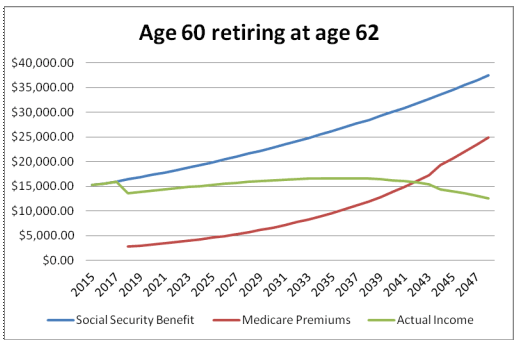
If the client opts to retire in two years (in 2015), then he or she can expect to generate Social Security income of $15,240, along with a corresponding Medicare bill of $2,740.12. By 2042, Medicare Part B premiums will increase by more than the COLA adjustment to Social Security income. The client’s actual income will actually decrease going forward.
As the graph illustrates, if the client retires at age 62 and then elects to receive Medicare at age 65, his or her actual income will never grow due to the Medicare expenses.

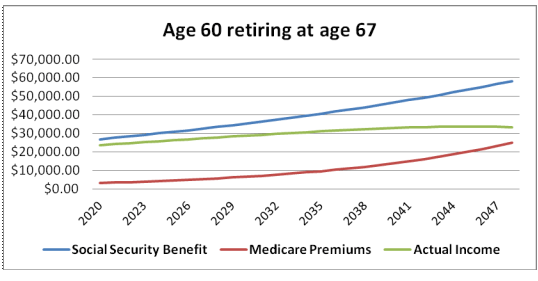
Now, if the client waits until age 67, things look different. The income at age 85 will be $44,168.37, while the Medicare premiums remain the same at $11,934.66. Actual income doesn’t start to fall until the client is 95 years old.
Here comes the cold water
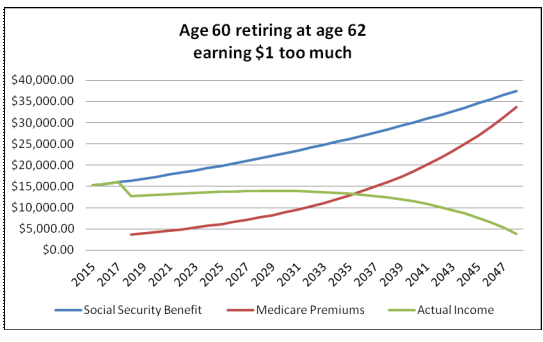
If the client has the misfortune of earning just one dollar above the threshold for means testing, Medicare premiums eat up Social Security benefit even faster:
The client’s income stays the same ($15,240), but those penalties drive up the cost of Medicare even faster, so he or she can expect to pay $2,944.53 at retirement in 2015. By age 85, the cost of health coverage explodes to roughly $16,056.
The point where Medicare premiums exceed actual income is in 2035, much earlier than in the previous example. By 2047, Medicare premiums have just about eaten up all of the client’s SSI benefit.
As you can see, the consequences of not planning for health-care costs in retirement will come at the expense of a person’s guaranteed Social Security benefit and financial freedom.With the inflation rate of Medicare premiums more than double that of Social Security, the issue only compounds for those who are younger, especially if they are subject to Medicare’s high-income thresholds.
What is the possibility of incurring a Medicare income surcharge?
For the many clients who also happen to be smart savers, the odds of incurring a Medicare income surcharge are high. For those who spent their money as fast as it came in, the odds are low. For those who saved in 401(k)s or other tax‐deferred vehicles and received an above-average rate of return, the possibility is extremely high, especially once they reach age 70.
The major issue our client has to account for is RMDs at age 70. Remember that improbably large amount of income that you needed to earn in order for a Medicare surcharge to apply? All of a sudden it might not be so unlikely. Unfortunately for smart savers, it could be a lot easier to pass the threshold than they previously imagined.
As these RMDs (which increase each year in retirement) are taken and combined with Social Security benefits (which may increase as well), the probability of passing the first Medicare income bracket is high. Those who have faithfully followed the advice of the financial industry will eventually, if they live long enough, be affected by this surcharge.
Why this is worse for your female clients
The problem is even worse for couples that haven’t taken these issues into consideration. What happens if one of them passes away? Statistically speaking, the wife usually outlives her husband. In many cases, the surviving spouse inherits tax‐deferred assets. This could put the surviving spouse in a weaker financial position. While income from investments remains constant, household income from SSI benefits decreases. Unfortunately for these widows, health-care costs could still be increasing.
Your next steps
A significant percentage of your clients will be adversely affected by these changes. Luckily, there are financial instruments that can provide the needed cash flow to provide for your clients’ health-care needs.
With simple, prudent financial planning and an understanding of how health-care costs impact Social Security, certain annuities (for income replacement), life insurance, tax-sheltered retirement plans and long‐term care insurance can provide the income for health-care needs. As drastic as the figures appear for our hypothetical client, the outcomes could be even worse for those who are younger than the example we used.
Dan McGrath, Paul Seidel and Josh Jackson are the director of institutional marketing, assistant vice president of marketing and senior associate for product and industry analysis, respectively, at Zenith Marketing Group, a New Jersey-based full-service brokerage firm.
Read more articles by Dan McGrath, Paul Seidel and Josh Jackson, CAS, ALMI