Since their introduction a little over a decade ago, gold-backed exchange-traded funds (ETFs) have accumulated more than $500 billion in assets. Investors’ most common rationale for owning gold is that it acts as a hedge against financial instability or a sudden shock to the markets, such as the 9/11 attacks. But what if the flow of assets into gold ETFs plays a greater role in the price of gold than do investors’ fears of instability? Is gold the hedge investors believe it to be?
A just-released academic study, Exchange-Traded Funds on Gold – A Free Lunch?, provides some valuable clues to the answers to those questions. It was written by Dirk Baur, a professor at the University of Technology in Sydney, Australia.
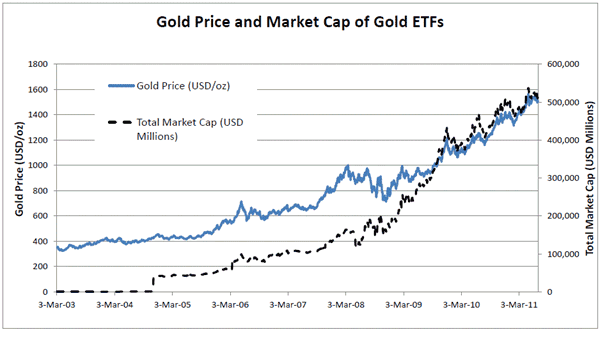
Baur looked at data from 84 physical and synthetic ETFs (including exchange-traded notes and exchange-traded commodities) since the first one was introduced in 2002. His most interesting finding is revealed in the graph below:

The price of gold has increased almost lockstep with the assets held in ETFs, particularly in the last three years. The question investors must answer is whether gold prices are being driven by the liquidity and other advantages (such as reduced storage costs) that ETFs provide, rather than by fear of systemic risk.
Baur did not answer that question, nor can he. Indeed, gold cannot be valued by traditional analytical techniques using cash-flow forecasts and discount rates. Investors must look for clues in the historical data, assess whether it has behaved in a manner consistent with a given model and forecast whether that model will be viable in the future.
If the model that explains gold prices is based on asset flows into ETFs, then many investors – “gold bugs” in particular – may be relying on an invalid set of assumptions. In an email exchange, Baur wrote that “ETFs have significantly contributed to the recent price changes,” but he also cautioned that “this may well be a phenomenon that will have no big impact on gold prices in the future.”
Baur noted that, since the collapse of the Bretton Woods system, gold data can be divided into three eras: (1) a sharp increase from $35/ounce in the 1970s to more than $600/ounce in 1980; (2) a stable period in the 1980s and 1990s, when prices varied between $300/ounce and $400/ounce; and (3) a bull market that began roughly when gold ETFs were introduced in 2002, that drove prices as high as $1,900/ounce in 2011.
That’s fairly clear evidence that the “financialization” of gold, through the introduction of ETFs, has been behind the rise in gold prices, according to Baur.
Baur cited theoretical reasons that explain why financialization has driven gold prices higher. Physically backed ETFs enjoy an economies of scale with respect to the storage cost of owning gold — the more gold a fund owns, the lower its storage cost per ounce. According to Baur, this increases the theoretical demand for gold, by lowering its liquidity premium (gold becomes a more liquid asset and cheaper to buy). Higher demand then translates to higher prices. The flow of assets into gold ETFs does not represent incremental supply of gold; it shows only a shift in how gold is owned.
For a time in 2012, GLD, the SPDR gold ETF, had a market value that exceeded any of the ETFs that tracked the S&P 500, according to Baur. In addition, gold ETFs often hold assets equivalent to the gold held by the world’s central banks.
Baur offered another way to view gold’s effectiveness as a hedge against financial turmoil, by looking at the effect of ETF growth on gold price volatility. He found “mixed evidence” that gold ETFs led to increased volatility in gold prices. Theoretically, however, that should not be the case; the ease of trading ETFs – with the click of a mouse – as compared to buying and selling physical gold should come with higher volatility.
As Baur noted, “the ease of trading gold through ETFs and the strong increase in the price of gold creates the possibility of substantial downward corrections with significant implications for the risk and thus the volatility of gold.”
Baur also compared the bid-ask spreads on ETFs to the VIX index, which measures volatility in the U.S. equity market. He found that spreads for physically backed ETFs decreased with the VIX. But spreads for synthetic ETFs increased with the VIX – implying that investors’ fears of counterparty risk rose in times of turmoil. Neither result was statistically significant, however.
Baur’s research dispels the myth that ETFs have no effect on the prices of the underlying commodity. Cleary, in the case of gold, they do. But his research has greater implications for the belief that gold will adequately defend investors against a systemic crisis. One of the explanations for the rise in gold prices over the last several years has been that it was due to quantitative easing and eroding faith in central banks’ ability to avert a crisis. Baur’s data present an alternative – and empirically supported – explanation — that the growth of gold ETFs contributed to the price increase.
Successful gold investing rests on one’s ability to accurately understand and predict investor psychology, and Baur’s research shows that is more difficult than previously thought.
Read more articles by Robert Huebscher