Advisor Perspectives welcomes guest contributions. The views presented here do not necessarily represent those of Advisor Perspectives.
The term "fiduciary" is at once accessible, familiar and confusing. We hear it often and think that we know what it means. But do we? Consider this assertion: A fee-only registered investment adviser (RIA) is at the top of the fiduciary pyramid. Is this a valid, provable statement?
In 2009, I needed a financial advisor to represent our family investment company. I inquired about the definition of a fiduciary with a banker, a broker and a RIA representative. I got different answers from each. I learned later, as a regional director for a large RIA, that none gave me the correct answer.
Industry consultant Ron Rhoades has said that the confusion over the fiduciary standard is in part due to a lack of guidance from regulators and a lack of education within the investment advisory community. According to a 2012 fi360 Advisorsurvey, almost three-quarters of advisors don’t think other advisors are knowledgeable enough to practice under the fiduciary standard. Also, 97% of advisors do not think investors understand the difference between brokers and investment advisors, according to the survey.
Let’s review the literature and examine the different levels of fiduciary within the fiduciary landscape.
Three questions for clarification
-
Who is a fiduciary?
With the possible exception of insurance agents, under common law the courts may hold that any party in the investment arena who is the object of trust and confidence from a weaker party is a fiduciary. But not everyone can claim to be a fiduciary under certain laws, which I’ll discuss later, or a top-level fiduciary. Further, few can claim to minimize conflict of interest and be at the highest level.
-
Is a broker or a bank a fiduciary?
A broker or a bank is considered a fiduciary under common law; courts usually only consider them a fiduciary under the Investment Advisers Act of 1940 if they handle client assets in a discretionary manner. This may be changed by the Dodd-Frank legislation. If it manages or advises retirement accounts, it is also a fiduciary under ERISA. It may also have higher responsibility than is required by common law if it acts as a co-trustee.
-
Is a financial advisor a fiduciary?
There is a distinction between a RIA and a generic advisor who may be a RIA, a broker or another related advisor in the general financial arena. An advisor can be a fiduciary under common law, in general, and if associated with a broker, as above. Only RIAs are automatically accountable to the Adviser’s Act. Only advisors who manage retirement funds are accountable to ERISA. Depending on the state, insurance agents may not be fiduciaries at all.
The fiduciary obligation: Context
Being a fiduciary involves due care, loyalty and good faith. Simply put, being a fiduciary means putting yourself in your client's shoes and sacrificing your interest for the client’s interest. It can be summed up by the concepts of loyalty and care.
The fiduciary obligation involves a narrowing spiral of requirements that begins with historical common and equity law, continues with the state and federal courts, narrows further with the Investment Advisers Act of 1940 and other federal and state statutes and then is further specified by the Employee Retirement Income Security Act (ERISA). The courts decide the final constraints of a fiduciary. Due to the intersecting requirements, parts of the fiduciary obligation are left open to court interpretation on a case-by-case basis.
Outside of common law and court decisions, the concepts of "best interest" and "prudent man" are the most familiar signatures of the fiduciary obligation. Let’s discuss those further.
“Best interest” relative to The Investment Adviser's Act of 1940
The “best interest” of the customer is the general fiduciary standard of the Adviser's Act; the word "fiduciary" is never mentioned. In Fiduciary Obligations, Arthur B. Laby articulates three components of best interest: a disclosure of conflict of interests, a suitability analysis of securities and best execution of transactions.
Section 211 of the Investment Adviser’s Act addresses standard of conduct, in general, and specifically notes that all advice shall be “in the best interest of the customer without regard to the financial or other interest of the broker, dealer, or investment adviser.” Section 223 of the Act requires that advisors safeguard client accounts and do an independent audit to verify assets. Even though the "best interests" language of the Act is meant to apply to advisors and broker-dealers, the total language of the Act — and subsequent court actions — is most pertinent for advisors. Though "best interest" is a good catchphrase for the fiduciary obligation relative to the 1940 Act, it is not synonymous with fiduciary obligation.
Section 211 of the Act implies that advisers should not only disclose conflict of interest but seek to minimize it, a concept that will reemerge below.
“Prudent man” relative to ERISA
The phrase "prudent man" comes out of ERISA’s oversight of the management of retirement and pension funds. The "prudent man" standard is higher than the "best interest" standard of the Advisers Act. According to Rhoades, Phyllis Borzi, the head of the Employee Benefits Security Administration in the U. S. Department of Labor, has stated that ERISA has higher fiduciary standards than other security laws.
According to the Congressional Research Service summary of ERISA, there is a five-part test that must be met before investment professionals can be held to ERISA‘s fiduciary duty standards. An advisor must:
- Render advice for a fee or other compensation, direct or indirect, with respect to any monies or other property of the plan.
- Render advice as to the value of property or make investment recommendations.
- Do so on a regular basis.
- Do so pursuant to a mutual understanding that the advice will serve as the primary basis for investment decisions.
- Render individual advice to the plan based on the particular needs of the plan.
If the advisor fails to meet any of the criteria, he or she is not an ERISA fiduciary.
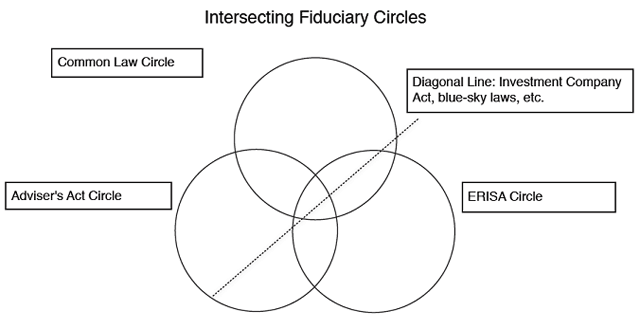
A helpful visual: Intersecting circles of a fiduciary
The fiduciary duty arises in a variety of contexts, including relationships between jockey and horse owner, real estate agent and client, attorney and client or doctor and patient. Roles demanding fiduciary duty are only limited by definition and by interpretation by the courts. Assessing the fiduciary obligation within these roles is sometimes messy, but organizing visually helps delineate the primary boundaries.
In the investment arena, the fiduciary obligation can be seen as a set of three interlocking circles: common law and general or quasi-fiduciary responsibility, the 1940 Act fiduciary and ERISA.
Common law can intersect with the 1940 Act or ERISA or with both at the same time. These circles can intersect with various parts of the Investment Company Act of 1940, blue-sky laws, broker-dealer laws and ongoing court decisions (the diagonal line).

Why are RIAs the top of the fiduciary pyramid?
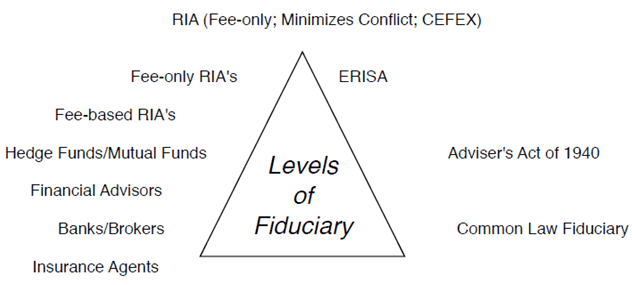
Another helpful way to envision the fiduciary obligation is with a pyramid.
The pyramid below illustrates the levels of the fiduciary duty. The boundaries of the fiduciary obligation narrow towards the top of the pyramid — the constraints increase, beginning with common law, progressing through the Adviser's Act and narrowing further with ERISA. Insurance companies are at the bottom of the pyramid, then banks and brokers, then financial advisors, then money managers, then RIAs, then fee-only RIAs who minimize conflicts of interest at the very top.
All of the players in the pyramid can call themselves a "fiduciary" because all are held to that standard by common law. Insurance agents, however, even those who give financial advice, are not generally held by the courts to be fiduciaries.
According to Rhoades in Fiduciary Duties, the courts do not put the same emphasis on the insurance agent-client pairing as they do other relationships. Whether insurance agents are fiduciaries varies by state and is decided on a case-by-case basis. But if an insurance agent poses as a financial advisor, he or she may be regarded as a fiduciary by the courts.
The ranking of the middle levels of the pyramid may be somewhat arbitrary and does not take into account whether these people are discretionary advisors, whether they manage retirement accounts and how well they minimize other conflicts of interest.
The standard for banks and brokers depends on whether they give discretionary advice, manage pensions or act as co-trustees. If none of those apply, they are not 1940 Act or ERISA fiduciaries. Money managers have a higher fiduciary standard if they manage pension funds. Financial advisors are in the middle because the standard changes depending on whom they are aligned with (banks, brokers, RIAs or insurance companies) and whether they give discretionary advice or advise on retirement funds. Banks, brokers and others can move up the fiduciary pyramid if they give discretionary advice, manage pension funds, or if the courts decide in any specific case that they have fiduciary responsibility. The Dodd-Frank Act may eventually make broker-dealers responsible based on the 1940 Act.
RIAs are at the top of the pyramid due to their responsibility under the 1940 Act and their accountability to the Securities and Exchange Commission. Fee-only RIAs are at the very top by virtue of the fact that a fee-only structure is one way to minimize conflicts of interest, an important facet of "best interest" that is implied by the 1940 Act. Conflict of interest is further minimized if they are ERISA advisors and if they fulfill ERISA requirements for retirement and non-retirement accounts as well as through prudent practices.
The Investment Advisers Act of 1940 holds RIAs to a high standard; ERISA holds them to a higher one if they are engaged in pension management. Is a fee-only RIA at the top of the fiduciary pyramid?If one fulfills the "best interest" standards specified in the 1940 Act, the "prudent man" standards specified in ERISA and minimizes conflicts of interest in additional ways that ensure top-level care for clients, then the answer is yes. An annual Centre for Fiduciary Excellence certification gives clients extra assurance they uphold the highest level of fiduciary standards.
Conclusion: Is the fee-only RIA at the top of the pyramid?
In general, “yes.” The problem within the fiduciary landscape is the gray area relative to the facts and circumstances of each case and how courts in alternate states rule. According to Laby, even though all advisors are broadly fiduciaries, the constraints narrow as federal regulations come into play. Since federal law lacks the flexibility of common law, it gives power and authority to government agencies. At the same time, courts modify the fiduciary duty according to their perspectives on each specific case. This leads to a lot of ambiguity and underscores the flexible and evolving nature of the fiduciary obligation. As Rhoades says, fiduciary duties are not static and need to evolve over time if they are to hold up under a changing business environment and creative fraudulent practices. Demott agrees that the fiduciary obligation is one of the most elusive concepts in the law.
The fiduciary obligation is a challenge for professional and lay investors to organize and define. My simple illustration of the fiduciary boundaries does not address areas like fraud, breach of fiduciary duty and lawsuits against advisors, not to mention more complex issues like the extent to which knowledge and application of the obligation actually protects investors. But the fiduciary pyramid is a simple and comprehensive paradigm to build on as future court decisions and federal regulations like Dodd-Frank unfold.
Seaborn Hall has been involved in some facet of the investment arena for over 30 years. He has a degree in management from Georgia Tech, two masters degrees in theology and has studied at the doctoral level. Until recently he was a regional director at a national top-50 RIA, headquartered in California; he now focuses on managing a family investment company.
Read more articles by Seaborn Hall