Advisor Perspectives welcomes guest contributions. The views presented here do not necessarily represent those of Advisor Perspectives.
Thirty years of rate declines have convinced many that bonds are safe. Indeed, a conservative portfolio has come to be synonymous with one that is heavy on bonds. But a rising interest-rate cycle is taking hold, and bond investors are now exposed to unfamiliar risks in their conservative portfolios. Bond funds will not provide the safety that investors seek. Holders of individual bonds will fare much better.
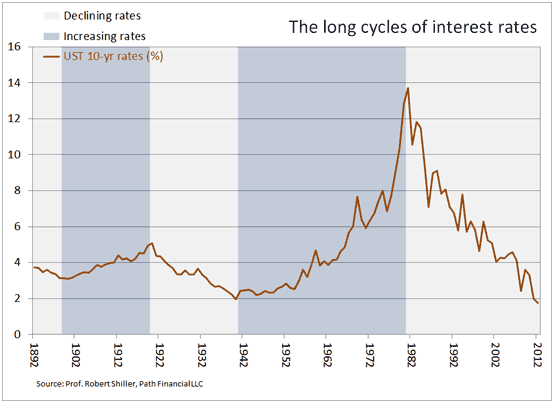
Interest rates have long cycles. They rose between 1898 and 1920, dropped between 1920 and 1940, climbed again to historic highs between 1940 and 1981 and then plunged to historic lows between 1981 and 2012. For the last 125 years, rates have behaved in cycles that lasted decades. A new cycle started about a year ago, when the U.S. Treasury 10-year note rate plummeted to about 1.5%, a record low and below the likely rate of inflation in the next 10 years. Barring deflation, such low interest-rate levels will not be around again for a long time.

Investors who hold individual bonds are only marginally affected when interest rates go up if they keep their bonds to maturity. Payments are fixed regardless of whether interest rates go up or down. Unless the borrower defaults, the scheduled payments remain the same.
There is a big difference between an investor who keeps an individual bond until maturity and one who doesn’t. While the former will get all the payments as promised, the second one will not, because he or she will sell the bond at a lower price.
This is the inherent problem with bond funds. Bond fund managers almost never hold bonds to maturity. Bond funds are typically defined by maturity targets (short-term, intermediate-term and so on), and as time goes by, holdings are rebalanced to keep the fund's average maturity constant. To do so, managers replace shorter bonds with longer ones. When interest rates go up, they sell bonds that were acquired at higher prices when interest rates were lower, realizing losses.
They buy high and sell low.
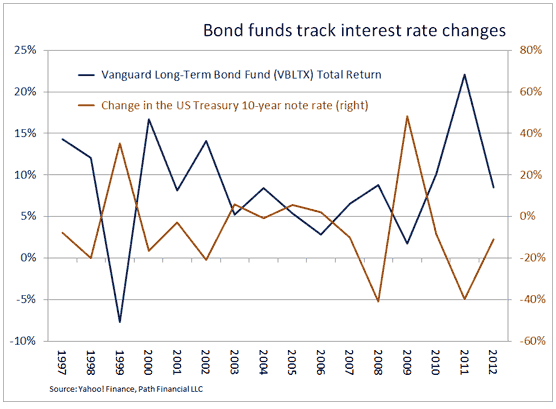
Bond funds do not have the certainty of payments that comes from holding a bond to maturity. This is not just a theoretical problem; empirical evidence proves this. Bond fund returns strongly mirror changes in interest rates. The graph below compares Vanguard’s long-term-bond fund VBLTX to the 10-year Treasury interest rate. Every year that interest rates declined, the fund’s returns went up, and vice versa. A multi-year string of interest-rate increases, which I expect we will see in the coming years, will cause this fund to perform quite poorly.
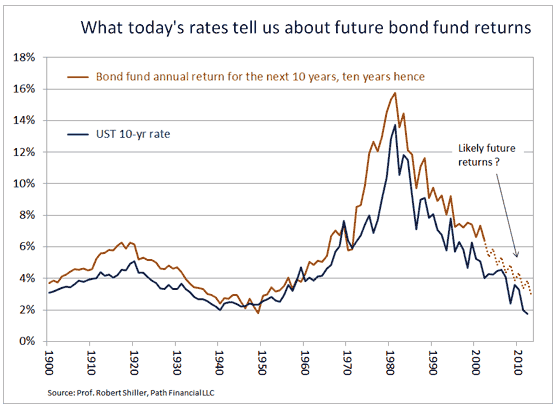
I estimated the return of a hypothetical intermediate-maturity bond fund for the last 110 years using interest-rate data provided by Robert Shiller of Yale University. I assumed that an investor would hold a 10-year US Treasury bond for a year and then replace it with a new one at the then prevailing rate. The average yearly return of that hypothetical bond fund over the next 10 years is shown in the graph below.
Not surprisingly, 1980 was the best time to buy this hypothetical bond fund. Not only were rates – and therefore coupon payments – very high in 1980 (close to 14%), but bond prices went up in the following years. Anyone who bought this hypothetical bond fund in 1980 would have reaped close to 18% average annual returns through 1990, due to a combination of high coupon payments and strong price appreciation.
Conversely, one of the worse times to buy this fund would have been 1940, at the bottom of the interest rate cycle. Ten years later, the average annual return would have been just above a paltry 2%. It could have been even worse if rates had increased more rapidly by 1950.
The level of 10-year interest rates today is a strong forecast of the return of a bond fund over the next 10 years. Investors should ignore the high returns of the last 30 years and instead look ahead and think what is likely to happen to bond funds if a new interest rate cycle has started. It is almost assured that bond funds will have far lower returns than at any point in the last few decades.
Bond funds’ future returns depend on the type of bonds they hold and how fast interest rates go up. If, as some argue, interest rates hover at low levels for a few years, then the damage might be limited, with returns low but hopefully not negative. If interest rates go up quickly, however, the result will be much worse. Some bond funds may be able to absorb interest-rate spikes better than others, particularly those with floating-rate bonds or with shorter maturities.
In fact, results from three of the largest bond funds in the world show how terrible things can be for supposedly conservative funds in this new environment.
Through September 20, PIMCO’s Long-Term Government Fund (PGOVX) is down over 11%, BlackRock’s Investment Grade Bond Portfolio (BLDIX) is down over 8%, and Fidelity’s Spartan Long-Term Bond Index Fund (FLBIX) is down close to 11%. Bond fund managers are hard at work trying to convince their clients that this dismal performance is an aberration. Looking at history, however, poor bond performance is inevitable. To protect their hard-earned money, investors will have to find new safe harbors. This is something that bond funds can no longer claim to be.
Raul Elizalde is president of Path Financial LLC, a Florida-based Registered Investment Advisor that specializes in tactical ETF portfolios for individual investors.
Read more articles by Raul Elizalde