Advisor Perspectives welcomes guest contributions. The views presented here do not necessarily represent those of Advisor Perspectives.
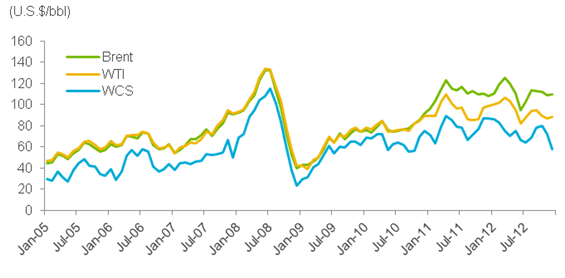
Amidst the clamor of fossil fuel divestment and the prospects for alternative energy, investors would do well to examine the underlying cause for oil’s pricing in recent years. High-quality crude oil has hovered around $100/barrel, sparking a discussion of whether waning global supply will eventually push prices to challenge the historic $140/barrel mark of 2008.
The reality, however, is that the U.S. – and indeed, the world as a whole – is approaching the threshold of peak oil demand, rather than peak supply. Prices will fall in the coming years, regardless of fluctuations in supply.
I’ve noted this peak before, based on the parallels between the seemingly untethered prices in 2008 and the high prices of 30 years ago, which reflected a similar global reduction in demand of stunning proportions.
Looking back at 1979 provides historical guidance for how the world economy may react to this current period of high energy prices. Staggering under an energy shock throughout the 1970s, the global economy entered a period of stagflation. The resulting decline in oil consumption reached amazing levels:
- The world’s consumption of oil peaked in 1979 and did not surpass that level until 10 years later, in 1989.
- U.S. consumption did not surpass the 1979 level until 18 years later, in 1997.
- Canadian consumption did not surpass the 1979 level until 20 years later, in 1999.
- European consumption still remains 5% below the 1979 level.
- Germany’s consumption still remains 26% below that level.
- France’s consumption still remains 21% below that level.
Bringing the debate to modern times, high oil prices in the last five years have had the same impact on the economy that they did in the late 1970s. Many people still argue that our demand for energy never goes down, but it does, in fact, respond fairly predictably to changing prices.
Benchmark Crude Oil Prices

U.S. demand for oil has fallen since 2007. In the past five years, our consumption of oil has dropped by 10%. While an uptick in consumption of 0.3% is predicted for 2014, the projected increase is attributed to distillate fuel oil and liquid natural gas.
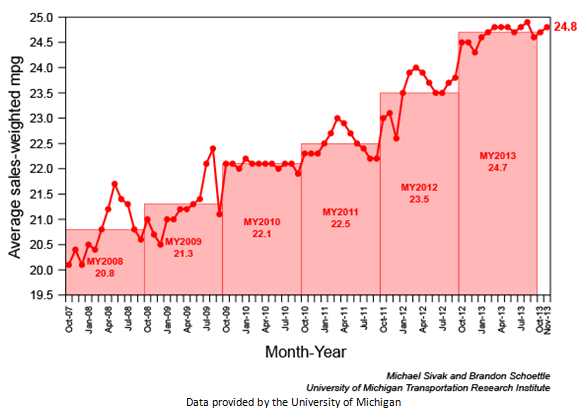
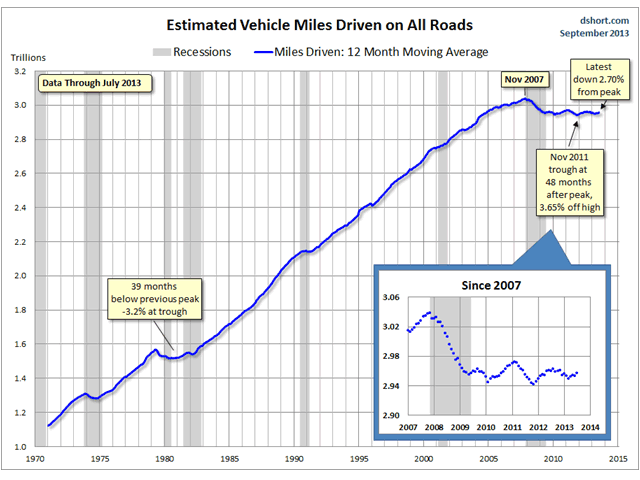
The predictions align with trends in the auto market, where the most fossil fuels are consumed –about 67% of U.S. oil use is for transportation. Not only are we driving 2.7% fewer miles, but also the fuel efficiency of new vehicles has risen by 22%. The 22% increase in new vehicle fuel efficiency has occurred since 2008. (January 2008 through August 2013.) Since August, new fuel efficiency has ticked down a bit, and the increase is now 21%. I expect that trucking fleets will gradually switch to natural gas and cars to electricity. Demand for oil will subsequently go down.
Even as demand flattens out, there is still a push to increase supply. The U.S. Energy Information Administration is predicting that global output of liquid fuels will rise from 90.52 million barrels per day to 91.68 million barrels per day next year. This increase in supply and the gradual drop in demand will likely lead to lower oil prices over the long term.
Meanwhile, just as technology has improved autos’ fuel efficiency, it has also led to new growth in supplies. Again, that correlates with the trend in the 1970s, as high prices at that time led to new oil discoveries in the early- to mid-1980s. The increase in oil supply in the past five years dwarves what we saw in the 1980s. The advances in additional energy alternatives including natural gas, solar and wind suggest that we will not be wanting for energy supplies for some time to come.
Can OPEC force prices higher?
In a free market, the decreased demand for oil should force its price lower. But oil does not trade in that manner. The market is dominated by the Organization of the Petroleum Exporting Countries, a cartel. How does that affect this analysis?
Saudi Arabia will begin to cut back its supply at some point. This is what they have done in the past.
But if we use history as our guide, other things could happen when oil prices go down.
First, my scenario for the next two years is that non-OPEC oil supply growth should outpace the growth in demand. Saudi Arabia has said it likes (and needs) oil prices around $90-100/barrel, so the nation will likely cut output to maintain the supply/demand balance.
But what if Libyan or Iranian production, which has been restricted by labor unrest and sanctions, respectively, returns to more normal levels? What if the miles driven in the U.S. continue to fall? It would be difficult for Saudi Arabia to cut supply enough to compensate for those supply increases or cutbacks in demand. In the past, the Saudis have tried to get all members of OPEC to cut back on their production levels. Everyone usually agrees, but then each nation starts to cheat because it needs more revenue. At some point, Saudi Arabia gets fed up with the cheating and tries to teach everyone a lesson by increasing production and driving down prices. It has always been willing to take some short-term pain to keep cheating members of OPEC in check.
Saudi Arabia also likes occasional volatility in oil prices as a way to keep new competition in check. If Saudi Arabia drives prices down enough, then new shale, oil-sand, and deep-water projects may not get the go-ahead. What is profitable to extract at $100/barrel is not at $60/barrel. Saudi Arabia occasionally drives prices really low to keep new competition off the market.
The risk to Saudi Arabia is that booming new oil production in the U.S., thanks to hydraulic fracturing and horizontal drilling technologies, gets repeated elsewhere and that natural gas becomes established as a fuel for trucks. The only way for Saudi Arabia to prevent this is by using lower prices as a competitive tool.
Competition for oil is also still coming from the unlikely source of coal. With natural gas prices outside the U.S. and oil prices still high, many countries continue to find coal a relative bargain despite its environmental impacts. Coal usage is still growing in Europe. Coal continues to take market share from oil.
Ten years ago, coal produced about 27% less on an energy-equivalent basis than did oil in the world. This year coal produces about 7% less of the world’s energy than oil.
On the whole, while the cartel-like nature of OPEC prevents oil prices from moving as they would in a perfectly free market, Saudi Arabia will nonetheless be unable to prevent the drop in demand, which will inevitably lead to lower prices. Saudi Arabia also has strong competitive incentives to keep prices low enough to deter competitive threats.
Peak demand trumps peak supply
It is no coincidence, then, that stocks of fossil fuel companies have underperformed the S&P 500 over the past five years – and their underperformance has been accelerating in recent years. For the five years ending on Sept. 23, 2013, the energy stock component of the S&P 500 has increased by 5.71% on an annualized basis versus a gain of 9.87% for the entire S&P 500. For the past year, energy stocks rose by 11.79% versus a 19.17% increase for the S&P 500.
The evidence demonstrates the reality of peak demand. Even if supply begins to wane, our consumption is on a steady downward trend. Recognizing this as a major liability for oil and gas stocks should factor into investment decisions.
Patrick McVeigh is president and CIO of Reynders, McVeigh Capital Management, a Boston-based investment advisory firm. His Twitter handle is @ReyndersMcVeigh.
Read more articles by Patrick McVeigh