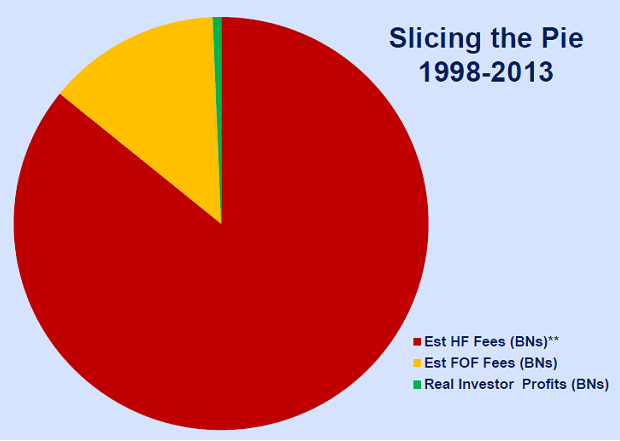
All you really need to know about hedge fund performance is evident from the fact that Simon Lack could not produce the pie chart below in 2012. The chart shows how hedge-fund returns have been divided among manager fees, fund-of-funds fees and investor profits. Because investor profits (which Lack defines as returns in excess of the risk-free rate) were negative in 2012, Lack couldn’t create the chart.

Lack said that he did not adjust his data for survivor or backfill bias, which are notorious for biasing hedge-fund returns upwards. Moreover, he used the high-water mark at the industry level, despite the fact that many funds did not pay incentive fees during years in which overall performance was poor. Those adjustments, he claimed, painted a more generous view of the industry than is warranted.
Lack is the author The Hedge Fund Mirage, which was published in 2012 and we reviewed here. He spoke at the CFA Institute’s annual conference in Seattle on May 5. Lack is the founder of SL Advisors, a New Jersey-based asset manager. Previously, he worked at J.P. Morgan as part of its hedge-fund due-diligence team, starting in the early 1990s.
The slides from Lack’s presentation are available here.
Lack reviewed hedge-fund performance since his book was published. The returns from the average hedge fund are dismal, according to Lack, unless you happen to be the manager of the fund or a fund-of-funds that sells it.
The problem with the hedge-fund industry, according to Lack, is that it is overcapitalized. He said that investors' current expectation of 7% net returns assumed that this $2 trillion industry could generate $140 billion of profits every year. Before fees that's somewhat more than $200 billion, about the size of the GDP of Chile.
“There isn’t a Chile-sized inefficiency lying around, year-to-year,” Lack said.
Using data starting in 1998, Lack showed that industry performance was great until around 2002, when hedge-fund popularity spiked. Since 2002, a 60/40 stock/bond portfolio has outperformed the average hedge fund every single year. Hedge funds as a whole have only earned 7% (a typical target return for an institution) once, in 2009, when they bounced back from the financial crisis, according to Lack.
“In the 1990s, hedge funds were great and made a lot of money,” he said, “but there just weren’t many clients.”
Lack said that investors accept, as an article of faith, that small funds outperform big ones and that big ones were better when they were smaller. “Yet investors neglect the fact that a small hedge-fund industry is better than a big one.”
A paradigm shift explains the change. In the mid 2000s, Lack said, hedge funds changed from private-banking, high-net worth vehicles to institutional vehicles. He said that during his tenure at J.P. Morgan in the mid 2000s, he evaluated more than 3,500 hedge fund applicants – and invested in less than 1% of them.
Fees are too high, Lack said, and transparency is too low. Transparency is even worse than in private equity, real estate, public equity or debt. He said that hedge-fund managers have persuaded investors they don’t need transparency because of the need to protect proprietary information.
Lack gave examples of how poor transparency can reduce investors’ returns. He said that managers generally have the discretion to value securities at the bid or ask price, or somewhere in between. During his tenure at J.P. Morgan, he said, managers would value their fund at the bid side when money was flowing into a fund and at the offer side when money was flowing out. This reduced returns to investors who were exiting and entering the fund.
Costs aren’t shared equally, Lack said. When a new investor enters a fund, the value of the fund decreases – at least temporarily – due to transaction costs. Current investors pay the transaction costs when new investors enter the fund, so early investors bear a disproportionate share of the costs. The effect is magnified by leverage.
“This is a dirty little secret,” Lack said. “Hedge-fund managers all understand this.” But only those, like Lack during his days at J.P. Morgan, who pay close attention to the daily profit-and-loss statements for a fund would see this.
Lack offered some advice for would-be hedge-fund investors. He said there is very little persistency in returns across the industry. He has data for approximately half of the individual funds. He said that only 7% of those funds were in the top 40% of the industry in every year of his data sample, which began in 1998.
“Hedge funds are highly mean-reverting vehicles,” he said.
The analysis one must do on individual funds is highly qualitative, he said, because there isn’t a lot of data. Most investors rely on past performance, which, he said, “is not good in a mean-reverting business.”
Investors need to be good at individual-manager selection. This is not true in the public-equity markets, he said, in which a passive investor will earn an often-acceptable market return. In hedge funds, the average investor is doomed to the mediocre returns of the average fund.
Indeed, too much diversification across funds draws you close to the “mediocre median,” he said. “If you have insight into manager selection, you should have very few funds – a couple with very high conviction.”
But for the industry that promotes hedge funds, this is not a very compelling value proposition, Lack said.
Lack cited some advice from Warren Buffett, who once said that the secret to a happy marriage is low expectations. “Hedge-fund investors will be happy as long as they bring their expectations down,” Lack said.
Read more articles by Robert Huebscher