Advisor Perspectives welcomes guest contributions. The views presented here do not necessarily represent those of Advisor Perspectives.
Industry and legal experts have described the fiduciary obligation as complex, simple, elusive, atomistic, and contradictory. It is like the parable of the six blind men describing the elephant: how you see it depends on your vantage point. Deriving a flexible, easily explained definition of the fiduciary obligation is a challenge.
My first article on the fiduciary obligation, The Fiduciary Pyramid, sought to demystify the investment fiduciary landscape and organize its boundaries. My goal was to simplify the fiduciary obligation so that it could be easily understood, but as simple, the attempt was necessarily constrained.
According to Demott, in Beyond Metaphor: An Analysis of Fiduciary Obligation, although much can be learned from attempts to conceptualize the fiduciary obligation, the power of each attempt is limited. According to Tamar Frankel in Fiduciary Law, rarely do either court decisions or legislation provide a general definition of a fiduciary relationship, and some declare that there is no universal application or definition.
With the above in mind, I want to review how leading industry experts understand the fiduciary obligation and propose a flexible definition relative to my previous fiduciary pyramid that will prove effective in client and industry interactions. To accomplish this, understanding the historical context is a foundational necessity.
Deriving an effective definition: The context
Demott explained in Beyond Metaphor how the historical development of the fiduciary obligation is critical to understanding the elusiveness of the concept. According to Demott, the origin of fiduciary in equity, the arena of law concerned with fairness, and its continuing tie to equity's legacy make it unusually context-bound as a legal obligation.
The primary development of fiduciary duty took place when judges were considered unfair, and litigants appealed to the King for justice. With too many cases, the King delegated to his Chancellor who typically was educated in theology as well as French, Latin and Roman civil and canon law. The Chancellor's task was to justly decide cases for the King according to 12 maxims of equity. Eventually, he needed a staff, which became the Court of Chancery. According to Wikipedia, equity mitigated the rigor of common law, the precedent of judge-made laws, allowing courts to use discretion and apply justice in accordance with natural law.
While fiduciary duties developed in equity, according to Aikin and Fausti in Fiduciary: A Historically Significant Standard, historians have traced the concept of a fiduciary back to the Code of Hammurabi (ca. 1790 BC) in Babylon, noting that the term fiduciary originated in Roman law. Cicero commented on the fiduciary principle inherent in agency. Even Jesus noted that a man cannot serve two masters.
Historically, equity granted relief through injunctions to those abused by their trust in another, where common law granted only damages. Today, the courts enact both, but the imposition of federal and state statutes have added another layer to the complex and elusive process of forming a comprehensive and concrete definition of a fiduciary.
For example, Laby, in Current Issues in Fiduciary Law, noted an opinion from Justice Scalia of the U.S. Supreme Court that recently there is no agreement regarding the source of the fiduciary duty. Possible sources include state or federal law, trust law, agency law and obligations of loyalty inherent in the fiduciary relationship.
This may be one reason why Hamilton said in Identifying Breaches of Fiduciary Duties, that fiduciary duties have been found to arise in a broad range of circumstances, and that court judgments are sometimes contradictory. According to Laby, the fiduciary standard is notoriously imprecise and, courts deciding cases under the Investment Advisers Act of 1940 (the 40-Act) have agreed on neither the source nor the content of fiduciary law. Some have looked to state common law doctrines, such as agency, while others have not.
As to the development of the fiduciary standard in the courts, according to Laby in Fiduciary Obligations of Broker-Dealers and Investment Advisers, The Capital Gains Research Bureau case has become the "cynosure" of the fiduciary obligation, referring back to the 40-Act, and establishing the federal regulatory scheme for advisers. The 40-Act – currently, at least – sets RIAs apart from other types or levels of fiduciaries, and gives the SEC the right to administrate, interpret, and qualify a fiduciary as to that federal regulation. The SEC, not the public, initiates suits in the courts relative to the 40-Act.
In summary, the fiduciary obligation currently operates in the context of common law and federal and state statutes, but the courts have the final say relative to a sometimes complex and even contradictory process of judgment and appeal. Today's Chancellor, and Court of Chancery, is the U.S. Supreme Court.
Deriving an effective definition of the fiduciary obligation
Before courts decide fiduciary cases they must determine whether a fiduciary relationship between the parties exists. Once that is done, a determination is made on what the fiduciary relationship involves and whether it has been breached.
According to Frankel, one reason for the paucity of general definitions of fiduciary is the variety of situations and roles in which the cases appear before the courts.Therefore, any effective definition of the fiduciary obligation must address two aspects: what it is, i.e., when it exists; and what it involves, or more specifically, what duties are necessary for it to be sustained without breach.
According to Demott, in Beyond Metaphor, a fiduciary relationship exists where there is a bond of confidence and the object of the confidence has duties imposed upon them by equity in order that it is not abused. But even here, in building the existence part of the fiduciary obligation, there is ambiguity and disagreement.
That said, Laby highlighted one of the best explanations of a fiduciary relationship's existence, rendered in MidAmerica v. American Express by the 10th Circuit in 1989, which stated that a fiduciary duty exists when the party in the weaker position reasonably places its confidence and responsibility in the stronger party. Lorna A. Schnase, in An Investment Adviser's Fiduciary Duty, also noted that the law provides protection for clients who are vulnerable by imposing fiduciary duties on advisors. In addition, Rhoades focuses on the vulnerability to a client inherent in the trust placed in a fiduciary in his comprehensive 2011 letter to the Department of Labor (DOL).
What duties does a fiduciary obligation entail?
According to Laby, duties of loyalty, a negative, and care, a positive, generally define the fiduciary obligation. Loyalty represents the minimum standard of care a fiduciary owes a client, i.e., the duty not to harm the principal. It is primarily a negative duty against self-dealing or deceitful conduct, but also implies acts in the best interest of the principal and performance in good faith.
Care is the positive, or the duty to promote the ends or the aims of the principal as if the ends were those of the fiduciary. It implies that the fiduciary will make informed decisions that promote the aims of the principal over his or her own.
Being a fiduciary implies other duties, but these, like good faith, are subsumed under the primary two, loyalty and care. According to Laby, in Resolving Conflicts of Duty in Fiduciary Relationships, wherever tension arises in conflicts between the two, courts always decide by favoring the duty of loyalty over the duty of care. Their concern is to do minimal harm to the principal.
Additionally, the duties of loyalty and care imply that the fiduciary minimize conflict of interest. Under the duty of loyalty a fiduciary is more likely to do harm if he allows his interests to conflict with the principal and gives an advantage to himself. Likewise, under the duty of care a fiduciary who pursues the aims and ends of the principal is at conflict if her own aims are also at issue. The conflict prevents the fiduciary from achieving the principal's aims because it inadvertently causes the fiduciary to unconsciously look to herself and give herself the advantage. According to Aikin and Fausti, the Supreme Court stated in 1963 that the 40-Act’s intent is to minimize conflict of interest.
These duties, loyalty and care, held together by the fiduciary's intent to perform in good faith and to minimize conflict of interest with the principal, makes the fiduciary obligation effective in the investment arena. This is in spite of the elusiveness caused by a variety of fiduciary permutations and vagueness relative to roles and court decisions.
Modifying the Fiduciary Pyramid
Industry and legal experts have asserted that a fiduciary obligation exists when there is a relationship of trust and vulnerability in which a condition of superiority exists over another, or where one holds property or assets in trust for another. IThe obligation has also been described using various fiduciary duties that imply good faith and minimal conflict of interest, which some authors reduce to two primaries: loyalty and care.
Even so, according to Laby, an SEC attorney, in Resolving Conflicts, a comprehensive definition of fiduciary does not seem to exist. Courts are reluctant to define it because of the flexible and evolving nature of future court decisions. In his definition of fiduciary, Laby focused on the fiduciary having control of the principal's property in a relationship of trust in which the fiduciary acts for the benefit of the principal.
Similarly, D. Gordon Smith, in The Critical Resource Theory of Fiduciary Duty, focuses on three items: trust, discretion and critical resource. According to him, fiduciary relationships form when one party acts on behalf of another party while exercising discretion with respect to a critical resource. Smith called his three aspects the core requirement of a fiduciary relationship. Rhoades also highlighted the discretionary requirement in his DOL letter, and in a later presentation noted Lord Millet's 1998 decision in the U.K. that emphasizes trust, the duty of loyalty, and minimizing conflict as essential traits of a fiduciary.
According to Frankel in Fiduciary Law, though definitions of fiduciary are not identical, they all have three traits in common: entrustment of property or power, an entrustor (a word she coined apparently for the principal) who trusts the fiduciary, and the entrustor risks by his or her trust in the fiduciary. Frankel's insights are unique in that her emphasis is directly on the risk the principal takes whereas the others only imply it. Aikin and Fausti affirm Frankel's fiduciary-entrustor insight. Yet they also conclude that it is not the definition of fiduciary that varies through history, the role does, which necessitates the narrowing requirement of court judgments and statutes.
Ultimately, according to Demott, in Beyond Metaphor, one could conclude that the law of fiduciary obligation is in many respects atomistic. That is, it consists of many separate, often disparate elements. Demott says that the fiduciary obligation is above all instrumental. Atomistic because it is uniquely interpreted by the courts according to each individual case; instrumental because the courts respond to a wide range of particular fiduciary situations, each in its own way. She classified fiduciary law as an exotic species.
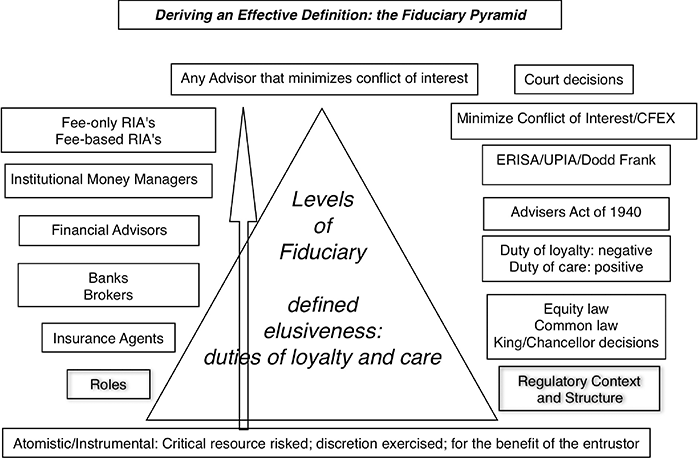
And since it is an exotic species, the best we can hope for is a flexible definition, included as part of the modified Fiduciary Pyramid below, which organizes the derived definition in a visual manner that anyone can understand. Conflating Laby, Rhoades, Smith, Demott, and Frankel, a flexible definition of the fiduciary obligation is as follows: A fiduciary relationship, though atomistic and instrumental, primarily involves duties of loyalty and care, and exists when an entrustor risks a critical resource to the fiduciary who exercises discretion over it for the benefit of the entrustor.
In the diagram below, on the right, each regulation or structure imposed on the obligation, from bottom to top, narrows the parameters that define it and imposes higher standards on the one who exercises it. On the left, lower level roles attain to these higher standards if their exercise of responsibility so constrains them. For instance, if brokers handle discretionary accounts courts usually hold them
responsible to the 40-Act; if they manage or advise on retirement funds they are held to ERISA. But then brokers need to also show that they minimize conflict of interest consistently and to the level required for top-level fiduciaries, like many RIAs.

According to Rhoades, broker-dealer firms and their registered representatives are always fiduciaries as to the scope of their agency, typically when they assume discretion over an account. According to Hamilton, whether a broker owes a duty to his client is hotly disputed in both arbitration and litigation and different results are reached in varying circumstances. How Dodd-Frank raises the fiduciary standard for broker-dealers remains unclear at this time, though it appears to point in the direction of bringing them under the 40-Act.
Since they answer to the SEC, RIAs generally minimize conflict of interest better than brokers or banks. More specific reasons for this are noted in my first article, The Fiduciary Pyramid. There is also disagreement among RIAs as to the degree which, if any, items such as in-house funds, tax, or estate services pose a conflict of interest, as long as they are ethically handled. And there is also disagreement as to whether a global certification such as CEFEX adds anything, except client assurance and a marketing edge. This is not to say that advisors at an insurance company, bank or brokerage could not minimize their conflict of interest at the highest level; only that at present their regulatory obligations and their structures are less suited to the task.
Conclusion
Courts have rendered apparently contradictory decisions on the fiduciary obligation, acknowledging that it is meant to be a flexible concept, each case dependent on the circumstances and facts. As has been said before, fiduciary duties are not static – they must evolve – and, so must any definition of the fiduciary obligation. This exercise has sought to sketch out a visual and effective, but flexible, definition.
In summary, a fiduciary relationship exists when an entrustor risks a critical resource to the fiduciary, who exercises discretion over it for the benefit of the entrustor. It is atomistic in that there are many elements, and instrumental, meaning the courts have discretion on its defined elusiveness and how it is applied in specific situations. Once the relationship exists, it is primarily sustained by the duties of loyalty and care, together which imply good faith to minimize conflict of interest for the entrustor's benefit.
Seaborn Hall has been involved in some facet of the investment arena for over 30 years. He has a degree in management from Georgia Tech, two masters degrees in theology and has studied at the doctoral level. Until recently he was a regional director at a national top-50 RIA, headquartered in California. He now focuses on managing a family investment company.
Read more articles by Seaborn Hall